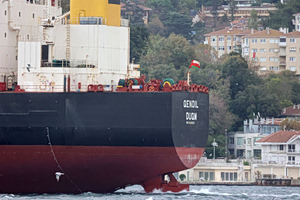

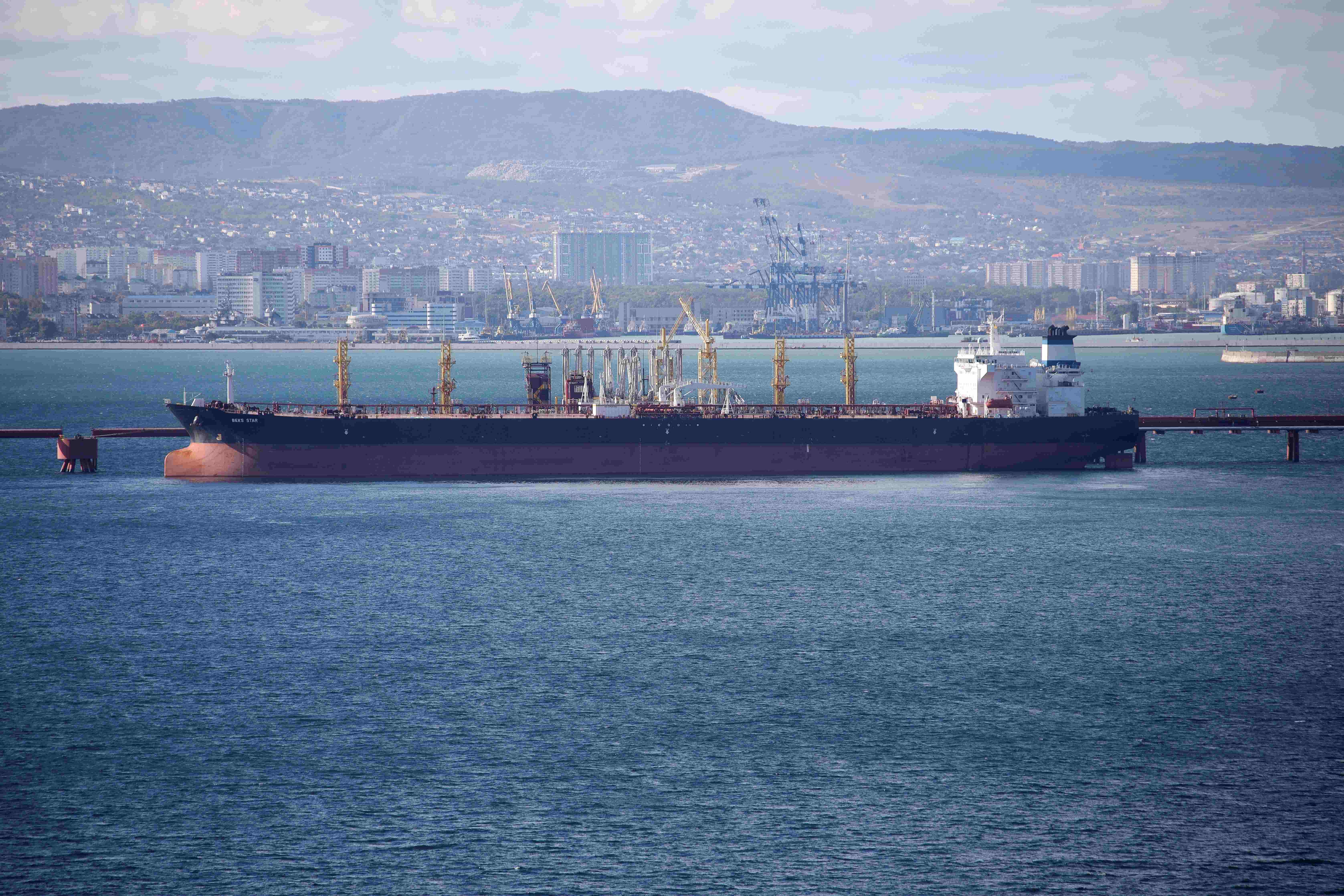
The pursuit of the Bella 1, an aging oil tanker that has been evading the U.S. Coast Guard for nearly two weeks, was complicated after a Russian flag was sloppily painted on the side of the vessel in an apparent attempt to claim protection from Moscow, according to senior U.S. officials.
Coast Guard vessels have been tracking the very large crude carrier through the Atlantic Ocean, staying about a half-mile behind, according to the officials. They said that they are in a position to seize the tanker should the White House give the green light to proceed, more than 10 days into a pursuit that began around Venezuelan waters.
The vessel has been resisting the U.S. policy of seizing some sanctioned oil tankers heading in and out of Venezuela, a practice that President Trump has said will stop through a complete blockade of such sanctioned tankers. The move is designed to choke off Venezuela’s principal means of generating income.
The officials said there has been some debate within the Coast Guard and the Navy over whether the tanker should be captured, given that it is empty and old.
The Coast Guard and U.S. military have the manpower and weapons to board the vessel forcibly, the officials said. Among the units in the area is a Maritime Special Response Team, an elite force trained to board hostile ships, they said.
Under the United Nations Convention on the Law of the Sea, the Coast Guard has the right to board foreign vessels if they are stateless or if there are reasonable grounds for suspecting that they are engaged in deceptive practices, according to maritime-law experts.
When the U.S. began pursuing the Bella 1, the White House said it was a sanctioned vessel under a judicial seizure order and that it was flying a false flag.
If the ship is now legitimately registered in Russia, it could make it harder for the Coast Guard to board it forcibly, the experts said.
“The U.S. is likely working through diplomatic channels to determine if it’s actually registered in Russia,” said retired Rear Adm. Fred Kenney , former director of legal affairs and external relations at the International Maritime Organization. “Merely painting a flag on the side of a hull does not immediately grant that ship that nationality,” he said.
“Is it possible Russia would permit it to be re-registered in Russia without an inspection?” said Eugene Fidell, a research scholar at Yale Law School and a former Coast Guard judge advocate. “Maybe the Russians, to jerk the U.S. around, are waiving all the formalities,” he said.
International law stipulates that ships aren’t permitted to change their flags midvoyage unless there is a change of ownership or registration.
The tanker, sanctioned for allegedly shipping oil to U.S.-designated terrorist organizations, made an unusual move last weekend, executing a U-turn, refusing to be boarded and racing away from Venezuela at full speed.
The Trump administration accuses Venezuela of flooding the U.S. with drugs. The country’s strongman leader, Nicolás Maduro , denies the charges and accuses Washington of naval piracy and trying to steal his country’s natural resources.
The U.S. military has over recent weeks built up considerable firepower in the Caribbean for the first time in decades, conducting deadly strikes on boats allegedly carrying drugs and now targeting oil tankers.
The U.S. has seized two tankers carrying Venezuelan oil since Dec. 10, aiming at Maduro’s most important source of revenue. Neither crew resisted.
Despite the seizures and Trump’s call for a blockade, the China-flagged Thousand Sunny VLCC, is set to arrive to load Venezuelan crude in mid-January. The tanker isn’t sanctioned by the U.S., but its ownership is obscure.
The tanker has been sailing between Jose Terminal, Venezuela, and the Port of Ningbo in China for the past five years, according to brokers. The Thousand Sunny went around the Cape of Good Hope on Dec. 24 and is now in the southern Atlantic en route to Venezuela.
It couldn’t be determined why the Bella 1 is refusing the Coast Guard’s demands. The Bella 1’s owner, Turkey-based Louis Marine Shipholding Enterprises, didn’t return calls seeking comment.
Most commercial seafaring vessels, even those carrying illicit products, are staffed by crews with little incentive to disobey the orders of the U.S. armed forces.
The U.S. has sanctioned the Bella 1 for allegedly carrying black-market Iranian oil on behalf of U.S.-designated terrorist organizations aligned with Tehran: the Lebanese militia Hezbollah and the Houthis, the rebels who have controlled swaths of Yemen for more than a decade. The U.S. Treasury Department has said the Bella 1 has links to the Quds Force, the foreign arm of Iran’s Islamic Revolutionary Guard Corps, a powerful paramilitary and business entity.
“They are probably getting orders from somewhere,” retired Rear Adm. William Baumgartner, a former judge advocate general in the Coast Guard, said of the unusual behavior of the ship’s crew. “These are owned by very bad people trying to make money in a particular manner.”
The U.S. has said the Bella 1 is part of a vast fleet of aging oil tankers, with murky ownership, that connect U.S.-sanctioned oil from Russia, Iran and Venezuela to buyers in China, Cuba and India, among other countries.