
 Μake us preferred on Google
 The European Central Bank raised interest rates for the second time this year and warned inflation pressures aren’t going away soon, leading investors to price in more policy tightening from the central bank.
The ECB’s heightened concern over inflation added fuel to a government bond-market selloff, sending benchmark borrowing costs in Germany and France to their highest levels since 2011 and 2008, respectively.
ECB President Christine Lagarde said above-target inflation “will be longer-lasting than we had anticipated.”
The context
Inflation is heating back up in Europe, climbing to a three-year-high of 3.3% in August after easing earlier in the summer. The ECB had previously forecast inflation would return to its 2% target by 2028, but its latest projections show inflation remaining slightly above that level then.
Renewed fighting in the Middle East could prolong the struggle to bring inflation back down. Global oil prices climbed back above $100 a barrel this week for the first time since July, and natural-gas prices in Europe have jumped to their highest level since 2023.
Lagarde said growth has proved more resilient than expected, boosted by AI activity and investment, suggesting the economy can tolerate higher levels of interest rates.
Investors added to bets that the ECB will raise rates again after the decision, with derivatives markets now fully pricing in another increase by year-end. Ahead of the meeting, some investors thought the ECB was on the verge of pausing its tightening campaign.
All eyes on the Fed
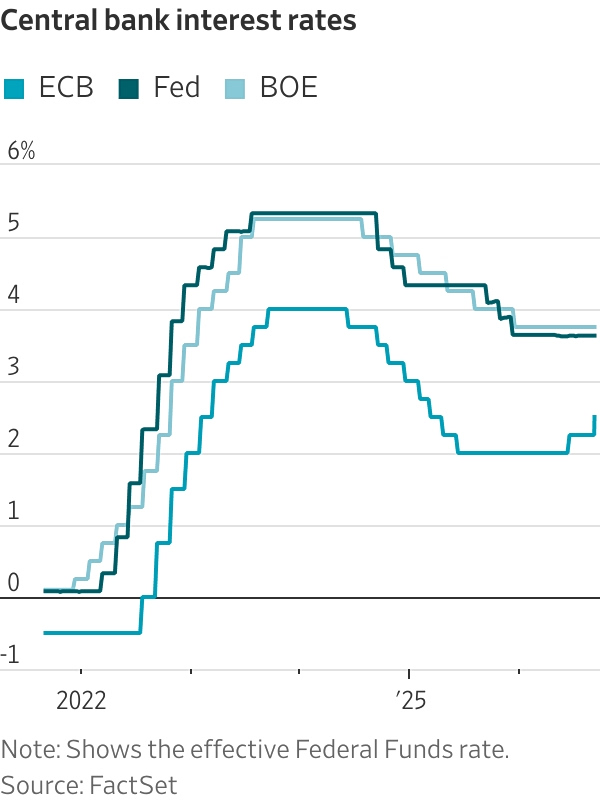
The ECB has taken a more aggressive approach to fighting war-driven inflation than many of its peers, leading the pack in June with a rate increase. A majority of investors expect the Federal Reserve to raise rates for the first time this year when it meets next week, according to CME Group data. The Bank of England is expected to raise rates in November.
The ECB had more runway to tighten policy because—unlike in the U.S. or U.K.—its key interest rate heading into the Iran war was well below the level economists view as neutral, neither restricting nor stimulating the economy.
Growth has held up surprisingly well this year, with the economy expanding 0.6% in the second quarter, or 0.3% excluding Ireland, where growth is prone to big swings because of its role as a hub for U.S. multinationals. Bank lending has also been resilient in recent months, suggesting interest rates aren’t yet weighing on the economy, according to Goldman Sachs.
The ECB boosted its growth forecasts for this year and 2027, citing the unexpected resilience of the economy.
Time to pause?
Lagarde described Thursday’s decision to raise rates as a “no-brainer.” But upcoming interest-rate decisions could be more divisive, said Konstantin Veit, a portfolio manager at Pimco .
Raising rates further could take borrowing costs into restrictive territory, threatening growth. The run-up in bond yields is also likely to depress economic activity by making borrowing more expensive for businesses, governments and consumers.
“While hiking in June and September has been agreeable to all…going further would probably split the group and faces a higher bar,” Veit said.
One factor limiting the need for more rate increases: There is little evidence so far that higher energy prices are driving so-called second-round effects that make inflation harder for central banks to contain. For example, workers in the eurozone aren’t demanding higher wages, which can lead businesses to lift prices.
Write to Chelsey Dulaney at chelsey.dulaney@wsj.com