

 Μake us preferred on Google
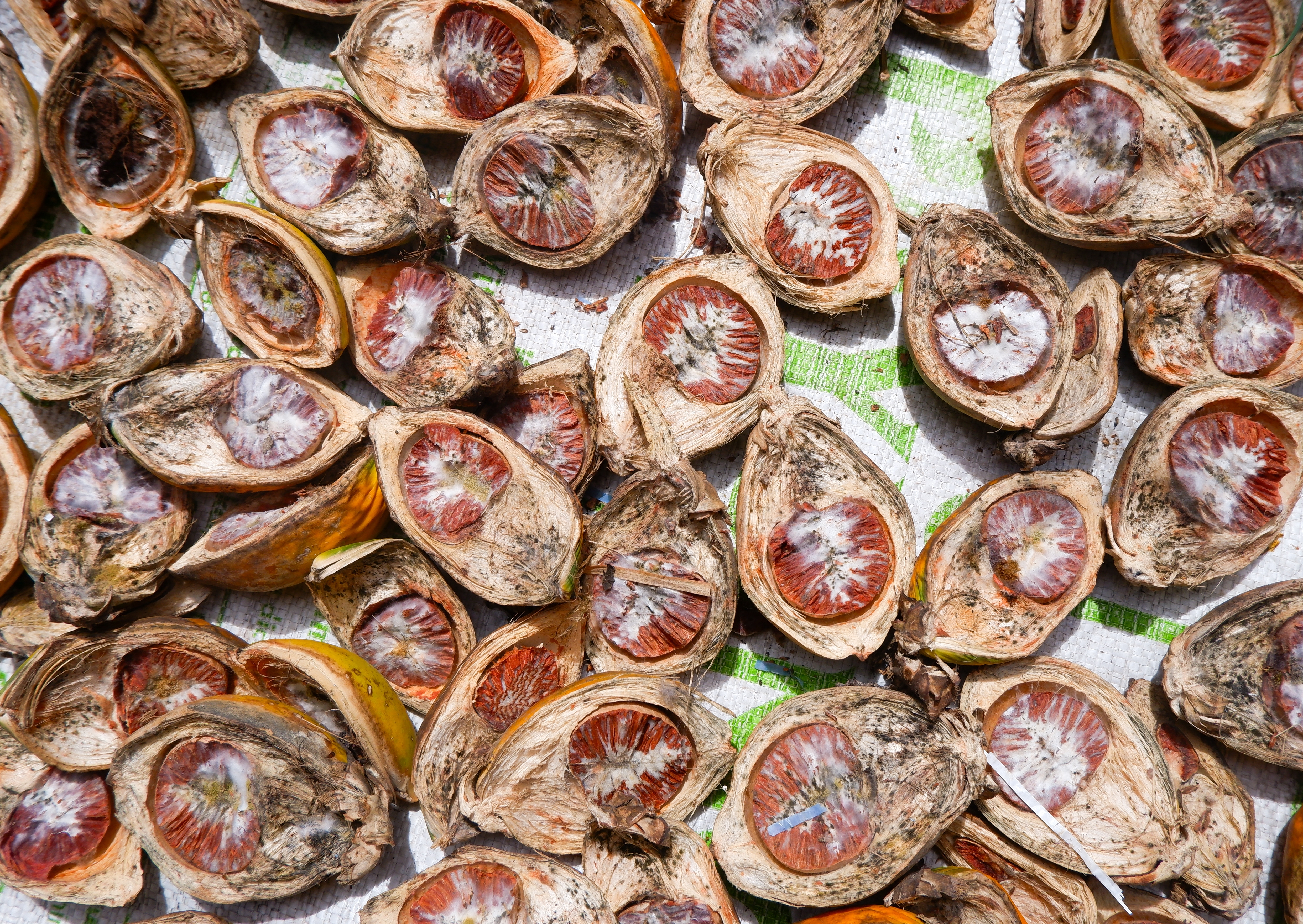
 The world’s oldest known case of habitual drug use has been traced to the Indonesian island of Sulawesi, where ice age hunter gatherers relied on betel nuts, seeds from a palm tree that contain a neuroactive compound, according to a new study.
Researchers at Griffith University in Australia uncovered the finding while examining unusual grooves in the teeth of two prehistoric hunter gatherers. The deep grooves, according to the study published in the journal Science Advances, came from regularly sucking on betel nuts (Areca catechu), most likely as a way to cope with tooth pain.
The partial skeletons were found on Sulawesi but lived thousands of years apart. One was a man who died sometime between the ages of 40 and 50, and lived between 25,000 and 16,000 years ago, a period roughly overlapping with the coldest stretch of the last ice age, although Sulawesi itself was never glaciated. The second individual, whose sex could not be determined, lived on the island between 7,600 and 6,300 years ago.
Betel nuts contain a compound called arecoline, which produces a strong stimulant effect when chewed together with slaked lime. But this earlier, simpler method, sucking on the whole, unprepared nut, would have mainly just numbed the mouth rather than delivering the full stimulant hit.
The dental damage was severe enough that researchers concluded both individuals must have sucked on betel nuts almost constantly throughout their lives. Ironically, the habit likely made things worse over time rather than better: the grooves grew progressively deeper, and in one case wore all the way through to the tooth’s inner pulp cavity, a condition study lead author Adam Brumm described to Live Science as extremely painful.
While a 2017 study had already shown Neanderthals used poplar bark, which contains a compound related to the active ingredient in aspirin, for pain relief, Brumm said this new finding represents the earliest evidence of a plant based drug being used habitually.
How they confirmed it
To verify their theory, researchers tested whether sucking on betel nuts could actually produce a neuroactive effect. They used a somewhat unusual method: frog eggs genetically modified to carry human neuroreceptors. The tests confirmed a neuroactive response, and further analysis of the tooth samples turned up traces of betel nut compounds.
A widely used substance today, with serious risks
Betel nut, also called areca nut, remains widely used across parts of South Asia and Oceania today. Modern users mix it with slaked lime to form a chewable wad, sometimes called a quid, which produces a stimulant effect and is strongly addictive. An estimated 600 million people worldwide use it. Arecoline is also carcinogenic, and because betel quids are frequently mixed with tobacco, users face a heightened risk of mouth cancer.
Researchers believe the practice of adding slaked lime didn’t emerge until much later, during the Neolithic period, roughly 4,000 years ago on Sulawesi, around the same time slaked lime was being used in local pottery-making to prevent cracking during firing. The study’s authors suggest that betel chewing as it’s practiced today likely evolved from this earlier, simpler habit of just sucking on the intact nut.
Pushing the timeline back further than farming
The earlier of the two individuals predates not just Sulawesi’s own Neolithic period, but also the rise of agriculture in the Fertile Crescent, which began around 12,500 years ago. Archaeologists have long debated whether humans started using neuroactive plants before or after farming took hold. Brumm said this new evidence shows psychoactive drug use goes back thousands of years earlier than previously thought.
Other prehistoric societies have left behind similar traces: 10,000 year old pollen from a psychedelic cactus has been found in Peru, and 13,000 year old residue from alcoholic beer has turned up in Israel. But sucking on betel nuts appears to be the earliest known addictive behavior identified so far.
Elisa Guerra Doce, a prehistoric archaeologist at the University of Valladolid in Spain who wasn’t involved in the study, called it a strong and compelling piece of direct evidence for how far back drug use goes. She noted that the findings are especially meaningful for betel nut specifically, since they trace the prehistoric roots of a cultural practice still deeply embedded across Southeast Asia and the Pacific today. The study, she added, also shows how prehistoric people on Sulawesi explored their environment and came to understand it as a source not just of food and medicine, but of substances that became woven into social and cultural traditions over thousands of years.
Source: LiveScience