

 Μake us preferred on Google
 Peptides are everywhere lately. Influencers inject them for muscle and recovery, and the Food and Drug Administration could soon allow these products to be sold by compounding pharmacies.
While the marketing of these injections to biohackers and wellness consumers will keep generating debate, the peptide boom that matters to biotech investors belongs to a company most TikTokers have never heard of. Protagonist Therapeutics is a small biotech that has cracked one of pharma’s hardest problems: getting fragile peptides, which are normally given through injections, to work as powerful pills.
With partner Johnson & Johnson , it has already turned that technology into a psoriasis pill selling fast enough to make AbbVie investors nervous. Now, with royalty streams from two approved drugs and a pipeline built on its platform for engineering gut-stable peptides, Protagonist may have a business that outlasts the current fad.
A peptide is simply a short chain of amino acids, often used by the body as a message to do things like quiet inflammation or release insulin. That precision can make peptides useful drugs. Insulin is a peptide. So is Ozempic’s active ingredient, which mimics the gut hormone GLP-1 to control blood sugar and curb appetite.
Until recently, peptides had to be injected because the gut treats them like a piece of steak and digests it. That is what makes the recent breakthrough in pharma so important: Companies are figuring out how to put peptides into pills, and it isn’t just Protagonist.
Novo Nordisk is seeing massive demand for its pill version of Wegovy, using the same peptide it first commercialized as the lower-dose diabetes drug Rybelsus. Merck has launched Lipfendra, the first oral cholesterol drug potent enough to challenge a class of powerful injectables such as Amgen’s Repatha. And then there is Protagonist and J&J’s autoimmune drug Icotyde.
The drug, launched earlier this year, is on pace to quickly become a blockbuster. What makes it notable isn’t that it’s a pill—psoriasis has had pills for decades. It is that Icotyde is the first oral psoriasis drug with efficacy approaching the injectable biologics that dominate the massive immune disease market. Analysts see the drug’s annual sales surpassing $5 billion within a few years.
Early analysis of patient prescriptions already shows a shift. A summer survey of dermatologists by Bernstein analyst Courtney Breen found doctors writing markedly fewer prescriptions for the old oral drugs. More tellingly, they were also writing about a quarter fewer for AbbVie’s Skyrizi, the injectable psoriasis blockbuster that generated nearly $18 billion in sales last year.
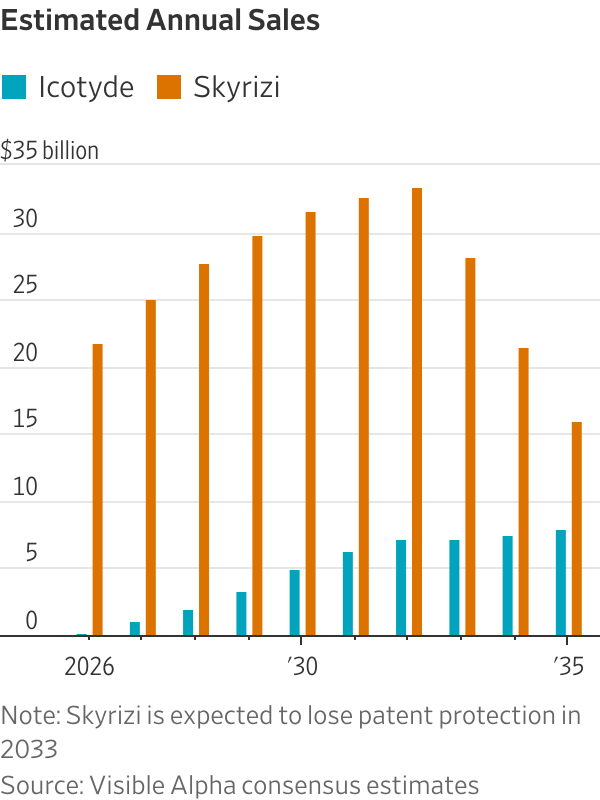
As Breen explains in her analysis, Icotyde isn’t pulling patients off Skyrizi. People doing well on a shot every three months have little reason to switch to a daily pill. But it does threaten to cut into Skyrizi’s growth. Patients used to start with a weak oral drug, fail it and then escalate to an injectable. Now they have an oral drug that actually works.
Protagonist spent more than a decade on the chemistry, drawing inspiration from an unlikely place: venom. A normal peptide is a linear chain, and the gut chews it apart from the loose ends. The venom peptides that snakes and snails use are built as closed loops, which is what lets them survive intact. Protagonist’s job, Chief Executive Dinesh Patel explains, was to build in that toughness while leaving the toxicity behind.
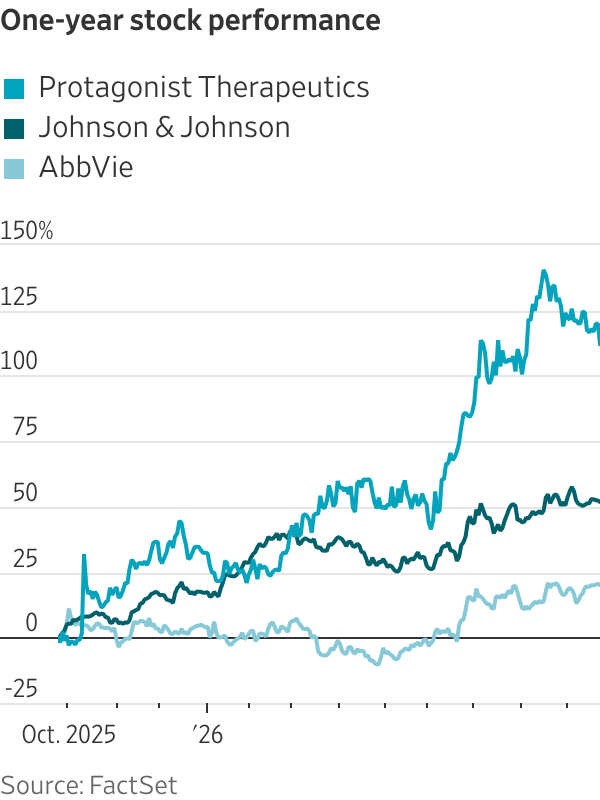
The pill’s fast growth has helped more than double Protagonist’s stock in the past year, giving the company a market value of just under $9 billion. It has also added momentum to J&J’s drug business and made AbbVie’s shares more volatile.
The question for investors is what Protagonist is worth beyond its two approved drugs. Takeout speculation has faded since The Wall Street Journal reported last year that J&J had considered buying the company. Protagonist also got FDA approval last month for a second drug, Mimrylo, to treat a rare blood cancer. Mimrylo is an injectable peptide, partnered with Takeda.
J&J could still buy Protagonist. But it already gets most of the economics from Icotyde: Protagonist receives tiered royalties of 6% to 10% on global sales, plus potential milestone payments. That means the case for owning the stock increasingly rests on what Protagonist can do with the platform over the long term, explains Evan Seigerman, an analyst at BMO Capital Markets.
The company now has a rare source of funding for a biotech: a steady cash flow for years to come that can finance a pipeline that includes another oral autoimmune drug targeting a different inflammatory pathway and a metabolic and obesity program. Those earlier-stage drugs are wholly owned by Protagonist.
Success, of course, breeds competition. Plenty of companies are now chasing ways to turn powerful injectable drugs into pills. Novo recently signed a deal worth up to $1.4 billion with Orbis Medicines to develop peptide-like drugs sturdy enough to survive the trip through the stomach and into the bloodstream.
The internet’s peptide craze is built around injections of questionable provenance and uncertain science. The investment opportunity is something more durable: getting around the needle without giving up the potency that made peptide drugs so valuable in the first place.