 Μake us preferred on Google
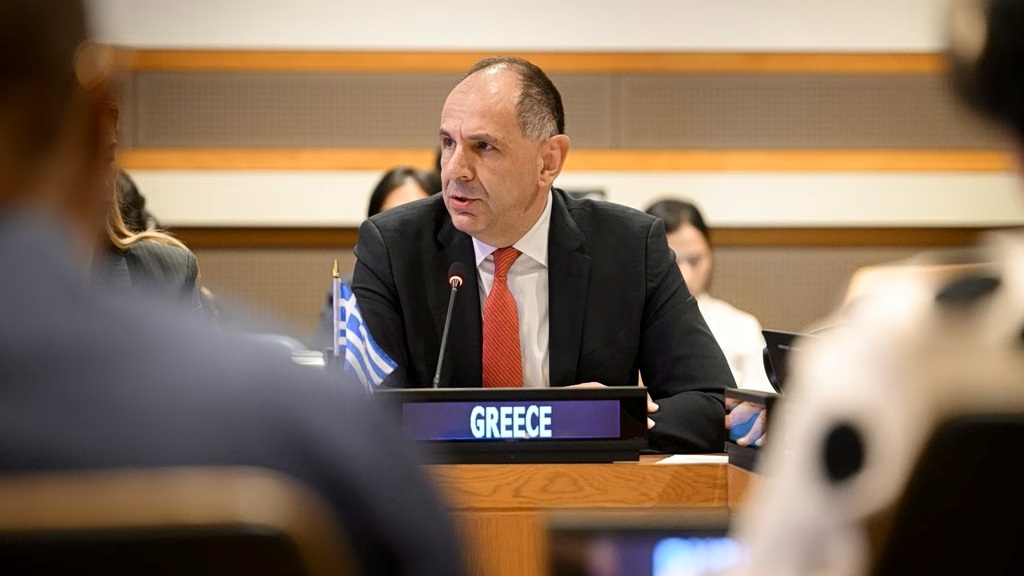
 Greek Foreign Minister George Gerapetritis stressed the need to protect freedom of navigation and seafarers amid growing threats to critical maritime routes, speaking at a ministerial meeting of the newly established Group of Friends for the Safety and Protection of Shipping and Seafarers.
Gerapetritis said threats to maritime security had multiplied, with attacks on international shipping putting lives at risk while disrupting global supply chains and affecting food and energy security.
He referred to recent attacks on commercial vessels and seafarers in the Red Sea and other critical maritime routes, saying seafarers were increasingly exposed to piracy, armed conflict, terrorist attacks and other serious threats.
“Protecting shipping must go hand in hand with protecting those who work at sea,” he said.
Gerapetritis placed particular emphasis on freedom of navigation through international straits, describing it as a fundamental principle of both treaty and customary international law and a basis for the unhindered conduct of global trade.
“Freedom of navigation must be safeguarded, while the safety and protection of shipping and seafarers must be ensured in accordance with international law and, in particular, the United Nations Convention on the Law of the Sea (UNCLOS),” he said.
His remarks come as maritime security and the application of UNCLOS have featured prominently in recent discussions in Athens, including the 49th Annual Conference on Oceans Law & Policy (COLP49), which examined maritime boundaries, shipping, critical infrastructure, migration, shadow fleets and naval-warfare law.
Gerapetritis also recalled that Greece has made maritime security a priority as an elected member of the UN Security Council. During Greece’s Security Council presidency in May 2025, it hosted a high-level open debate on strengthening international cooperation on maritime security. The issue is expected to return to the Council’s agenda during Greece’s upcoming presidency in October.
He highlighted the central role of the International Maritime Organization (IMO), as well as cooperation between the IMO and the International Labour Organization in protecting seafarers.
Gerapetritis summarized Greece’s position around three priorities: safer seas and greater protection for seafarers, safeguarding freedom of navigation through international straits and more consistent implementation of the 2006 Maritime Labour Convention.
“Without seafarers, half the world would freeze and the other half would starve,” he said, citing an old maritime saying.
The minister said Greece was ready to work with the other members of the Group of Friends, established on the initiative of India and Liberia, to translate shared commitments to international maritime security into concrete action.
The broader maritime-security debate also comes against the backdrop of longstanding Greek-Turkish differences over maritime boundaries and the application of UNCLOS in the eastern Mediterranean. Greece, a signatory and ratifier of UNCLOS, maintains that the main outstanding dispute concerns the delimitation of the continental shelf and exclusive economic zone, while Turkey is not a party to the convention and has objected to several of its provisions. Athens has also rejected the 2019 Turkey-Libya maritime memorandum and Turkey’s “Mavi Vatan” doctrine, which it considers incompatible with international law.