Ukraine is planning to step up the presence of its drones near Russian airports to compel their closure, while warning international airlines to re-evaluate the safety of flying there, as part of its effort to disrupt Russia’s economy and pressure Moscow to end the war.
Ukrainian President Volodymyr Zelensky cautioned airlines and their insurers on Tuesday that Russian airspace “is becoming completely unsafe.” Behind his comments, the Ukrainian military said, is a plan to put so many drones in the air near Russian airports that the temporary closures—already increasingly common—become a complete shutdown.
“This is no longer simply a repetition of isolated, sporadic emergency alerts; it is a transition to constant pressure aimed at paralyzing civilian air traffic in the European part of the Russian Federation,” Serhiy Bratchuk, spokesman for the Ukrainian Armed Forces’ Southern Command, told The Wall Street Journal.
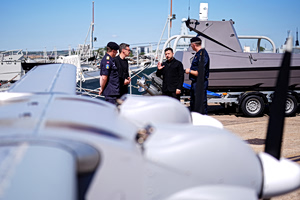
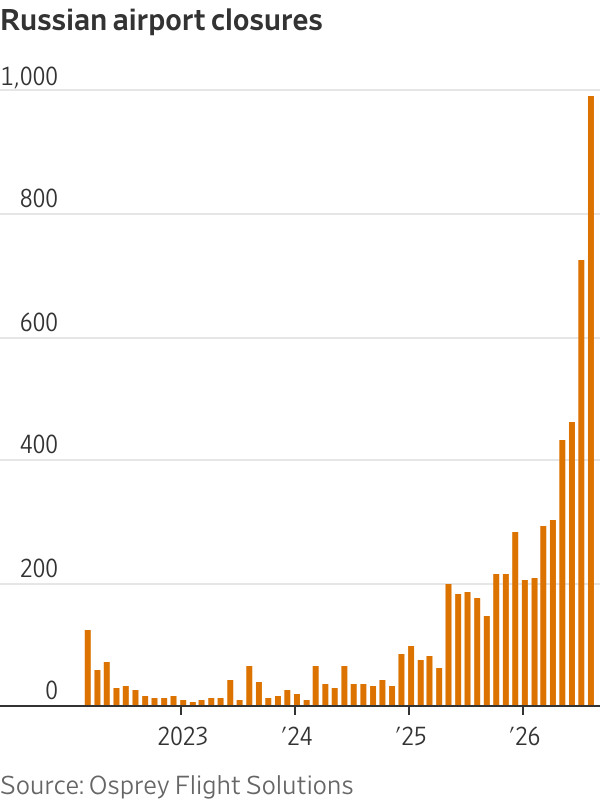
Ukrainian officials have vowed to avoid targeting airliners and civilian deaths. Rather, their plan is to scale up so-called Operation Carpet, under which drones circulate near Russian airports, forcing air-traffic control to pause takeoffs and landings. Ukrainian drones began causing such temporary closures in the summer of 2023. The number of closures has grown steadily since then, and has surged in recent months.
Russian authorities have refused to close the country’s airspace for civil aviation, despite the escalating war . Ukraine has kept its own airspace closed to civilian flights since February 2022, when Russia launched a full-scale invasion of its smaller neighbor.
Although Western countries ended direct air links after the invasion, airlines from many Middle Eastern and Asian countries have continued to fly to Russia. The absence of U.S. and European competitors has proven a boon for them, offsetting the risk of operating in skies regularly penetrated by Ukrainian drones.
Now, Ukraine wants to make that calculus untenable.
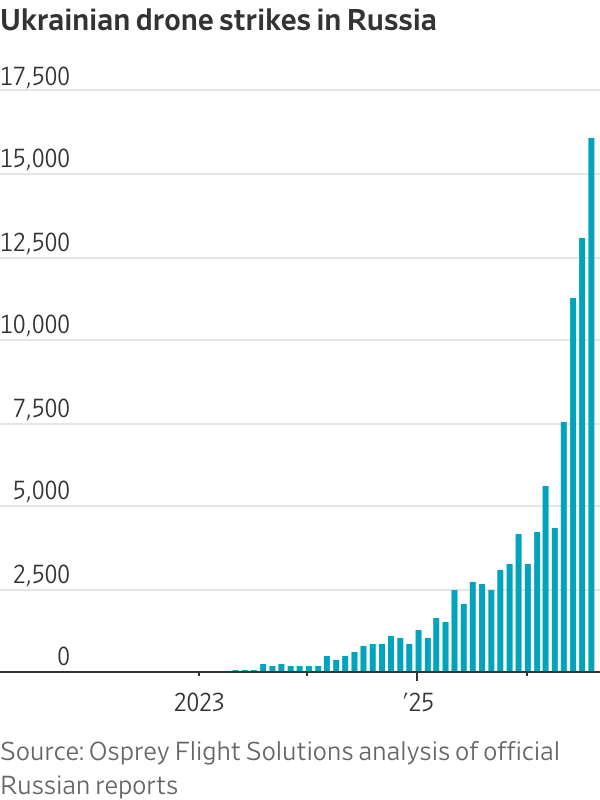
In recent months, Ukraine has rapidly expanded its long-range air campaign against Russia, sending hundreds of drones a day, as well as cruise missiles, at targets including oil refineries, military industries and commercial warehouses.
In August, a new peak of around 16,000 Ukrainian drones crossed the border into airspace that Russia has kept open to civilian aircraft, according to data tracked by aviation security specialist Osprey Flight Solutions.
The sheer numbers of drones, and the frantic activity of Russian air defenses trying to shoot them down, are creating growing risks for civilian aircraft, according to aviation safety experts. Air defenses’ large-scale use of spoofing, or transmitting fake GPS signals to send drones off course, can disorient civilian air traffic.
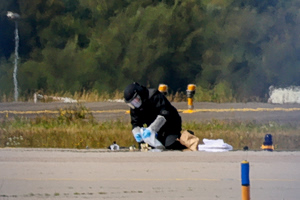
On average, the proximity of drones has forced the temporary closures of 32 airports in Russia each day in August, including around Moscow and St. Petersburg.
In May, shrapnel from an intercepted drone landed near the runway of Moscow’s Sheremetyevo Airport, days after a Ukrainian strike on an air-traffic control hub in the Rostov area that caused a prolonged halt to flights into 13 airports.
Zelensky on Tuesday criticized Russia for not closing its airspace to remove risks to civilians, as Ukraine has done. “Ukraine does not threaten civilian aviation as such—not a single civilian aircraft,” he said. “There will simply be drones in Russia’s skies on a scale that has to be taken into account.”
Russian President Vladimir Putin described Zelensky’s warning as a “declaration of terrorism,” adding: “If they follow through, we’ll see how best to answer. We’ll find the right tools,” Putin told reporters.
It remains unclear whether Ukraine’s drone fleet can compel a full-blown closure of Russian airspace, despite the rapid growth of Kyiv’s arsenal. The effort is part of a multipronged strategy to impose costs on the Russian economy and bring the war home to Russia’s elites and population.
So far, however, Putin has shown no sign of ending the war and has rejected Kyiv’s call for a ceasefire that would freeze the fighting on the current front lines.
Instead, Moscow continues to escalate its own strategic bombing campaign, which has targeted Ukraine’s cities, energy infrastructure and vital business sectors since late 2022. For the past week, Russian forces have been conducting virtually uninterrupted airstrikes against Kyiv and other cities with jet-powered drones and other munitions. Russian attacks have killed hundreds of Ukrainian civilians in recent months.
Kyiv’s plan to force more airport closures is part of the country’s response to Russia’s escalating airstrikes, a senior Ukrainian official said.
Airlines are starting to balk at the growing risk of a disastrous accident in Russian airspace. In late June, Israeli flag carrier El Al halted flights between Tel Aviv and Moscow, citing Ukraine’s drone attacks. In April, Air India shifted its last route from the U.S. that had been crossing Russia, instead adding a refueling stop in Seoul on flights from San Francisco to Delhi.
Other airlines have relied on private security companies to help map out which flight paths, altitudes and times of day to use, to reduce risks and manage the growing disruptions of Russian air traffic.
After Zelensky’s comments late on Tuesday, Turkish low-cost airline Pegasus scrapped several flights into Russia, citing “technical and operational reasons.” The next day, Emirati carrier Flydubai followed suit, saying it was adjusting schedules and flight paths due to the “evolving situation in the region.”
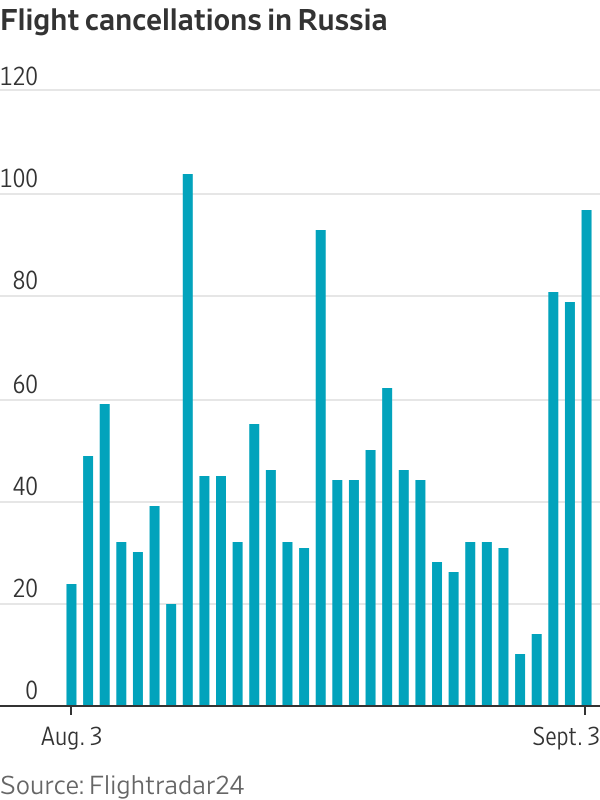
Domestic and international carriers have canceled an average of 86 flights a day since Sept. 1, according to tracking specialist Flightradar24.
Russia’s federal aviation authority has eschewed standard practice under the Chicago Convention, the agreement that governs commercial aviation globally, and which typically requires states to respond to safety threats by restricting airspace and issuing prompt notices to pilots and airlines about risks and runway closures.
Instead, Russia has used a limited security protocol that it calls “carpet” restrictions, in contrast to the “blanket” ban that a formal airspace closure would involve. Russia’s civil aviation regulator has posted news of temporary closures on messaging platforms such as Telegram and Russia’s state-backed Max, forgoing formal alerts known as a Notice to Airmen.
“The situation is only getting more and more complex in the airspace. It’s probably only a matter of time before, statistically, another catastrophic event occurs in and around this conflict zone,” said Matt Borie, chief intelligence officer at Osprey. “The bottom line is, if you do the things that Russia is doing, it leads to aircraft being shot down.”
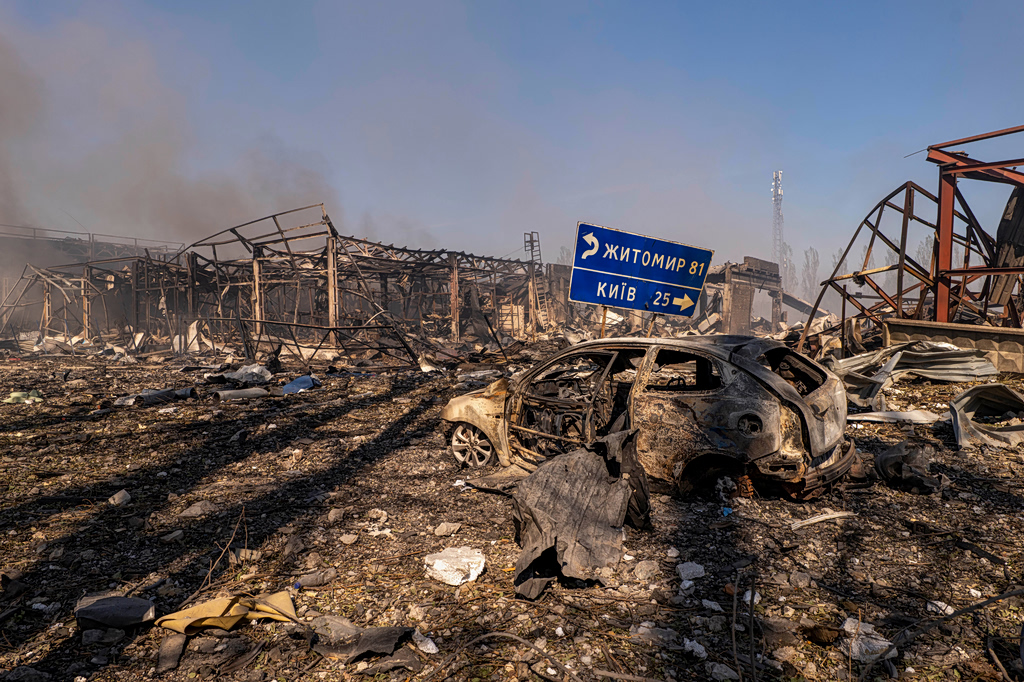
A view of a destroyed car amid damaged buildings, with a road sign showing the direction and distance to Kyiv and Zhytomyr after a Russian attack struck a warehouse, followed by an explosion, in the village of Myla, Kyiv region, Ukraine, Saturday, Aug. 29, 2026. (AP Photo/Dan Bashakov)
Putin’s war on Ukraine has already led to the downing of two civilian airlines by Russian forces. On Christmas Day in 2024, a Russian air-defense missile accidentally hit Azerbaijan Airlines Flight 8243 near Grozny. The subsequent crash-landing killed 38 of the 67 passengers and crew on board, including the two pilots, and sparked a diplomatic crisis between Russia and Azerbaijan.
In 2014, after Russia launched its first invasion of eastern Ukraine, a Russian surface-to-air missile shot down Malaysia Airlines Flight MH17, killing all 298 people on board.
On Wednesday, the International Civil Aviation Organization warned member states that the “risk of weapons targeting civilian planes” is growing and urged member states “to take all appropriate measures” including improving coordination between authorities to minimize the risk of commercial aircraft being misidentified as military targets.
The comments came after Ukraine filed a formal notice to the United Nations body of the threats posed to civilian aircraft from its munitions—a risk Kyiv blames on Russia’s refusal to take adequate safety measures.
“We are constantly improving flight safety and airport security requirements, and we have solutions for all of this,” Russian transport minister, Andrei Nikitin, said in comments published by the Interfax news agency. “We will not allow any significant disruption to civil aviation.”