 Μake us preferred on Google
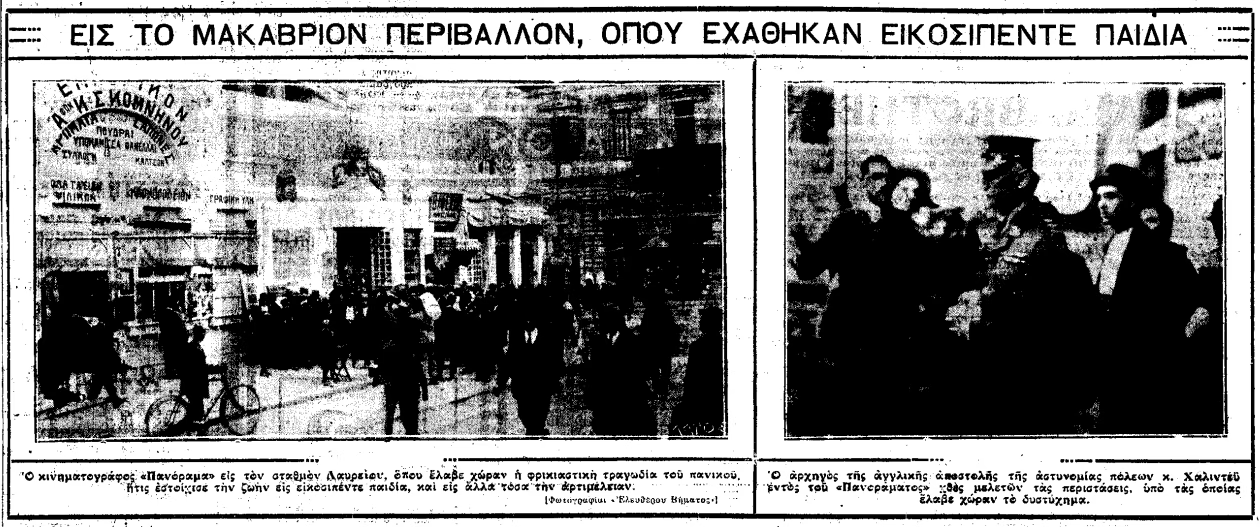
On October 19, 1924, one of the worst tragedies Athens had ever witnessed unfolded at the “Panorama” cinema in Lavriou Square. A cry of “Fire!” triggered panic among the hundreds of spectators, most of them children, who had gathered for a Sunday screening. Within minutes, their attempt to escape the theater turned into a nightmare, leaving dozens dead or injured.
The following day, Eleftheron Vima, the newspaper that would later become To Vima, documented the harrowing scenes and the circumstances surrounding the disaster, while raising serious questions about the responsibility of the authorities:
“Twenty-five dead, more than three times as many injured and many near death! All innocent victims of a tragic panic in a movie theater, the recklessness of a businessman and the criminal indifference of all the responsible authorities.”
Later accounts put the final death toll at 26.
The Cry That Triggered the Panic
On Sunday afternoon, the popular Panorama cinema was screening a movie with the chillingly ironic title The Blow of Death.
According to the newspaper, the theater was packed, primarily with children between the ages of 8 and 14. At around 4 p.m., a voice interrupted the screening:
“Fire!”
Within seconds, panic took hold:
“That tragic word brought about the terrible consequences of the panic that immediately followed. Before any of the spectators could even establish whether a fire had actually broken out, everyone leapt to their feet.”
Despite pleas from some moviegoers for everyone to remain in their seats, the crowd surged toward the exit. Spectators in the balcony rushed down the stairs, while those on the main floor headed for the same point:
“People crushing one another amid screams, groans, curses and pleas.
“I can’t breathe!
“Help!
“Mother!
“Christ, help us.”
The crush became unbearable. Children fell to the floor and were trampled, while others became trapped among spectators desperately trying to escape.
According to the same report, cinema employees and gendarmes attempted to stop people from leaving, believing that doing so would contain the panic:
“Cinema employees, assisted by gendarmes, blocked the first terrified children from leaving in an attempt to prevent panic, and in this way the crush at the entrance became horrific.”
The Scenes After the Disaster
Once the theater had emptied, the scale of the disaster became clear:
“The filthy floor near the exit was covered with innocent victims, most of them children aged 8 to 15. Some dead, some barely alive, others seriously injured, one on top of another, in an endless heap!”
Firefighters and cinema employees carried the victims outside. Cars were commandeered to transport the dead and injured to hospitals.
There, further harrowing scenes unfolded as families searched for their loved ones:
“Mothers, children and old people bend over the heads of the dead, looking to see whether they recognize anyone. Every so often, the deathly silence of the ward is broken by a piercing scream, a groan, a wail of grief.”
On Oct. 21, Eleftheron Vima returned to the tragedy, publishing the names of the victims and noting:
“All those killed, with the exception of Nikolopoulos, are children between the ages of 10 and 16.”
Was There Actually a Fire?
One of the central questions concerned the origin of the cry that set off the panic.
Markakis, the police chief of Athens’ 6th Precinct, attributed the disaster to a prank by a young spectator:
“There was no fire. Tonight’s tragic and horrific accident can only be described as a fatal accident.”
Witness accounts, however, differed. Anastasios Dimitriadis, a 17-year-old who was injured, said he saw a lit cigarette fall into a box containing film reels:
“The film immediately caught fire and there was a large flash. Then someone shouted, ‘Fire!’”
The newspaper itself reported that a small fire had broken out but was extinguished in time, although exactly how it started had not been established.
Regardless of whether that limited ignition occurred, the mass-casualty disaster was caused by the ensuing panic and crush of spectators, rather than by a devastating fire.
A Cinema Packed Beyond Capacity
Beyond the cause of the panic, Eleftheron Vima turned its attention to the conditions under which the cinema operated.
The Panorama had been built about five years earlier as a theater before being converted into a popular movie house.
According to the newspaper, its capacity was no more than 400 to 450 spectators, yet more than 2,000 people would gather there on Sundays.
“Despite this daily suffocating overcrowding — two or three people would sit in a single seat — the responsible authority never showed the slightest concern. And the proprietor kept issuing tickets without end!”
Police, however, presented a different account. In a statement published on Oct. 21, authorities said about 550 people had been inside the cinema and that there were two additional illuminated emergency exits.
Police described the disaster as a tragic accident, arguing that the exits would have been sufficient had the spectators remained calm.
Anger and the Search for Accountability
Conflicting accounts over the number of spectators, the available exits and whether there had been a fire were accompanied by allegations over the authorities’ handling of the situation.
The Oct. 21 edition of Eleftheron Vima reported that members of Greece’s National Assembly had expressed outrage and were preparing a parliamentary question on responsibility for the disaster and measures to prevent another one:
“A question was to be submitted […] concerning the measures taken both to punish those indirectly responsible for the disaster and to prevent similar tragedies.”
The Panorama tragedy left 26 people dead and dozens injured, along with serious questions about safety conditions at public entertainment venues, compliance with operating regulations and the responsibility of the authorities.