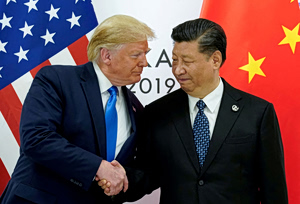
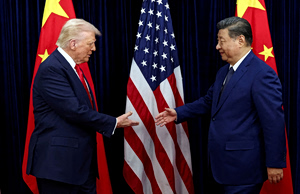
BEIJING—President Trump touches down here on Wednesday for a two-day summit with Xi Jinping , where he will be face-to-face with the Chinese leader for the seventh time, reuniting with a man who has become a pen pal of sorts.
The leaders of the world’s two most powerful nations have corresponded through letters, according to people familiar with the practice, one of many ways that they have sought to build a personal rapport despite longstanding tensions between Washington and Beijing and their positions overseeing vastly different political systems.
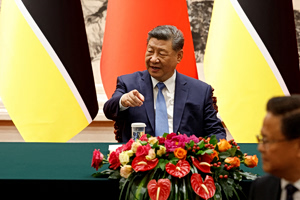
That dynamic will be put to the test during this week’s summit, where the two leaders will discuss thorny issues such as trade, Iran and Taiwan. Publicly, Xi and Trump will seek to paper over their differences. Xi will fete Trump in grand style, giving him a tour of the Temple of Heaven, holding talks in the Great Hall of the People, hosting a state dinner for the American delegation of CEOs and cabinet members, and sitting with the U.S. president for a tea ceremony.
The summit will be the first presidential visit to China since Trump traveled there nearly nine years ago. The meeting of superpowers comes as the Iran war looms over both countries, Trump targets Beijing’s partners in Venezuela and Cuba and as the U.S.-China relationship aims to recover from tit-for-tat economic brinkmanship last year. That it is even taking place as the U.S. blockades Iranian shipments of oil bound for China is extraordinary, according to analysts.
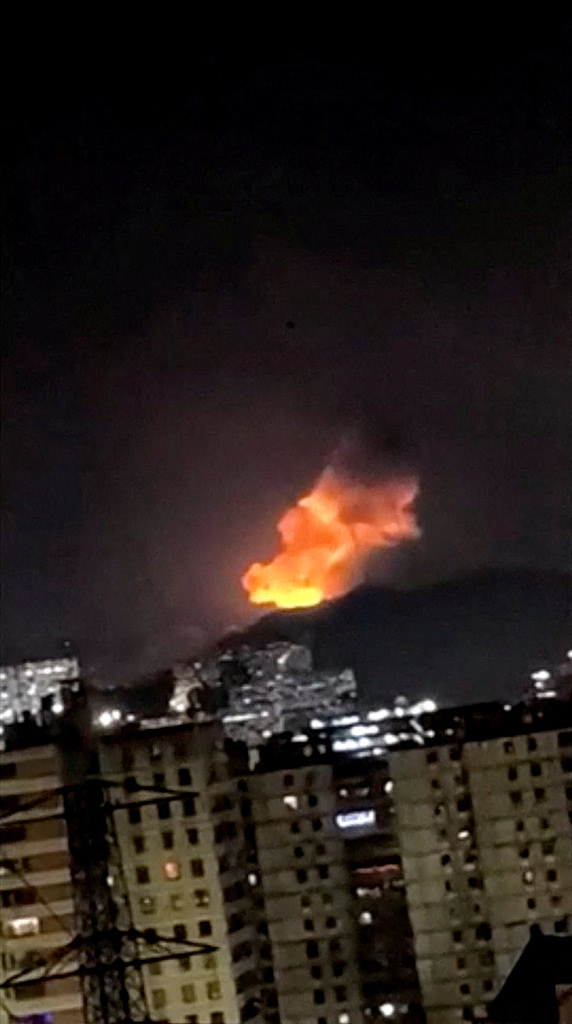
A column of smoke rises during multiple explosions in the early hours of the morning, in Caracas, Venezuela, January 3, 2026 in this screen grab obtained from video obtained by Reuters. Video Obtained by Reuters/via REUTERS
Both leaders seek tangible wins. Trump, who is traveling with a delegation including Elon Musk , wants China to help end the Iran war and make big purchases of U.S. products, including soybeans and Boeing aircraft. Xi, faced with a deepening economic slump at home, wants a more predictable relationship with Washington, as he works to erode its political and military commitments to Taiwan.
“Both Trump and Xi are aligned around the desirability of stabilizing the relationship and see trade and investment as the most fruitful channel to accomplish this in the near term,” said Elizabeth Economy , a former Biden administration China adviser.
Still, each side is trying to reduce dependence on the other without rupturing the relationship that makes both economies work. The competitive backdrop sharpened this week with the release by the U.S. Chamber of Commerce, right before Trump’s departure, of a new assessment on China’s industrial strategy. It argues that the “window for effective policy response” to China’s state-led economic model “is narrowing.” The timing—from the U.S.’s largest business-lobbying group—was a pointed reminder that the case for managed separation has only grown stronger.
Behind closed doors, Trump treats Xi with a deference he rarely extends to other leaders, according to people familiar with their meetings, replacing jokes intended to break the ice with compliments.
“The U.S. relationship with China, and President Trump’s personal relationship with President Xi, is an extremely good one, and both realize how important it is to keep it that way,” White House spokeswoman Olivia Wales said.
Trump and Xi’s relationship extends back nearly a decade, after Trump rose to political power accusing China of stealing jobs and intellectual property from American workers.
It got off to a surprising start, when Trump revealed to Xi during an April 2017 dinner at Mar-a-Lago that he had authorized airstrikes on Syria. Trump later joked with guests that Xi was a tough negotiator, but “we have developed a friendship,” adding, “In the long term we’re going to have a very, very great relationship and I look very much forward to it.”
Trump has since continued to label Xi a friend whom he respects deeply, assuring aides and reporters the feeling is mutual. In November 2017, Xi honored Trump by making him the first foreign leader to dine in Beijing’s Forbidden City since the founding of modern China in 1949.
Some former senior U.S. officials say Trump is sometimes reluctant to be tough on Xi.
In an interview, John Bolton , Trump’s national security adviser in the first term and now critic, said Trump often praised Xi as either the best Chinese leader of all time or the greatest since Mao Zedong, the brutal autocrat who first led the People’s Republic of China.
In his book, Bolton wrote that during a G-20 meeting in 2019, Xi explained to Trump that he was placing Uyghur Muslims in “concentration camps” in the Xinjiang region. “According to our interpreter, Trump said that Xi should go ahead with building the camps, which Trump thought was exactly the right thing to do,” Bolton wrote .
Wales, the White House spokeswoman, criticized Bolton as irrelevant to the current dynamics between the two leaders.
Some current and former U.S. officials have pushed Trump to make a more public case in favor of the U.S. form of government and against China’s state-controlled economy, according to a person familiar with those conversations. But Trump has rebuffed those efforts, telling advisers that he won’t take a publicly confrontational approach, the person said.
That history has tempered expectations that Trump will press Xi to release Jimmy Lai , the 78-year-old Hong Kong publisher sentenced in February to 20 years imprisonment under a national-security law. While a bipartisan set of more than 100 U.S. lawmakers have called for Lai’s freedom, Trump on Monday signaled it wasn’t a priority for him.
“Jimmy Lai, you know, he caused a lot of bedlam,” Trump told reporters in the Oval Office earlier this week. “It’s like saying to me, ‘If [former FBI director James] Comey ever went to jail, would you let him out?’ That might be a hard one for me.”
U.S. officials and analysts expect Trump and Xi to repeat their usual displays of bonhomie but make few political breakthroughs in bilateral ties.
“There are no hopeful expectations for grand bargains or transformations to the relationship,” said Ryan Hass , director of the Brookings Institution’s China center.
Both Trump and Xi enter their encounter hobbled at home.
The war in Iran is a drag on the global economy as well as Trump’s political standing, raising fears that his Republican Party will face significant losses in the coming midterm elections. Xi, who presents himself as an era-defining strongman, is overseeing lower-than-normal economic growth.
Domestic consumption in China is weak, deflation is sticky, and Xi himself has called insufficient demand a strategic problem. Xi’s hold on power isn’t under threat because of the gathering economic gloom. But a successful meeting with Trump would provide Chinese businesses more predictability for longer-term planning, Chinese officials say. For Xi, they say, the one issue that could turn a manageable economic slowdown into a political problem is a sudden escalation with Washington.
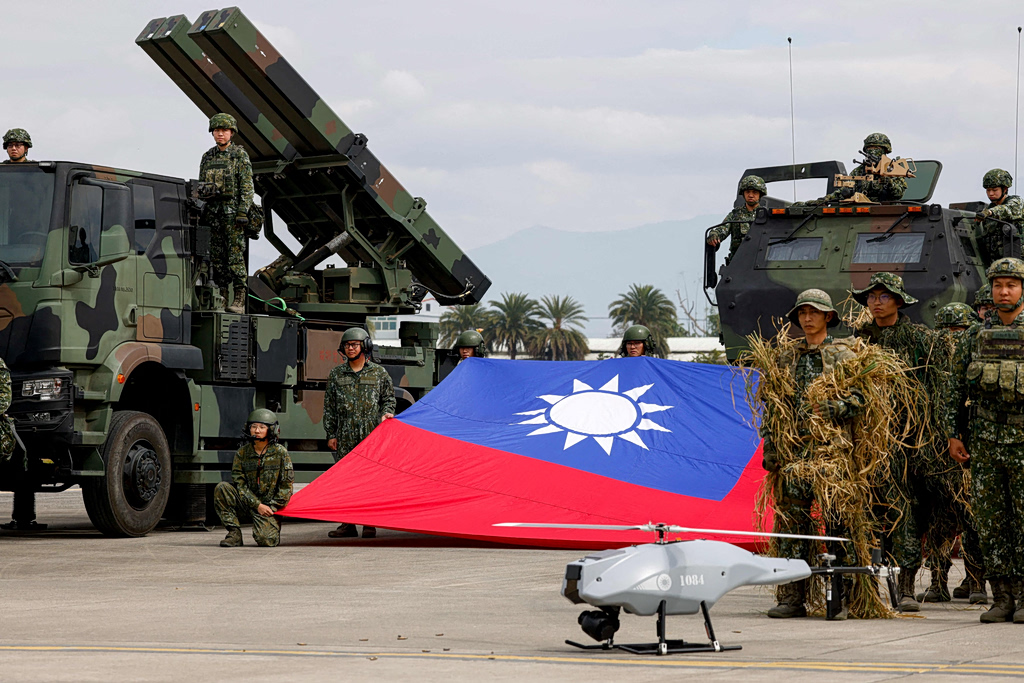
FILE PHOTO: Taiwanese soldiers pose with a Taiwanese flag near a Sky Sword II surface-to-air missile launcher and a military UAV during an annual military exercise ahead of Lunar New Year in Taichung, Taiwan, January 27, 2026. REUTERS/Ann Wang/File Photo
A major uncertainty hanging over the meeting is Taiwan, the self-governing democratic island Xi hopes to bring under Beijing’s fold. He is expected to try to press Trump to reduce the U.S.’s military support for the island and to shift U.S. rhetoric closer to Beijing’s position in a bid to isolate Taipei.
For instance, where the administration under former President Joe Biden said it “does not support” Taiwan’s independence, China now wants the Trump administration to say it “opposes” it—a change that would end Washington’s longstanding strategic ambiguity. Xi made a similar request of Biden in 2023 and was rebuffed.
Senior U.S. officials briefing reporters Sunday said Trump’s preparation for the summit “hasn’t included any plans” for a shift on Taiwan. But the next day Trump signaled openness to discussing Taiwan-related issues with Xi, saying they would weigh a multibillion-dollar arms package Washington was assembling for Taipei.
“President Xi would like us not to, and I’ll have that discussion. That’s one of the many things I’ll be talking about,” Trump told reporters.
Write to Lingling Wei at Lingling.Wei@wsj.com , Annie Linskey at annie.linskey@wsj.com and Alexander Ward at alex.ward@wsj.com