Speaking at an event on the sidelines of the 81st United Nations General Assembly in New York, Greek Prime Minister Mitsotakis committeed his country’s support of the new “OceanEye” International Alliance for the Global Ocean Observing System.
At a time that the United States is dismantling its marine observation infrastructure, the European Union and Canada are co-leading an international alliance aimed at advancing global ocean observation by 2035.
Pledges from all partner countries supporting the effort currently amount to at least €211 million. These are a “mix of financial contribution, in-kind support and the provision of assets such as research vessels, sensors, drones and data‑processing facilities,” says the EU.
Greece’s Pledged Support

During his intervention, Mitsotakis made three key committments including:
- ratification of the convention establishing Mercator Ocean International as an intergovernmental organization;
- contributing computing capacity from Greece’s EU-financed AI infrastructure in order to process the mass amounts of ocean data available and to contribute to the development of what Europe calls the Digital Twin of the Ocean;
- aid in the ocean observation and collection through Greece’s national space assets, in-situ observation system and the country’s operational presence in the eastern Mediterranean.
The PM also took the opportunity to highlight Greece’s role in the maritime sector as well as the fact that it is the EU country with the longest coastline.
He also reminded the delegation of Greece’s announcement to establish two marine parks- one in the Ionian Sea and another in the southern Cyclades- and that it is committed to mapping these parks along with marine habitats in the Natura 2000 network.
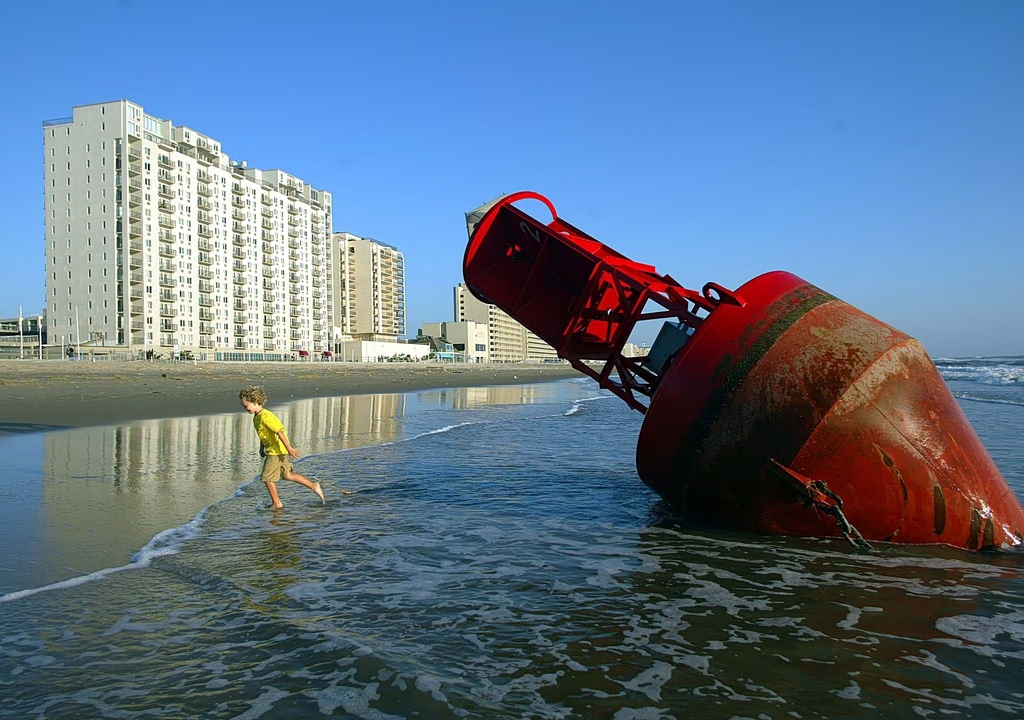
Six-year-old Austin Ewing splashes in the surf beneath a massive weather buoy that washed up onto the beach during Hurricane Isabel in Virginia Beach, Virginia 19 September 2003. EPA/PAUL BUCK
OceanEye and the Alliance
OceanEye was initially announced in the spring of 2026 and seeks to make the EU a leader in ocean intelligence, contributing to the global ocean observation system and securing a significant share of the ocean observation tech market.
A total of 31 members have joined the OceanEye International Alliance, including the EU and 30 countries (Angola, Belgium, Brazil, Canada, Chile, Colombia, Cabo Verde, Costa Rica, Croatia, Cyprus, France, Germany, Greece, Iceland, Ireland, Italy, Madagascar, Malta, Mauritius, Mexico, Norway, Namibia, Palau, Portugal, Slovenia, South Korea, Spain, the Netherlands, the Faroe Islands and the United Kingdom).
In a press release on the announcement, the EU explained that countries’ pledges will support:
- the maintenance of existing observation platforms;
- the closure of critical data gaps;
- the strengthening of the Global Ocean Observing System Secretariat;
- the Global Ocean Observing System coordination hubs;
- and the reinforcement of the OceanOPS data‑reporting center.