A dense layer of sea fog spread across parts of the Cyclades island chain on Wednesday, creating an unusual summer spectacle, as beaches, boats and stretches of coastline disappeared beneath a white veil.
The phenomenon was reported on several islands, including Paros, Antiparos, Folegandros, Koufonisia, Kimolos, Milos and Ios, as the fog formed over the sea and in some areas extended toward the coast.
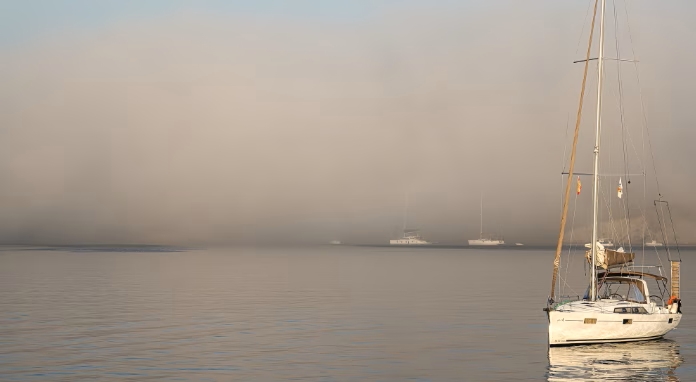
For residents and visitors accustomed to the intense sunlight and sharply defined horizons of the Aegean in August, the effect was striking. Boats appeared and disappeared into the haze while familiar coastlines were temporarily erased, giving parts of the islands an almost northern maritime character.
Sea fog forms when air near the surface becomes saturated and water vapor condenses into tiny droplets that remain suspended close to the sea. Several different atmospheric processes can produce the phenomenon, depending on the relationship between air and sea-surface temperatures and the movement of air masses.
One particularly dramatic form is known as sea smoke or steam fog. It occurs when very cold air moves across relatively warmer water, increasing evaporation from the sea while the moisture-laden air cools and condenses almost immediately above the surface. The resulting fog can look as though the sea itself is steaming.
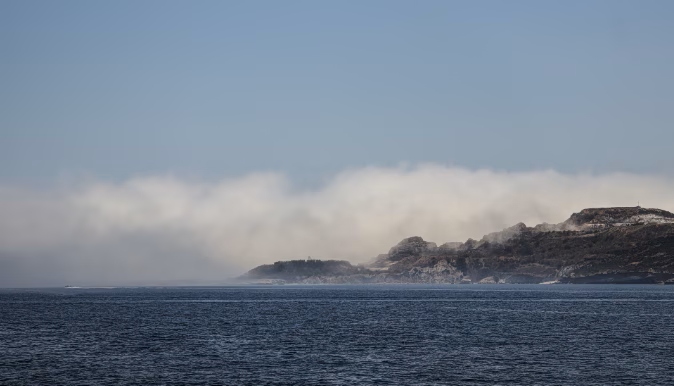
That mechanism, however, should not automatically be assumed to explain every episode of sea fog in the Aegean. Meteorologists distinguish between evaporation or steam fog and other forms of marine fog, including fog that develops when warm, moist air moves over colder water.
In the absence of detailed local observations showing the precise temperature relationship between the air and the sea during Wednesday’s event, sea fog is therefore the more accurate description.
For a few hours, the quintessentially blue Aegean can become almost monochrome — a landscape of white water, disappearing boats and islands suspended between sea and sky.