 Μake us preferred on Google
The jurors filed back into Hall 22 of the Courts of Justice in Valletta after eight hours of deliberation. It was around 7.30pm on September 2 2026, and they were about to tell us whether they thought one of Malta’s richest businessmen, Yorgen Fenech, had murdered my mother, the journalist Daphne Caruana Galizia.
As we waited, I steadied myself by rehearsing the evidence I’d heard during the two-month trial. Fenech had emailed his wife that he had been “petrified of the consequences” of one of my mother’s stories. “I would throw her to her death with my own hands,” he’d said on a secret recording made in his office.
In his police statement, he admitted to giving the go-ahead for the murder to a middleman — his own driver. During the trial, Fenech acknowledged passing more than €100,000 to the hitmen through the same intermediary, followed by another €450,000 for legal fees after they were charged. He had messaged him: “Our power is money” and “No one can touch me.” But in court, he’d argued that his initial payment was in fact meant to stop the murder, and that he had been blackmailed into making further payments. He said he didn’t think to alert the police or my family about the plot.
Could the jury believe his story? Even if they did, I held on to what the judge had told them just before they went out to deliberate: a person could be complicit in a murder plot they were connected to, even by failing to stop it. That was the first charge against Fenech and it carried a whole-life sentence.
The forewoman of the jury stood, her hands shaking around the verdict form. Eight to one, she said. I let out a huge sigh of relief.
Then she said: not guilty.
Fenech roared from the dock. His lawyers and family cheered until the judge quieted them so we could hear the verdict on a second charge: criminal association. Even if the jurors believed the murder wasn’t Fenech’s idea, how could they not find that he’d joined the group behind it? The intermediary’s confession had helped secure guilty pleas from the three hitmen and jury convictions of the suppliers of the bomb that was placed in her car.
Eight to one, the forewoman said. Not guilty.
Fenech shouted again, stretched out his arms and embraced his lawyers. After more than five years in pre-trial detention and over a year on bail, secured by €52mn of shares in the family business, he was a free man.
It was the majority that bewildered me. In Malta, juries often leave a single dissenting vote so that any juror can later claim to have made it. The jurors had effectively been unanimous in finding that Fenech was not responsible for any part of my mother’s murder. I could make no sense of it.
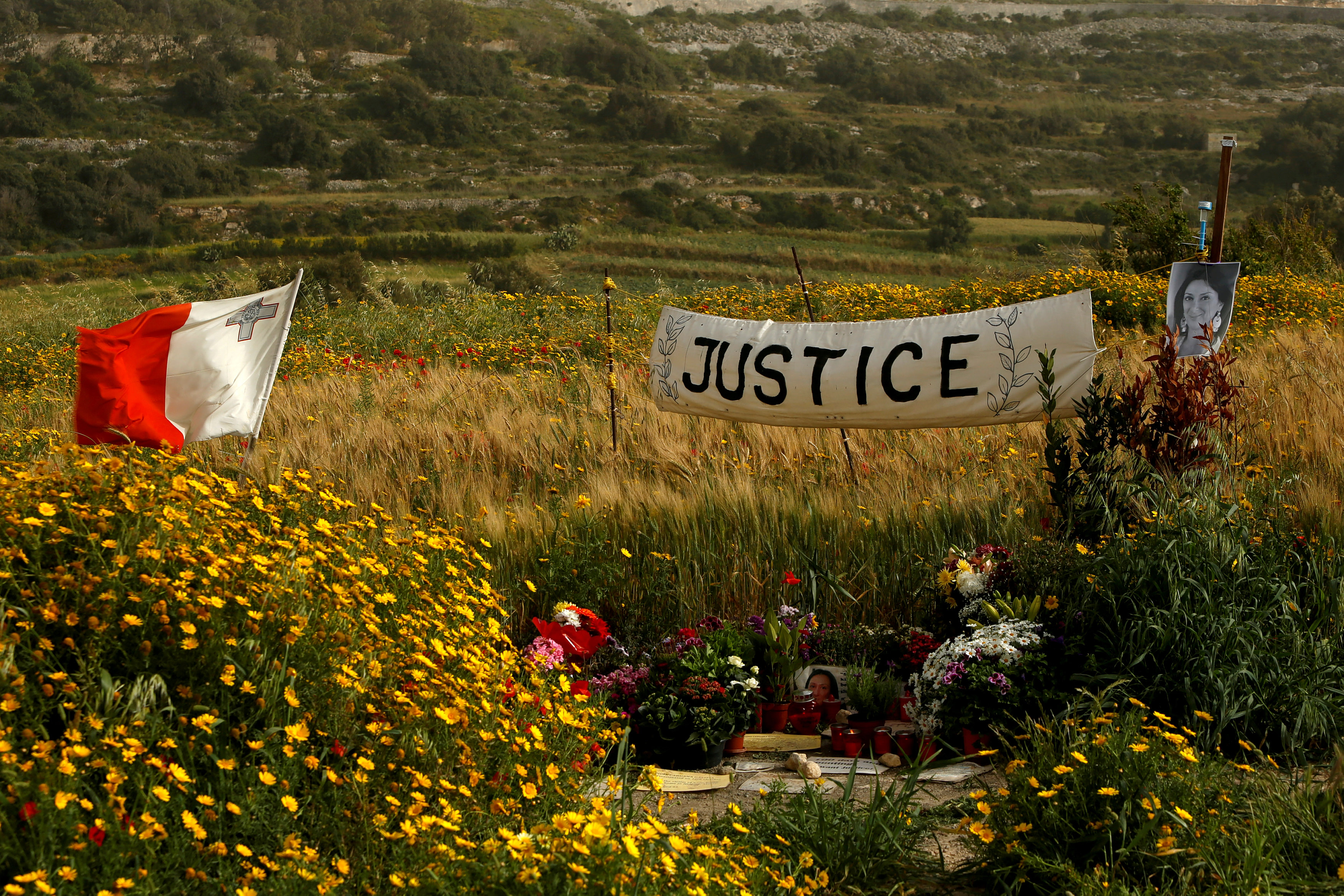
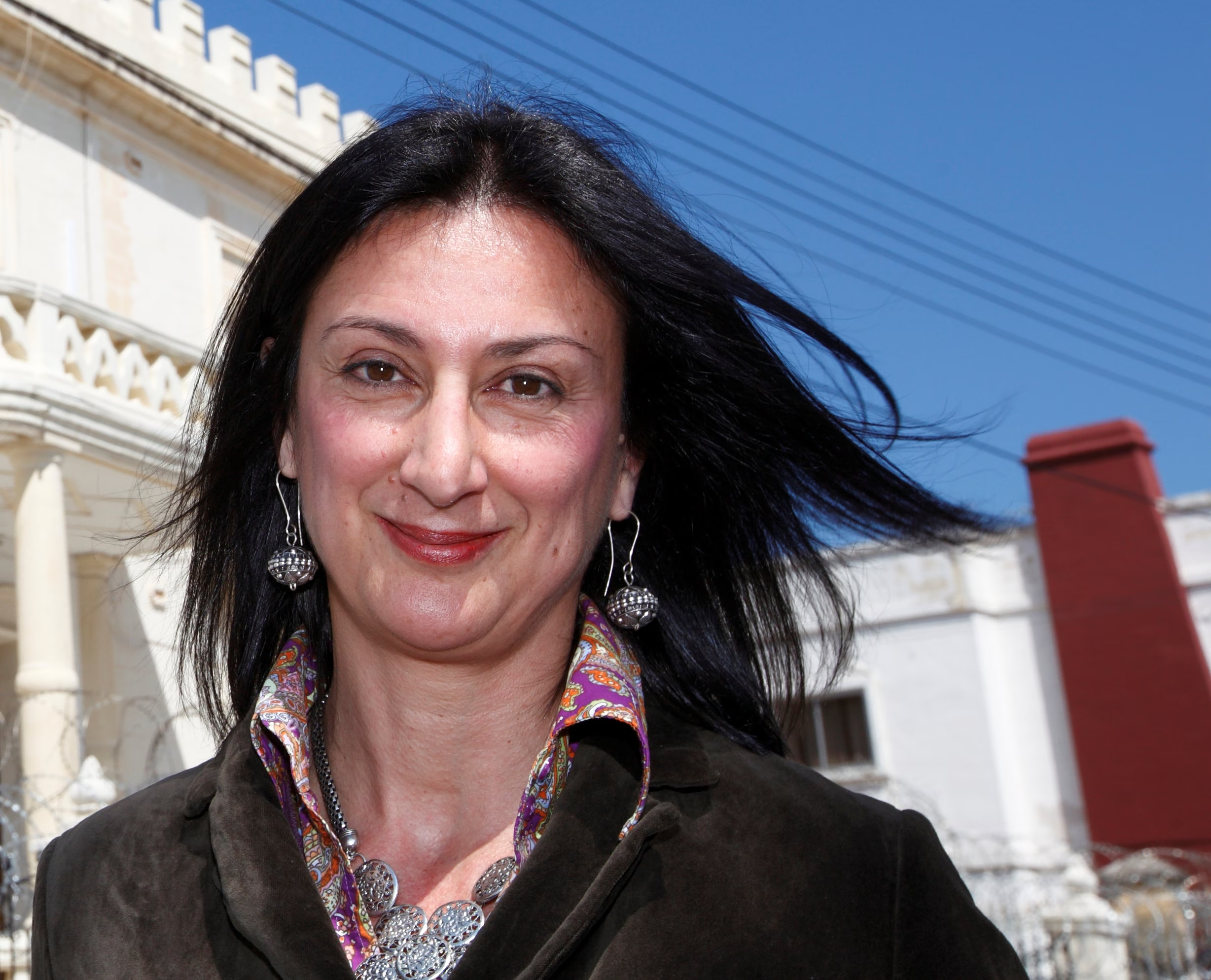
A banner calling for justice is seen next to a photo of assassinated anti-corruption journalist Daphne Caruana Galizia at the bomb site, as Maltese prepare to mark six months since her murder, in Bidnija, Malta April 15, 2018. To match Special Report MALTA-DAPHNE/ REUTERS/Darrin Zammit Lupi/File Photo
Nor, it seemed, could most of the country. The trial had been heard in an open court and reported minute by minute, from 9am to 6pm, Monday to Saturday. Protesters carried signs saying, “We all saw the evidence.” Both the government and opposition party were stunned, calling an urgent debate in parliament. European institutions began scrutinising Malta, and newspapers called the verdict “bizarre”.
Rumours spread that the jurors could have been bribed, fuelled by testimony that two of Fenech’s lawyers had tried to pay a key witness and a journalist to favour their client. I’d sat through the trial, listening to dozens of witnesses under oath and following hours of recordings and thousands of pages of documents presented to the jury. Much of what follows comes from that evidence. But none of it could explain how the jury had reached its verdict.
It was only after the acquittal that I looked closer. I examined the answers the jurors had given during their selection process, studied their social media posts, obtained more court filings and heard from their associates. The picture that emerged was more horrifying than the rumours, and all along it had been in plain sight. For the seven years since Fenech’s arrest, my attention had been fixed on the man on trial. I’d barely looked at the people who would judge him.
Long before I saw him in court, my mother had been asking questions about Fenech’s business. He worked in a high-rise office in Portomaso — a development with a marina, Hilton hotel and luxury apartments all built by his grandfather Tumas, a police sergeant who moved into real estate. Fenech’s father was a gambler who expanded the Tumas Group into one of Malta’s largest companies.
Fenech grew up inside the family firm, fascinated by the possibilities of money and power. Once, at a school event at the age of 12, he gave a speech about his idol, Silvio Berlusconi. “Being what he is,” Fenech said, “one expected him to be involved in the political scandals and corruption, but Berlusconi’s business dealings were always clean.”
In his early thirties, he was given the chance to lead a major deal of his own. In 2013, Malta’s newly elected Labour government announced that Electrogas, the consortium Fenech led in Malta, and in which Tumas Group held a stake, had won a €450mn public tender to build a gas-fired power station. A day later, Fenech told the press that Electrogas’ floating gas-storage facility had already been contracted, leading my mother to write on her blog that the deal “was all-too-clearly thrashed out well before the election”.
When I contacted him for this story, Fenech’s uncle Ray, who is now chair of Tumas Group, told me the deal was not pre-arranged and that “no contract for the gas storage was entered into before the bid”. But my mother’s piece concerned the speed of Fenech’s announcement after the award, not the bid. “Perhaps the specialised storage ship administration offices operate on Sundays and are not averse to whipping up a contract there and then,” she wrote. “The devil is in the detail.”
She had made a career of noticing such details. In the late 1980s, Daphne Caruana Galizia became Malta’s first female columnist. She was also the first columnist to publish under her own name when others wrote about controversial issues anonymously for fear of violent reprisals. In a country of around half a million people, her blog received hundreds of thousands of visits a day. Everyone read “Daphne”; even Yorgen Fenech had her bookmarked. She had criticised both of Malta’s main political parties, but after 2013 her fiercest battles were with Labour, which had regained power after many years in opposition.
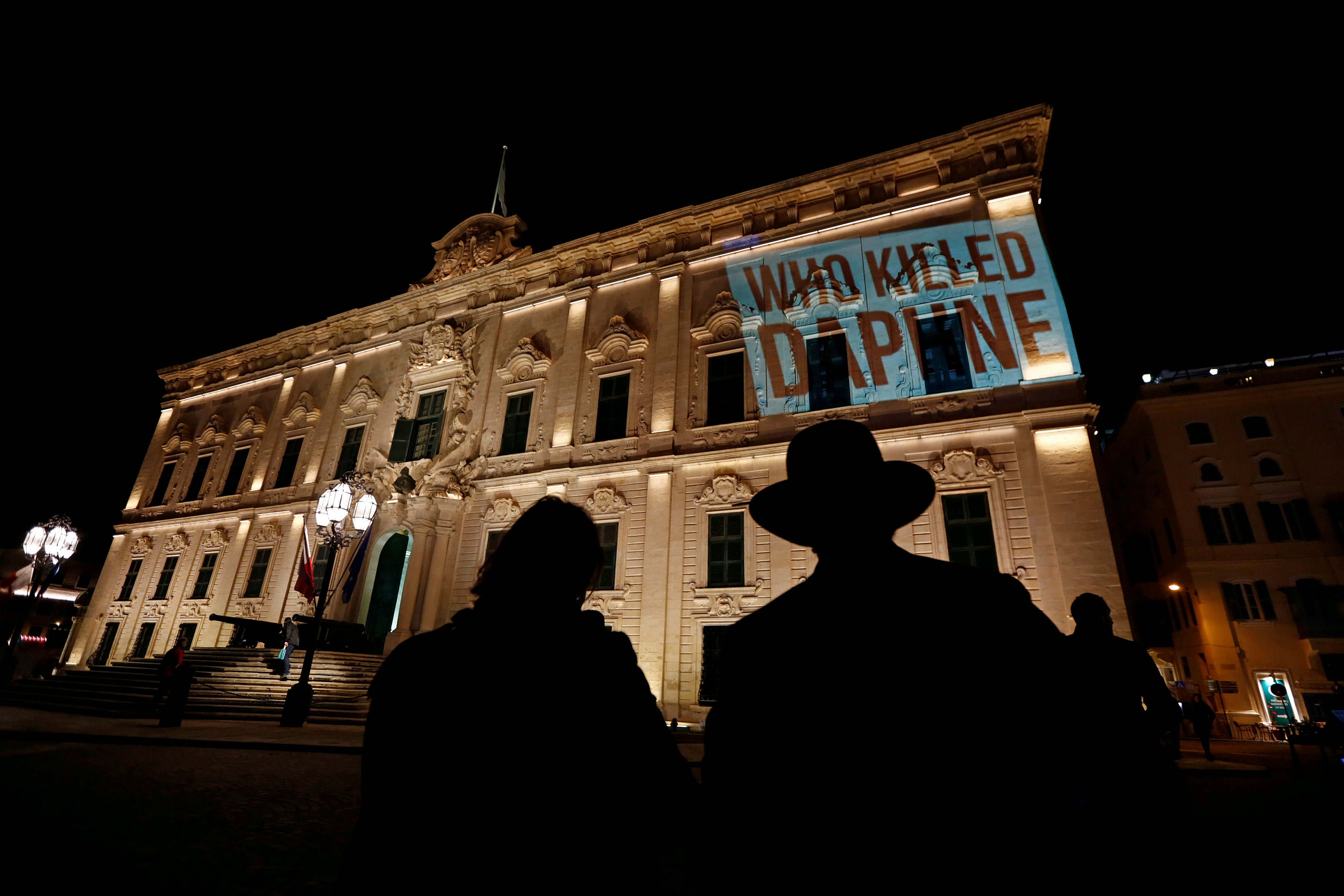
Activists project the words “Who killed Daphne?”, in reference to the assassination of anti-corruption journalist Daphne Caruana Galizia in 2017, on the facade of the Auberge de Castille, the office of Prime Minister Joseph Muscat, in Valletta, Malta February 1, 2018. To match Special Report MALTA-DAPHNE/ REUTERS/Darrin Zammit Lupi/File Photo
In 2016, she began reporting on the Panama Papers, a vast leak of offshore company records. She found that the Labour prime minister’s chief of staff, Keith Schembri, and the energy minister, Konrad Mizzi, had acquired companies in Panama five days after entering government. What she could not yet tell was what those companies were for, and what she did not see was just how close these two men were to Yorgen Fenech.
Fenech owned 17 Black, a secret company in Ajman, the United Arab Emirates, named after his father’s preferred roulette number. After my mother confronted Mizzi about his Panama company, digital records show that Fenech repeatedly searched for “Ajman offshore company safety” and urgently sought to change 17 Black’s corporate agent, a firm that manages a company’s paperwork, including its nominee directors and registered address. Weeks later, a source alerted my mother to 17 Black, but not to its owner. She messaged my eldest brother, Matthew, a journalist also working on the Panama Papers, to say the company was “crucial to unravelling the web”. When she eventually named the company on her blog, a commenter wrote beneath the post: “Yorgen Fenech”. Within days, Fenech had renamed 17 Black as Wings Development.
Fenech’s driver, Melvin Theuma, who had a taxi stand at the Hilton and links to the criminal underworld, would later testify that Fenech asked him to arrange my mother’s murder before she could publish a post about Fenech’s “Uncle Ray”. (Ray Fenech told me he was not aware of his nephew’s discussions with Theuma.) Pressed to hurry, Theuma came to believe it was Fenech’s own secrets that were at risk.
In May 2017, my mother wrote about a leaked official report linking the Panama companies to Electrogas and 17 Black. Fenech emailed Electrogas employees, saying that the stories “will surely make new lenders nervous”. He needed loans to keep Electrogas afloat. The banks were already uneasy about compliance risks, and discovering his ownership of 17 Black could sink the project.
The hitmen had first planned to shoot my mother through the dining-room window of our house in the countryside. But their guns were not up to it. Instead, they chose a bomb that another gang had imported into Malta the previous year. On the night of October 15 2017, they broke into her car, which was parked as usual outside our garden wall, and placed the bomb under the driver’s seat, with a bottle of petrol and ball bearings added.
The next day, October 16, a Monday, my mother had an appointment at the bank. She had barely left the white gravel lane leading from our house when one of the hitmen tried to send the message that would detonate the bomb: “#REL1=ON”. His burner phone had no credit. From his registered mobile, he called a friend and asked him to put €5 on it. At 2.58pm, he sent the message again. The explosion shook the doors and windows of our house.
Fenech did not go to work that day. His employees were told he was sick. Nearly a year after the murder, having finally secured the loans, he emailed his wife that Electrogas was “one massive mistake” that “killed me”. He added: “I regret it and think it changed me and scarred me for ever but once i was in it i had to finish it because failure would have ruined me (reputation, respect, credibility).”
When I arrived at the court, an imposing neoclassical building on Valletta’s main street, for the first day of Fenech’s trial in July this year, dozens of prospective jurors were milling around outside — some silent, others grumbling. I could watch them there, but not inside. The judge had barred our family from attending the jury selection. Over five hours, candidates were called into the courtroom one by one and questioned under oath. One question they were asked was whether they had ever been phoned by a caller who claimed to be from “a survey company in Malta acting on behalf of an independent client” with questions about the case.
Ray Fenech had been commissioning the clandestine polls since 2021, using questions supplied by his nephew’s defence lawyers, including: “What did you think of Daphne Caruana Galizia?” He told me he’d “authorised” the surveys to help “a family member in difficulty” and in order to assess the damage to Tumas Group, although the survey asked no questions about the business. He denied playing a role in his nephew’s case and said there was “never any suggestion the survey could be used to influence the composition of the jury”.
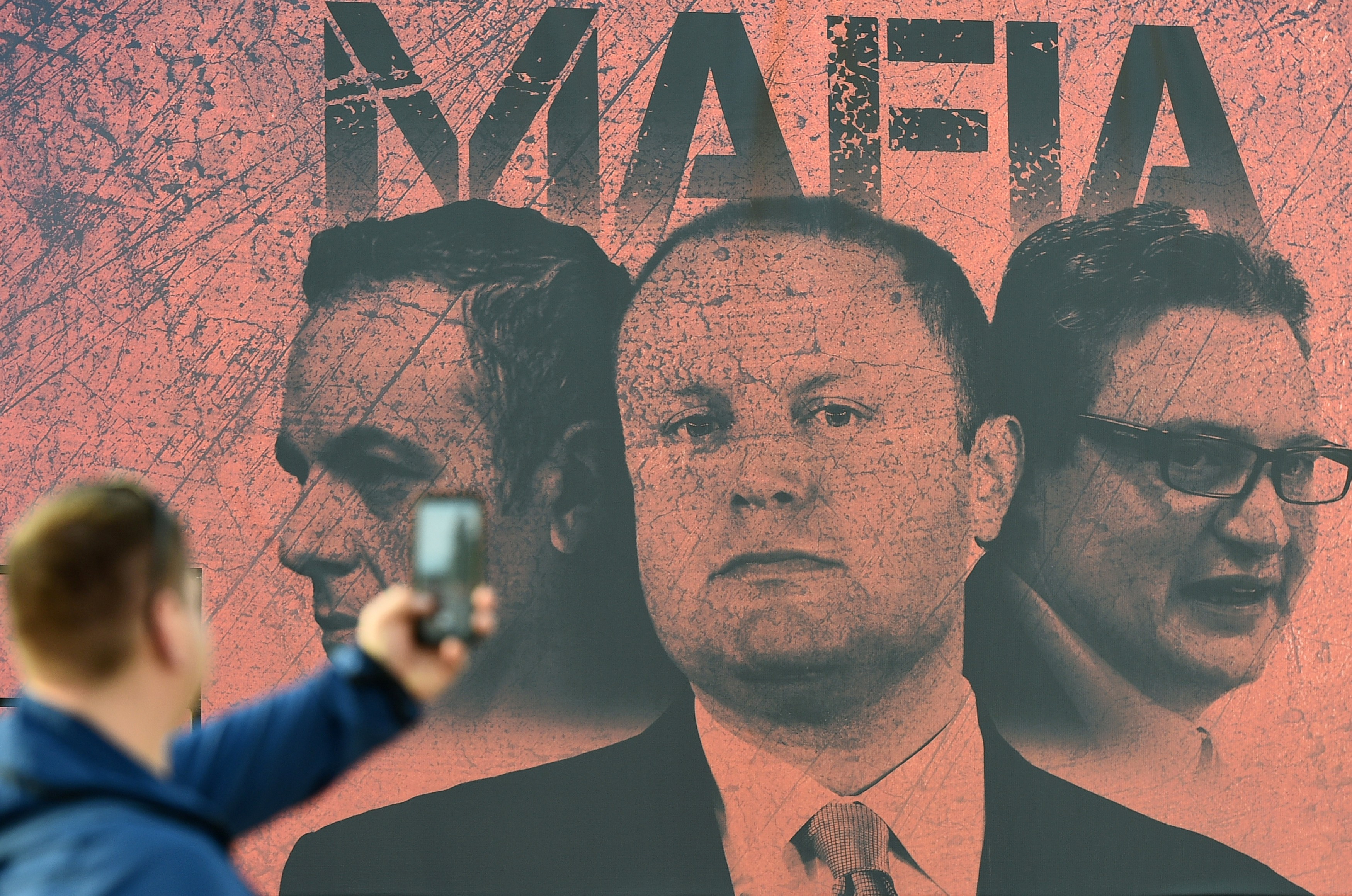
A man takes a photograph of a poster showing Malta’s Prime Minister Joseph Muscat (C), Chief of Staff Keith Schembri (L) and Minister for Tourism Konrad Mizzi with the words ‘mafia’ written above them, ahead of an anti-government protest outside Maltese Prime Minister’s office in Valletta, Malta, November 22, 2019. REUTERS/Guglielmo Mangiapane
The last poll came weeks before the trial, in June, and after the prospective jurors’ names had already been published in the government gazette, as is the law in Malta. Some prospective jurors informed my family’s lawyers they had been contacted. When we alerted the court, the judge ordered an investigation that uncovered Fenech’s lawyers’ role and ruled that anyone who had received such a call would be excluded from serving. The court eventually went through 64 people before completing a panel of nine jurors and six reserves.
The case these jurors would hear began with the hitman’s two phones. Investigators first connected his registered mobile to the burner phone, and then gathered forensic evidence placing all three men around our house on the day of the murder. But even as they closed in, word of their investigation was reaching Fenech through a well-placed source.
Fenech later claimed, in a separate court case he filed nine days after his arrest, that the lead investigator had leaked information to him “continually” and in “real time”, starting “within a week” of the murder. The judge in that case found that he was trying to discredit the officer — and that his primary source had in fact been Schembri, the prime minister’s chief of staff. The judge described Fenech as “lax and dishonest”, and his claim of being blackmailed into paying for the murder as “incredible and untruthful”.
The leaks, the judge found, were detailed. Fenech had even received the text of the detonating message. He’d warned the hitmen that the police were getting close to identifying them, and he passed on the dates of a planned police raid. All three hitmen were arrested within seven weeks of the murder. When one began talking to police in the hope of negotiating a plea deal, Fenech told the middleman Theuma, who panicked. Fenech tried to reassure him: “If you hold firm,” Fenech messaged, “they can kiss our balls.”
But Theuma felt vulnerable. Convinced the police would find him, he began secretly recording his conversations with Fenech. If he was arrested, then at least he would have something to offer. When the police finally came for him in November 2019, more than two years after the murder, Theuma was carrying an old ice-cream box filled with pen drives containing the recordings. He sought a pardon: immunity in exchange for telling investigators what he knew.
Before the police had finished questioning Theuma, a photograph of his draft pardon agreement had been leaked to Fenech. He forwarded it to a former schoolmate who had become a lawyer, Gianluca Caruana Curran, adding: “I’m worried sick.”
Caruana Curran said he would help and, at Fenech’s request, also speak to his mother, Giannella de Marco, a high-profile lawyer who would ultimately lead Fenech’s defence at trial. De Marco knew my mother. She had once won a libel case against her over a column she’d written questioning de Marco’s representation of a man accused of trying to murder a colleague of de Marco’s father. That evening, the two lawyers, mother and son, went to Fenech’s penthouse. After they left, Fenech continued messaging Caruana Curran. He blamed Schembri for the murder. Had Theuma recorded Schembri too, Caruana Curran asked. No, Fenech replied, the picture was more complicated.
“If we get to this point explaining all we will be in a trial by jury,” Caruana Curran said, in messages later found on Fenech’s phone. He proposed another way out: “go somewhere far we look for no extradition”.
Before dawn, Fenech had left the Portomaso marina aboard his yacht, bound for Sicily. He later claimed he was taking it for routine repairs. He had €7,000 in cash and several SIM cards; his uncle Ray had advised him in messages not to use credit cards because they could be traced. (Ray Fenech told me his advice was meant to help his nephew recuperate in private, not evade tracking if an arrest warrant were issued.)
Fenech told the captain to disable the yacht’s tracker, then to restore it, worried that its disappearance would attract suspicion. After the captain felt their planned trip no longer looked “fishy”, as he messaged Fenech, they left. But police speedboats caught up with the yacht shortly after it left the marina. Officers boarded and arrested Fenech on suspicion of murder.
In custody, after four days of meetings with his lawyers, Fenech sought his own pardon for the murder. After the government rejected his first request, he then submitted a second and also tried to get a pardon directly from Malta’s president. The cabinet rejected the second request, and Fenech challenged its decision in court. The suit was dismissed on procedural grounds, a decision upheld on appeal. In the separate case to remove the lead investigator, the judge found Fenech’s claims that others had commissioned the murder (the basis of his pardon requests) rested on hearsay, were “not corroborated in any way” and involved “fictitious and unbelievable scenarios”.
As Fenech fought to avoid a jury trial, a former public prosecutor joined his defence. Charles Joseph Mercieca had joined the Attorney General’s Office in August 2018. Less than two years later, in January 2020, Mercieca was promoted, though he was not assigned to the AG’s biggest case: Fenech. The next day, he visited Fenech in prison without telling his employer. In the visitors’ register, he had entered his real identity-card number with the name “Joseph Charles”. Four months later, Mercieca paid off his notice to leave the AG’s office. The next day, he appeared opposite his former colleagues in court, acting for Fenech beside Caruana Curran.
A government inquiry was set up to investigate Mercieca’s move. It found no evidence that he had accessed Fenech’s prosecution file or discussed the case within the office. But it said it had not been asked to investigate whether Mercieca had breached criminal laws prohibiting lawyers from switching sides or betraying their clients’ interests, or the profession’s code of ethics. Nor had the inquiry uncovered Mercieca’s prison visit.
Soon after the inquiry reported, in June 2020, Schembri sent a WhatsApp message to Mercieca: “Signal”, the name of an encrypted messaging app. A few days later, Schembri and his assistant met Mercieca and Caruana Curran outside Schembri’s office in the Valletta suburb of Floriana. Schembri, who had been forced out of government, was about to testify in the compilation of evidence against Fenech — the preliminary proceedings in which a magistrate hears witnesses before a case can go to a jury. He would tell the eventual jury that the lawyers had asked him to speak in Fenech’s favour.
“How can I help him more than I already have?” Schembri said he asked them.
Fenech’s legal strategy was to use Schembri’s leaks to suggest that his involvement in the cover-up pointed to involvement in the murder itself. Casting enough suspicion on Schembri could free their client without putting Schembri in his place. Schembri’s lawyer reassured him that investigators, though searching intensively, had nothing on him. “I know,” Schembri replied. “Because there isn’t.”
A week after the Floriana meeting, prosecutors asked Schembri about a recording where Fenech said Schembri “went cold” when Fenech indicated he was behind the murder. The audio file implicated Fenech and suggested Schembri had learnt of the murder only afterwards. But Schembri told the magistrate under oath: “Yorgen never informed me of any crime”. Three days later, Schembri told his lawyer: “I saved him life.”
Fenech’s lawyers spent the next six years of pre-trial proceedings blaming Schembri without producing evidence that he took part in the murder itself. But when the jury trial finally arrived, Schembri admitted the conversation had happened.
“He hinted at it without saying it,” Schembri told the jurors. He said he “froze” and “went cold” when he understood that Fenech was telling him he had been involved in the murder. The two men had cried and hugged, and afterwards Schembri had tried to help his friend. Maltese law has no general offence of helping a murderer evade detection after the killing, but Schembri has since been charged with leaking confidential information from an investigation, which he denies.
As proceedings involving him are ongoing, Schembri’s lawyers told me he would not comment beyond testimony he had already given in court. His decision not to address my questions, they added, should not be taken as accepting the “assertions or characterisations” they contain. One question was why Schembri appeared to have stopped helping Fenech. His lawyers told me he stood by all the testimony he had given.
I wondered whether a separate inquiry into 17 Black, which had led to charges against both men, had ended whatever leverage they held over one another. The inquiry found that Fenech’s company was set to pay millions of euros to Schembri and Mizzi’s Panama companies. It was the story Fenech had stopped my mother from reporting.
By the end of the trial, I’d begun to feel that the defence was worried about the weight of evidence against their client. In his closing address to the jury, Mercieca pleaded: “All I ask is that you don’t give Mr Fenech more than he deserves.” After the jurors acquitted Fenech of both charges, I realised Mercieca hadn’t needed to persuade them at all.
I began looking through the jurors’ social media activity. On the first day of the trial, each prospective juror had been asked whether they had posted material relevant to the case. All of the nine who had been selected and the six reserve jurors, answered “no” under oath. They then swore to decide the case without “hatred or malice”. Since the acquittal verdict, police have arrested three of them on suspicion of perjury.
One had commented beneath a Facebook video showing my mother being arrested for writing about the former prime minister on the legally mandated day of silence before the 2013 election. “I can’t stand her, man”, the juror had written. “I can’t even look at her face.”
A second juror had shared a post before the 2013 election, accusing the then ruling Nationalist party of being “complicit” in my mother’s “personally attack[ing] innocent people” by giving her police protection. The juror urged readers to consider their vote, implying they should elect the Labour party and have that protection withdrawn.
A third juror shared posts rubbishing the public inquiry into my mother’s death, which found in 2021 that the state had failed to protect her life. They opposed compensation for “the Caruana Galizia family”, although we haven’t asked the state for any, declaring, after a list of grievances against my mother: “NOT IN MY NAME and NOT UNDER ANY CIRCUMSTANCES”. This juror also shared a Labour MP’s criticism of her reporting on the shell companies surrounding Fenech’s power-station contract: “If Daphne Caruana Galizia had the evidence, then why didn’t she go to the Police Commissioner with it?” Another of their shared posts celebrated the Electrogas power station’s opening.
When questioned about the Facebook comment, according to a court filing dated after the verdict, the first juror told police they had continued to feel “I can’t stand her” throughout the trial. They said they couldn’t just set aside their opinion — the judge had asked jurors to do just that. The other two arrested jurors, accompanied by their lawyers, refused to answer questions about their posts.
Some jurors also belonged to private Facebook groups for Labour party supporters. One was called Labourites until Death, in which members shared memes celebrating my mother’s death, including of witches burning at the stake. Other members of the group joined in with clinking-champagne-glass emojis and comments that she was burning in hell. For years, the Labour party had encouraged its supporters to vilify and dehumanise my mother to discredit her reporting. For many supporters in the party’s radical core, hatred of her had become a form of political loyalty and communal ritual.
The public inquiry found that this campaign had created an enabling environment for her murder. It singled out the former prime minister’s closest aide, Glenn Bedingfield, for running a blog that harassed her and spread conspiracy theories. He kept it going even after her death, and the attacks turned on those asking for justice. Government supporters claimed my two brothers and I had left our mother’s car outside the low garden wall on purpose, so the hitmen could reach it. We were called traitors, accused of shaming Malta and exploiting her murder for money.
View this post on Instagram
In September 2018, one MP accused us of being on a “mission to disrupt investigations”. Robert Abela, who became prime minister in 2020 after revelations from the murder investigation had forced his predecessor and chief of staff Schembri from office, has since apologised for the remark. Stunned by the verdict, Abela asked whether he could visit us at home. Bedingfield apologised for his blog: “I could have been less harsh.” The former prime minister himself said the case against Fenech was a “slam dunk” and that he was “baffled” by the acquittal. He needn’t have been: it appears some members of this jury were his monsters.
Early in the trial, a senior police officer had told me Fenech was showing he had no defence. I went home that day reassured that someone who knew the case inside out saw it the same way I did. After the verdict, I understood our mistake: we had assumed the defence needed to overcome the evidence. But after nine years of fighting the investigation, spending millions of euros and challenging proceedings at every stage, Fenech could be acquitted by jurors, some of whose hostility towards my mother may have mattered more to them than anything they heard in court. Fenech needed less from the jury than we had thought.
On one of Theuma’s tapes, Fenech said that conspiracy theories helped because they “confuse people’s minds”. After his arrest, selective material from the pre-trial proceedings surfaced through fringe bloggers and social media influencers who claimed Fenech was being framed. The court ordered an investigation into those leaks. The matter became part of a wider and ongoing judicial inquiry in which Caruana Curran is a person of interest, though he has not been charged.
I sent detailed questions to each of Fenech’s three lawyers and, through Mercieca, to Fenech himself. They offered no answers or rebuttal of my reporting. But they had rather more to say about me. In a joint email copied to the FT’s editor and complaints commissioner, they said I had a “conflict of interest” because my mother was the murder victim and a “lingering personal grievance” against de Marco because she sued my mother. They also accused me of “heckling and insulting” them in court. I did neither.
But it was the jurors’ conduct I kept returning to. Afterwards, I began to see moments from the trial differently. During the jury’s visit to our home, my father, Matthew and I had waited outside the garden wall to show respect for their role and demonstrate that we had nothing to hide.
The juror who, as I now know, had shared the post about my mother’s protection stood near me. The one who had opposed the idea of compensation for the family hurried over. “Look, the car was here,” they said, pointing to the space where we always parked the cars. At the time, I heard a statement of fact. Maybe it was just that. But after the verdict, I thought of the conspiracy theory about my mother’s car — that my brothers and I had left it outside the wall for the hitmen to access. I felt ill wondering whether they had made that exchange near me deliberately, already anticipating Fenech’s acquittal.
The spouse of one juror had boasted to people in their hometown of an eight-to-one verdict weeks before the trial ended, even before Fenech testified, according to a tip my family received from one of those people. Just before Fenech’s testimony, the spouse liked a post on Facebook by a Labour activist who was an official in the former government: “the nightmare for the Caruana Galizia family is about to begin”, raising the possibility that some jurors had discussed the case during the twice-weekly family visits that were permitted under the supervision of court marshals.
I understood that the jurors had been through a gruelling experience. For the two-month duration of the trial, they had surrendered their devices and travelled between court and a nondescript hotel, watched by marshals. They could not work and saw their children only on visits. Halfway through, relatives told the Times of Malta of “helplessness” and “exasperation”. Jurors were “increasingly frustrated and emotional”. Some cried during visits. They missed pre-paid holidays, weddings and birthdays. They asked for Netflix and didn’t get it.
“They are exposed to gruesome images” (the photographs of my mother’s remains), “disturbing testimony and details that many people simply don’t have the stomach for,” one relative said. “Everyone is making money from this — the defence lawyers and the prosecution and court marshals who are getting paid overtime. And those who have to decide, have the responsibility and are sequestered, get €10 a day.”
Their exhaustion might explain some of what I saw in court. I heard jurors grumble from their holding room about the length of proceedings. Some stared at the ceiling or rolled their eyes. One slept through much of the trial, waking to doodle; another played with rubber bands and never took a note. I told myself sequestration was unpleasant and perhaps they had already heard enough to convict.
After the finding, the spouse called it “a great verdict!” on Facebook. Beneath an interview with a retired European Court of Human Rights judge who criticised the verdict, the spouse wrote: “find a system, then, where your guys always win!!” But it appeared we had ended up with some of “their guys”, a group of people whose views seemed so completely out of step with the public. A nationally representative MaltaToday survey conducted three weeks after the verdict found that only 16.1 per cent had expected an acquittal. I wondered whether a handful of politically committed jurors had managed to bring the others around.
Another juror told a colleague after the verdict that some jurors were “simple people” who, like him, found everything too confusing. This juror was the fourth to be arrested, not because of social media activity about my mother, but after police received indications that their phone had been used during the trial. While examining the phone, officers asked about a line scribbled on the deliberation-room wall, dated September 2 2026, the day of the verdict. Had the juror written it? Yes. It said: “Democracy does not exist. Only dictatorship does.”
Fenech’s acquittal has not ended the story. He is still facing charges over 17 Black, police corruption, money laundering, and attempts to buy firearms, ammunition and cyanide from the dark web. He denies them all but, in one way, he may have a harder time with these cases. They are being heard before magistrates because the possible sentences are not long enough for juries.
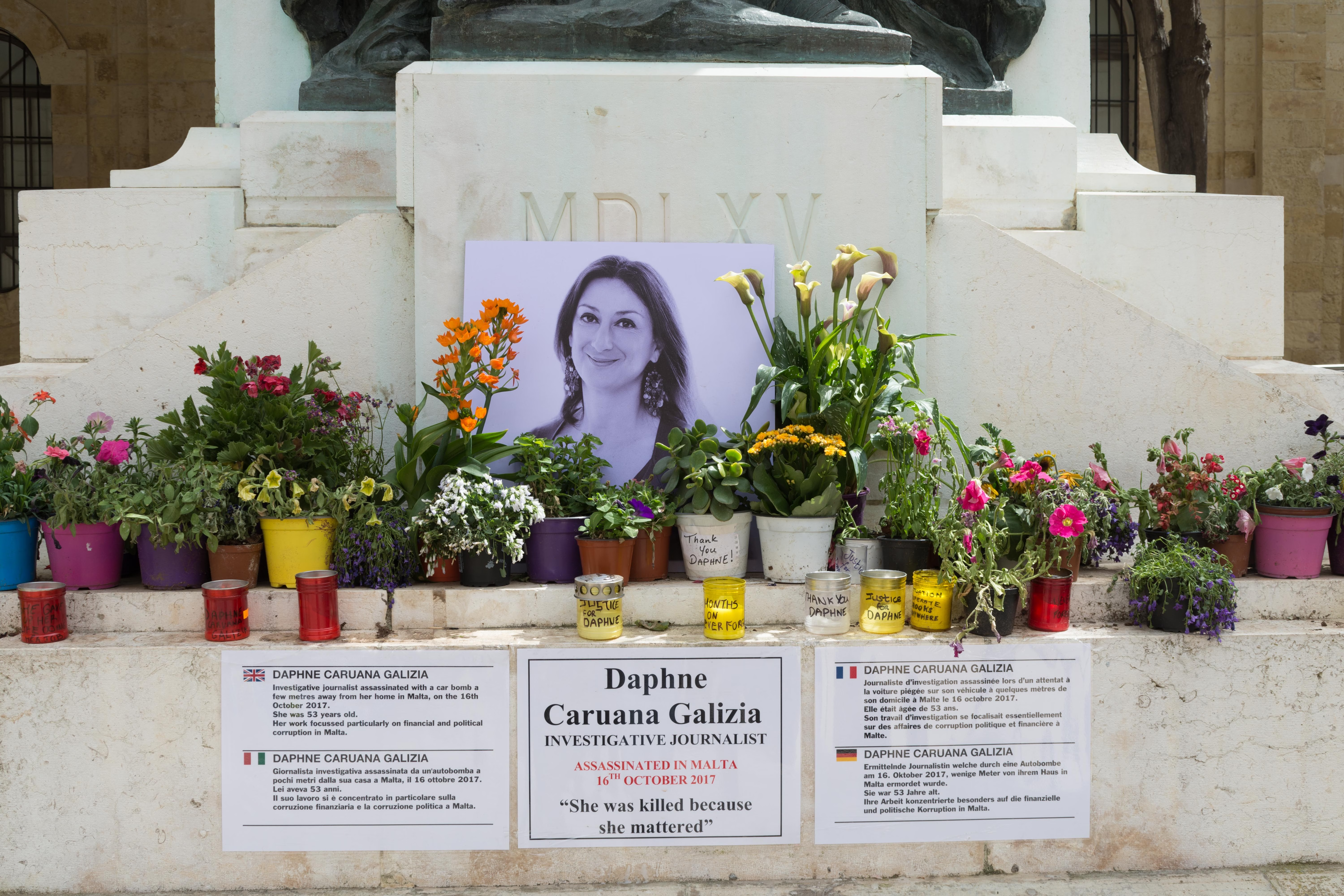
Valletta, Malta – April 3rd 2018: Photographs, candles and messages at the base of the Great Siege Monument demanding justice for the journalist Daphne Caruana Galizia who was murdered in 2017.. Credit: Pablo L Mendoza via Shutterstock
My family is also suing him, Theuma and the hitmen for damages before a single judge. We filed the suit to freeze their assets and prevent them from using money in their favour during the criminal proceedings. Theuma has repeatedly asked for our forgiveness. After a suicide attempt in his safe house, he woke in hospital and wrote on a piece of paper: “I wish that the children of Daphne forgive me.”
I was shocked when I first received an email from him at my FT address. But one of the many difficult things about murderers is that they force moral compromises on everyone. I can’t forgive Theuma, although I believe his remorse is real. I do want him to live and keep telling the truth. That’s all I say to him. Matthew once told Theuma not to give Fenech the satisfaction of his death. I also feel that. We are still suing him because his pardon doesn’t shield him from civil claims, and he should be held to account in the only way left. What we hope from the court is a judgment that follows the evidence, whatever our feelings towards the people involved. It’s the same thing that was hoped for from the jurors.
After the verdict, a smiling de Marco had said outside court that “justice for Daphne now has to go further”, implying that her client had been framed. It just might, but not in the way she meant. The attorney-general has appealed against the verdict. That could mean several things. Three appellate judges could find a grave irregularity in the trial — for example, with the jurors — yet still leave the acquittal intact. Or they could order a retrial. If so, we would face another jury, knowing the risks posed to any group by the years of propaganda through which my mother was dehumanised — propaganda that also dehumanised those who believed it.
In October, I learnt from the attorney-general’s appeal filings that the nine jurors had set up a WhatsApp group two days after the verdict called the Line of Truth, a mocking reference to one of the prosecution witnesses’ testimony. The chat was a kind of deliberation room, but one that generated a transcript. When news of the appeal reached them, one juror messaged sarcastically: “How they cry for her !!!!”
The juror who sent that message is a person. A person who saw my middle brother Andrew break down in tears on the witness stand and saw me in court every day, including the sitting where a coroner said he’d taken a DNA sample from me to identify our mother’s remains. The juror is a person who listened to my older brother Matthew describe the explosion that shook our house at 2.58pm on October 16 2017; how he ran barefoot down the road, saw our mother’s body parts scattered around him and her car in flames, then circled it, trying to rescue her silhouette.
“How they cry for her !!!!” the juror said in their message. “Not even her children do !!!!”
Paul Caruana Galizia is an investigative reporter at the Financial Times
Find out about our latest stories first — follow FT Weekend Magazine on and FT Weekend on
Copyright The Financial Times Limited 2026
© 2026 The Financial Times Ltd. All rights reserved. Please do not copy and paste FT articles and redistribute by email or post to the web.