 Μake us preferred on Google
So you reach for your phone. Your WhatsApp messages crawl. Photos will not send, videos will not load, you cannot share your location. You assume the problem is your own connection, and perhaps you go to sleep. Meanwhile, across town, thousands of people are on the streets, and you will not know until morning, if at all.
That is not a thought experiment. It is what happened in Istanbul on 19 March 2025, the night Ekrem İmamoğlu, the city’s mayor and the opposition’s strongest challenger to President Erdoğan, was detained. For 42 hours the internet across the city slowed to a crawl. Nobody announced it. Nothing was officially blocked. That is exactly why it worked.
A shutdown is loud. It makes headlines abroad and makes people angry at home. A slowdown is quiet. People blame their phone, their provider, their luck. It is hard to protest against something that looks like a bad connection. That night Istanbul resisted, while much of the rest of the country barely knew.
Since then, a second and even quieter tool has taken over. The state no longer needs to delete anyone. It simply makes them invisible from Turkey. The account is still there. I can read it here in Athens; someone in Istanbul cannot. İmamoğlu, a presidential candidate who still enjoys the presumption of innocence, has been erased in this way from the screens of the very people he hopes to govern.
What began with protest accounts now reaches almost anyone. Every morning brings a new list: economists, academics, a publisher, a trade unionist, a political party, an opposition television channel. In September alone, more than a thousand accounts vanished from Turkish screens, and X, the platform that once promised to be a home for free speech, complied almost every time. Women’s and LGBTI+ organisations have felt this most sharply. Their accounts have disappeared one after another, and in September the pressure left the screen altogether. Under an operation named, without irony, “Ailem Güvende” (“My Family Is Safe”), dozens of people were arrested, among them board members of Kaos GL, one of Turkey’s oldest LGBTI+ associations.
The moment that struck me most came in late September, when the account of Yaman Akdeniz disappeared. For years Akdeniz and the Freedom of Expression Association (İFÖD), which he founded, have done the patient, unglamorous work of taking blocked websites and news stories to court one by one, archiving every decision and publishing a report every year. If you wanted to know what Turkey had hidden from its citizens, you went to them. Within days, the accounts of İFÖD and its EngelliWeb archive went dark too. It is no longer only the violations that are hidden. It is the people who keep the record of them.
There is another, less visible mechanism of censorship: Google delisting. Unlike traditional access bans, delisting removes content from search results without necessarily making the original website inaccessible. The information still exists, but for millions of people who rely on Google to find news, it effectively disappears. Between August 2024 and January 2026, Google sent 37 delisting notifications concerning İFÖD’s EngelliWeb documentation of blocked content, without identifying the relevant court decisions or providing clear legal justifications. In other words, even the records documenting censorship were being removed from public view.
This raises a broader question about the power of algorithms. Today, freedom of expression is not simply about whether someone is allowed to publish. It is also about whether their work can be found, recommended and circulated. Search engines and social media platforms increasingly determine which voices reach an audience and which remain practically invisible. Yet their ranking and recommendation systems operate with limited transparency, making it difficult to establish when reduced visibility results from algorithmic decisions or deliberate political interference. A government no longer needs to erase every critical voice. In a digital public sphere controlled by private platforms, making dissent difficult to discover can be almost as effective as silencing it.
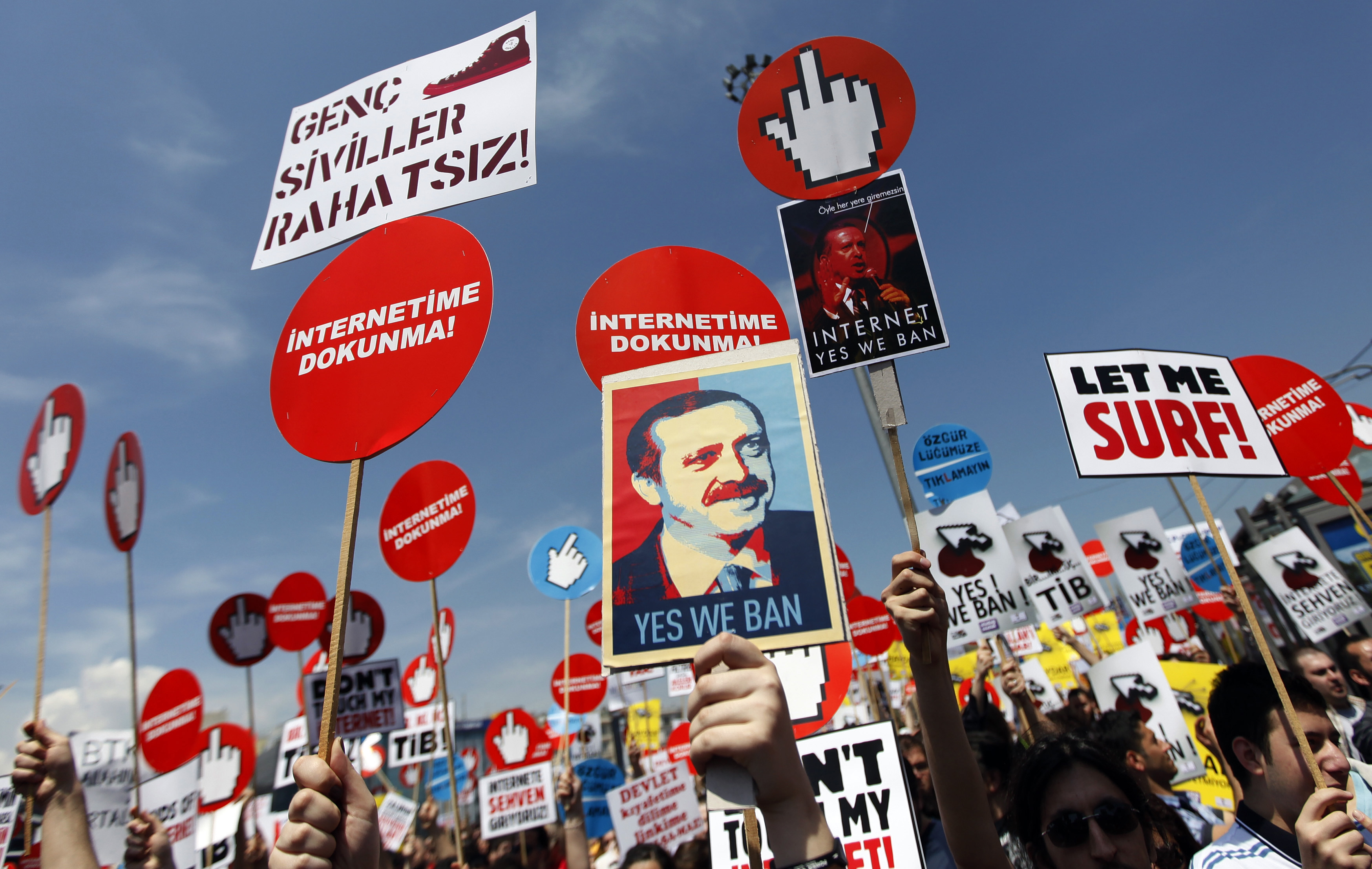
This is what makes the present moment feel different. Rights in Turkey are being narrowed in two places at once. The street has long been closed: protests are banned, and if you film one without a press card, you may be taken away. The internet was where we went instead. Now it is being managed exactly like the street. Police in the square, the regulator on the network.
The tech companies are not simply caught in the middle. Most of them comply, to protect a young and lucrative market. Yet Meta refused several court orders over protest content, paid the fines and still operates in Turkey. Saying no is possible. Compliance is a business decision dressed up as a legal obligation.
And yet none of this has stopped people from telling their own story. Turkish citizen journalism was born in 2013, during the Gezi Park protests, when police were firing tear gas in the heart of Istanbul and one of the country’s main news channels was showing a documentary about penguins. People stopped waiting for the news and started making it: filming on their phones, reporting from the streets, organising help on Twitter. Within two weeks, the number of Twitter users in Turkey rose from under two million to almost ten. In 2025, it was again ordinary people with phones who documented the police violence television refused to show. Citizen journalism in Turkey was never a trend. It was a necessity.
That is why I watched this month’s US midterms with particular interest. Hasan Piker, a Turkish-American streamer who broadcasts for hours every day from his own home, and whose Twitch account has been suspended more than once, ended up at the centre of the campaign. Republicans made him a target, and many now credit him with a real influence on the result. One person, no studio, no licence, and a national election felt his presence.
I would love to believe the same could happen in Turkey. For now it cannot. When an election or a protest comes, our networks slow down exactly when we need them, and any voice that grows too loud is simply made invisible. The difference between Piker’s America and today’s Turkey is not courage or talent. It is whether the infrastructure lets you be heard.
This should worry Europe more than it does. Turkey’s model is not China’s or Iran’s. The internet looks open, the platforms are there, the accounts technically exist. That is what makes it so easy to copy, and with the far right rising across the continent, nobody should assume these tools will stay in Ankara. Platforms should publish every government order they receive, and European governments, Greece’s included, should call digital censorship what it is: a human rights violation.
What is at stake is larger than one man. A presidential candidate has been jailed, and the opposition as a whole is being wiped from the digital space. When that happens, we can no longer speak of pluralist democracy in any meaningful sense. Turkey may become the precedent for this new kind of authoritarianism, and what happens there should be watched closely. If we accept that a presidential candidate can be erased from the internet before his trial, we have accepted that platforms can be used to override democracy.