 Μake us preferred on Google
In the world of major auctions, the fall of the hammer usually marks the end of the bidding and the start of a new owner’s claim. In the case of a small painting by Frida Kahlo, however, the process stopped before it even began.
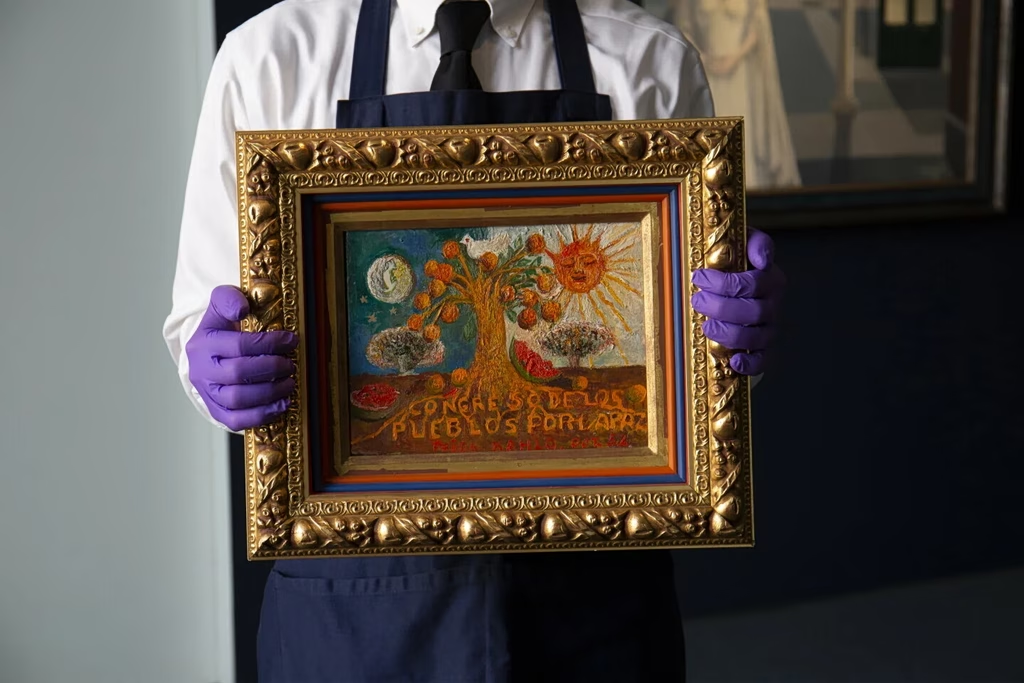
The work, “Congreso de los pueblos por la paz” (“Congress of the Peoples for Peace”), was estimated at $2 million to $3.5 million. It was due to be sold by Christie’s in New York on November 17. But an official protest from Mexico, and the authorities’ demand for full documentation of where the painting came from, led to its withdrawal at the last minute.
The case could be seen as just another episode in the unusual rivalry between collectors, galleries and major auction houses. The painting’s story, however, runs deeper. It touches on the last years of Kahlo’s life, the political commitment of her art, the history of the famous Casa Azul and, finally, the thorny question of who owns works that are an inseparable part of a country’s cultural memory.
A Painting For Peace In The Shadow Of The Cold War
In October 1952, Frida Kahlo painted “Congreso de los pueblos por la paz.” The work was linked to the international congress of the same name held in Vienna that December. Hundreds of delegates from the arts, science, medicine and law gathered in the Austrian capital, at a time when postwar Europe still lived under the weight of ideological conflict and the nuclear threat.
The congress had a clear anti-war focus and condemned the Korean War and the use of weapons of mass destruction. Kahlo, who had embraced communism from a young age, approached the subject not as an abstract allegory but as a political statement.
In her diary in the fall of 1952, she wrote: “For the first time in my life, my painting serves the line set by the party. Revolutionary realism.” In another entry, on November 4, she restated her long-held political position: “I have been a communist for 25 years.”
View this post on Instagram
The painting’s imagery sums up this intention. A white dove, the symbol of peace, sits in the branches of a large tree, while the sun and the moon frame the composition. The title of the congress is written at the roots of the tree. The fruit growing from its branches suggests hope for a peaceful flourishing of peoples, at a time when humanity was still dealing with the aftermath of World War II.
Art historian Raquel Tibol recorded that the painting was sent to Vienna by Kahlo’s husband, Diego Rivera, and his daughter, the architect Ruth Rivera Marín. Kahlo herself did not travel to Europe. By then her health had been permanently damaged. Pain often confined her to bed, and her daily life depended on constant medical care. She would die in Mexico City in 1954, at just 47.
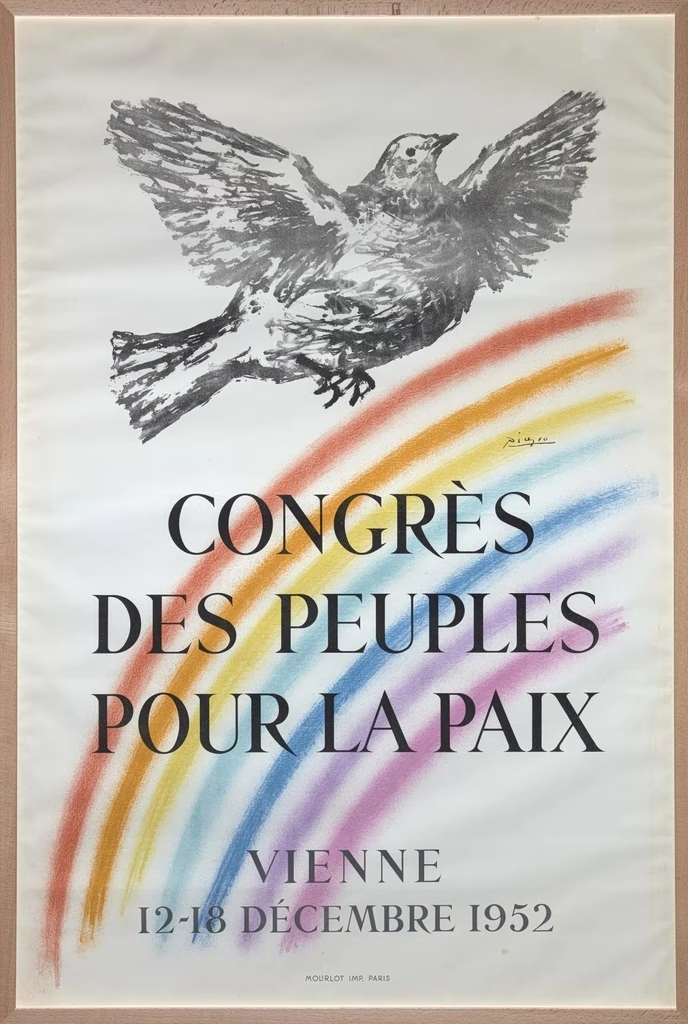
The poster for the Vienna International Congress, designed by Picasso / Museo Nacional Centro de Arte Reina Sofía
The Painting’s Mysterious Journey From Casa Azul To New York
What makes the case so complicated is not the painting’s first departure from Mexico, but what happened afterward. Contrary to the initial impression that the work left the country for good in 1952, the available evidence suggests it returned home a year later.
According to documentation cited by Christie’s, “Congreso de los pueblos por la paz” was shown at Kahlo’s first and only solo exhibition held during her lifetime, in April 1953, at the Galería de Arte Contemporáneo in Mexico City. The show was organized by Kahlo’s friend, the photographer Lola Álvarez Bravo, and it was one of the most moving events of her final years. Unable to move normally, Kahlo arrived by ambulance and attended the opening lying in a four-poster bed, wearing traditional Tehuana dress.
The painting’s presence at the 1953 exhibition is confirmed by Christie’s and Sotheby’s catalogs. Another reference is even more important, however. The collective “Defendamos la Colección Gelman” says the work appears in the inventory Rivera drew up in 1957, when the trust for Casa Azul was created. Casa Azul was Kahlo’s home and now operates as a museum.
The painter Pedro Diego Alvarado, Rivera’s grandson, also confirmed this to the Spanish newspaper El País. He places the painting in Kahlo’s studio and among the assets of Casa Azul.
The collective says the work was removed from the house under unclear circumstances and ended up with a gallery owner in New York. From there, its path becomes easier to trace, but it still has large gaps.
In 1997, the painting appeared in the exhibition “Tarsila, Frida, Amelia,” organized by the La Caixa Foundation in Madrid and Barcelona. It was then included in an exhibition on Frida Kahlo and the women of surrealism in Mexico, which toured museums in Japan from 2003 to 2004. After that, it disappears from public view again for several years.
In June 2020, the painting came up at a Sotheby’s auction, consigned by Galeria Ramis Barquet in New York. It sold for about $600,000 to a private collector.
Six years later, the same painting was set to return to the auction room, this time with an estimate of up to $3.5 million. The rise in its value was striking. Its ownership history, however, proved far less tidy.
The 1984 Decree And Mexico’s Claim
The legal side of the case rests on a 1984 decree in which Mexico declared Frida Kahlo’s entire body of work an artistic monument. The law bans the permanent export of her works that were in the country when it was published, and sets strict conditions for taking them abroad temporarily.
That timing condition is crucial. At first, Mexico’s National Institute of Fine Arts and Literature (INBAL) noted that the painting had left the country more than three decades before the decree was issued. In other words, if its departure in 1952 was permanent, the ban would not automatically apply.
View this post on Instagram
However, its return to Mexico City in 1953 for Kahlo’s exhibition changes things. If it can be shown that the painting stayed in the country and was included in the 1957 Casa Azul inventory, the question becomes whether it was protected by the 1984 law. The key issue is no longer just when it crossed the border, but where it was when the decree took effect, and under what ownership.
On November 16, the Frida Kahlo Museum announced that the work was under investigation by the relevant authorities. INBAL asked Christie’s for full documentation of the painting’s provenance and for the auction to be postponed until the matter was clarified.
Christie’s confirmed to the Associated Press that it had decided, together with the seller, to withdraw the work for further research. It also said it intends to offer the painting for sale at a later date.
The wording matters. This is not a final cancellation of the sale, nor a court ruling that recognizes an illegal export. It is a pending claim that highlights the gap between a work’s commercial life and its historical, and sometimes public, significance.
When Art Is Valued In Millions
The timing makes the case even more striking. Frida Kahlo never enjoyed the commercial success in her lifetime that would follow her death. Today she is one of the most sought-after artists on the international market. In 2025, her 1940 self-portrait “El sueño (La cama)” sold for $54.7 million, a new record for a work by a woman artist.
View this post on Instagram
Her commercial value, however, cannot be separated from her cultural and symbolic importance. Kahlo has long since gone beyond the narrow bounds of art history. Her face, her autobiographical imagery, her political identity and the constant posthumous attention to her work have made her one of the most recognizable symbols of the 20th century.
In the art market, a work’s provenance is an essential part of its identity. It records the successive sales, the collections it passed through and the circumstances under which each owner acquired it. When a work has particular national and historical importance, this documentation carries even more weight.
The case of “Congreso de los pueblos por la paz” brings to light a contradiction the international art market faces more and more often: private ownership does not automatically free an object from its historical weight. A painting can change hands, travel from continent to continent and multiply in market value. Its journey, however, still ties it to the people, places and circumstances that created it.
For now, Kahlo’s painting remains off the auction block. Its story, however, has already found a place in a much wider debate. That debate is where art stops being purely an object of collectors’ desire and becomes a matter of historical memory, legal claims and cultural sovereignty.