 Μake us preferred on Google
Ties have never been better, Greece’s finance minister, Kyriakos Pierrakakis, said. Andreas Kindl, Germany’s popular ambassador in Athens, went so far as to call the relationship “fantastic” at an official event. You might think the wounds of the past had healed. One reason they remain in the public consciousness is Germany’s Erinnerungskultur, its culture of remembrance. Through a series of state-funded initiatives, Germany keeps alive the memory of the crimes the Wehrmacht committed during World War II.
Where the relationship stands today and where it might go were the questions at the German-Greek Economic Talks, hosted by the German-Hellenic Business Association (DHW) at the Goethe-Institute in Athens. Ambassador Kindl called the one-day conference “an important fixture on the German-Greek calendar.” Political and business experts discussed security and defense procurement, new supply chains, energy supplies, environmental protection and food technology. “Germany and Greece have complementary strengths, and we want to help raise the relationship to a new level,” said Phedon Codjambopoulo, the association’s president. He had traveled from Germany with a large group of German-Greek business people.
The opening panel took up Europe’s security and asked whether Germany and Greece were working toward the same goals. On one of the most urgent issues in world affairs, Russia’s war of aggression against Ukraine, Athens and Berlin stand together. Prime Minister Kyriakos Mitsotakis represented Greece at the meeting of the “coalition of the willing” in Berlin. The war in Ukraine is Germany’s overriding security priority. On the panel at the Goethe-Institute, it soon became clear how differently the two countries assess the threats they face. “We don’t see the threats in the same way,” said Michalis Katrinis, the opposition party PASOK’s spokesman on security policy. He argued that Russia’s aggression against Ukraine should be put on the same footing as Turkey’s occupation of Cyprus and Ankara’s continuing threats to overturn the regional status quo.
Athens keeps a close watch on the arms deals its allies make with Turkey. Such deals can quickly cause diplomatic friction. This issue has long strained also Greece’s relations with Germany and now reaches into European defense procurement policy. Berlin supports Turkish participation in SAFE, the European Union program that provides billions in loans for joint defense purchases. Athens firmly opposes Turkish participation as long as Ankara continues to threaten war in the Aegean. “If we see Europe as a community of shared values, we cannot admit a country that threatens another partner country,” said Evripidis Stylianidis, a lawmaker from the governing New Democracy party and chairman of the Greek-German Parliamentary Friendship Group in Athens. Thomas Rachel, a Christian Democratic lawmaker, put it more cautiously, though his position was close to that of Stylianidis. Rachel chairs the German-Greek Parliamentary Group in the Bundestag and is one of the few avowed philhellenes in the German parliament. “We expect all NATO members to treat one another with respect and in accordance with international law,” he said. “We have to insist on respect for international law, and that of course applies to Turkey as well.”
Arms deals are one measure of how closely the two countries actually work together on security. Germany has fallen well behind the United States, France and, above all, Israel. Lately, cooperation has begun to pick up again. Last May, the two countries’ foreign ministers agreed on a “partnership for strategic cooperation.” Its stated aim is to “strengthen our ability to respond to conventional and hybrid threats and expand our efforts in defense procurement.”
German diplomats in Athens complain privately about how hard it is for German suppliers to win contracts in Greece. Dimitrios Skalkos, secretary general for international economic relations at the Greek Foreign Ministry, turned the tables at the conference. “Ninety percent of the German armed forces’ contracts go to the German defense industry,” he said, calling for “deeper integration of the European single market.” Among the projects he cited were upgrades to Greece’s aging tank fleet and its German-built submarines. Meanwhile, international competition to supply new submarines to the Greek Navy is fierce, and Germany is among the front-runners. Rachel, the German parliamentarian, hinted at that. “We want to deepen our cooperation, particularly in the maritime domain,” he said.
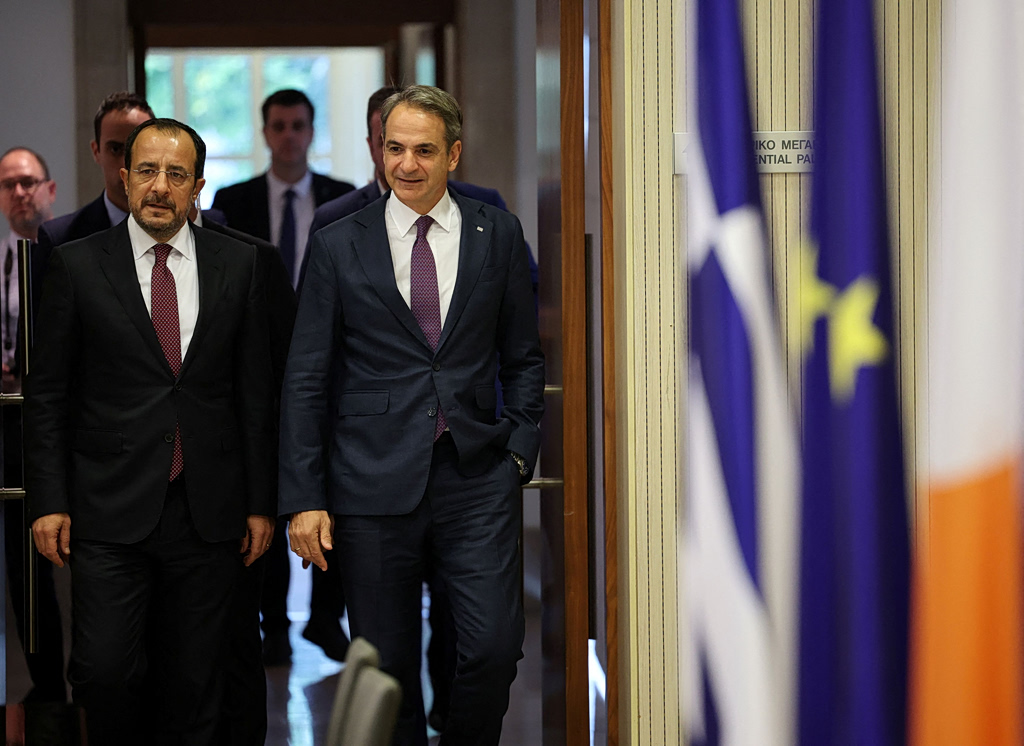
German diplomats in Athens speak of a possible “turning point” in relations if the submarine deal goes through. Whether it does will depend in part on the two countries’ defense ministers. Nikos Dendias and Boris Pistorius met recently on Crete on the sidelines of an allied live-fire exercise. Pistorius reportedly expressed interest in returning to Greece next spring. It takes no prophet to predict what they would talk about then. New submarines and, above all, a lot of money for military hardware.
Dr. Ronald Meinardus is a Senior Research Fellow at the Hellenic Foundation for European and Foreign Policy (ELIAMEP).