 Μake us preferred on Google
In November 1974, the first parliamentary elections after the fall of the junta brought to power the first government of the newly founded New Democracy party.
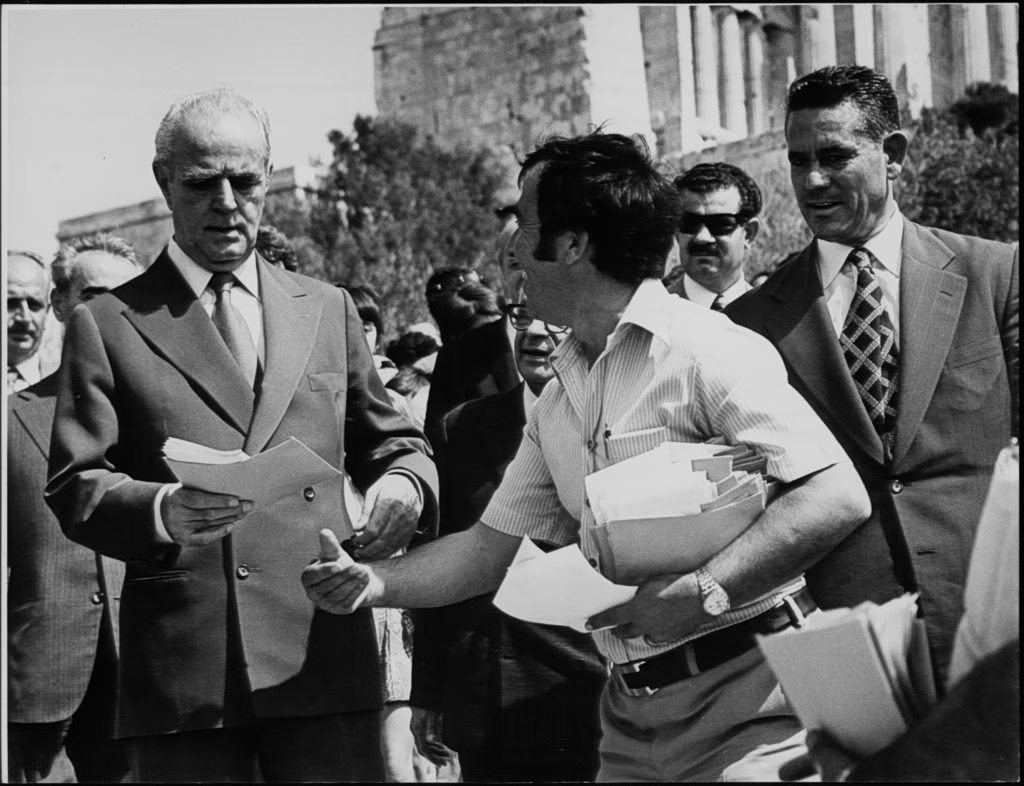
The new government was led by Prime Minister Konstantinos Karamanlis. After the collapse of the junta in late July, he had also headed the government of National Unity. The new government was sworn in on November 21.
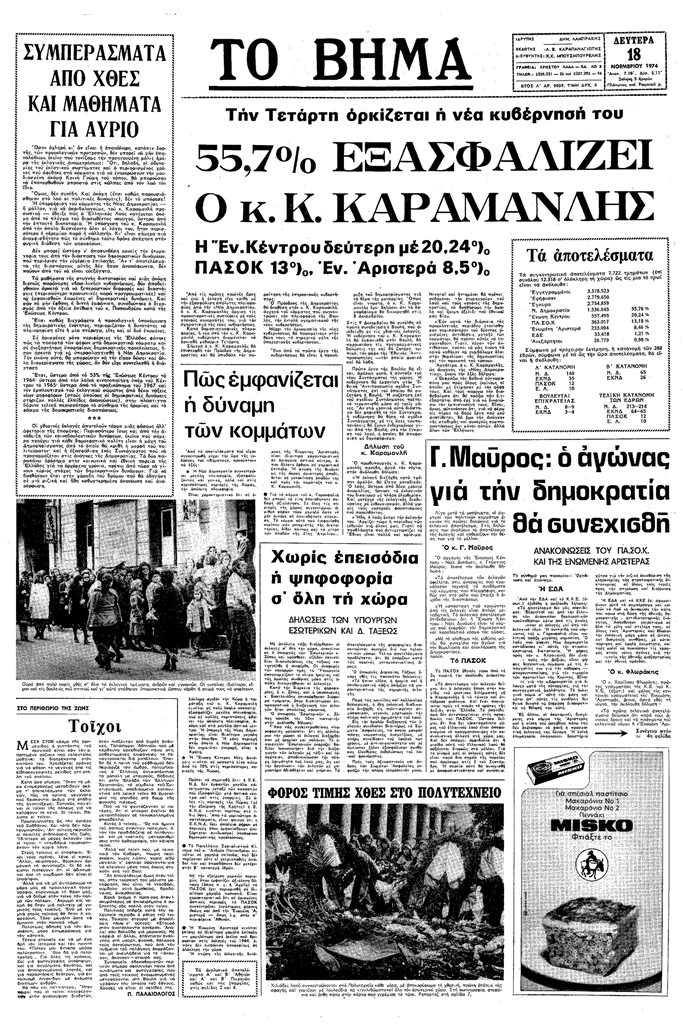
“ΤΟ ΒΗΜΑ,” November 18, 1974, ΤΟ ΒΗΜΑ Historical Archive | “TA NEA”
On November 16, 1974, ΤΟ ΒΗΜΑ wrote:
“In normal times, a citizen who exercises the right to vote aims to serve their ideological views, the interests of the class to which they belong, or at least their personal goals. They may also hope that the party they support will effectively solve problems that previous parliaments created or left unsolved.
“In the rare cases where the newly elected Parliament is declared a revisionary one, the vote carries many times more weight. Through it, the voter grants the new government the right to decide how the state will function in the future.
“In the even rarer cases where the country is emerging from an ordeal, such as an occupation or a dictatorship, that has uprooted institutions and called traditional values into question, citizens’ votes carry an added power of renewal.
“And when the elections coincide, just weeks apart, with a referendum that will decide the form of the state, it can be said that the people will truly exercise sovereign rights.
“Tomorrow’s elections belong to this last and rare kind, which leaves almost every choice in our hands. Because of their unique nature, they cannot be compared with any other election of the past 20 years.”
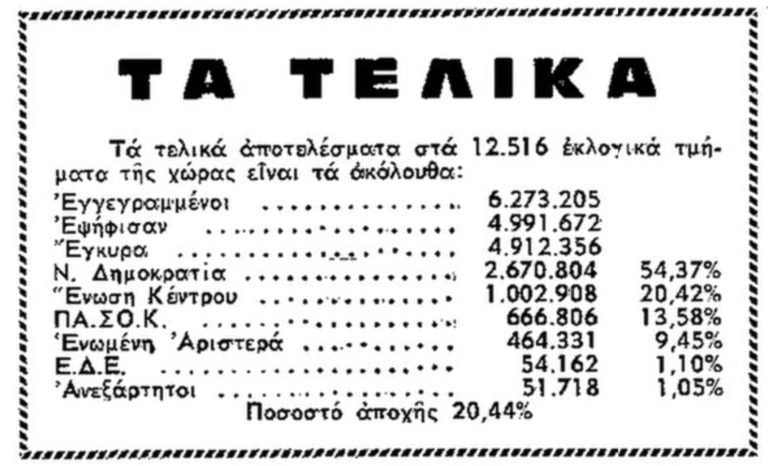
The big winners of the elections were Konstantinos Karamanlis and New Democracy, with 54.37% of the vote, which gave them 220 seats.
“ΤΟ ΒΗΜΑ,” November 21, 1974, ΤΟ ΒΗΜΑ Historical Archive | “TA NEA”
On November 22, 1974, ΤΟ ΒΗΜΑ wrote:
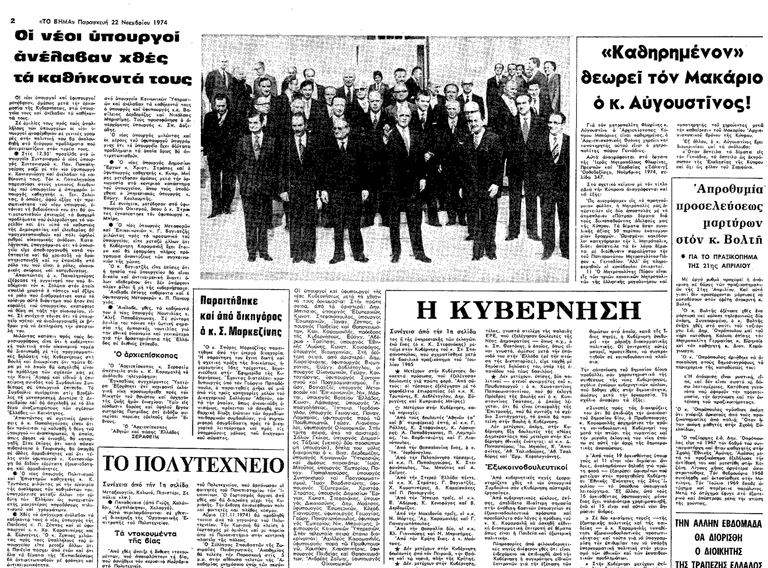
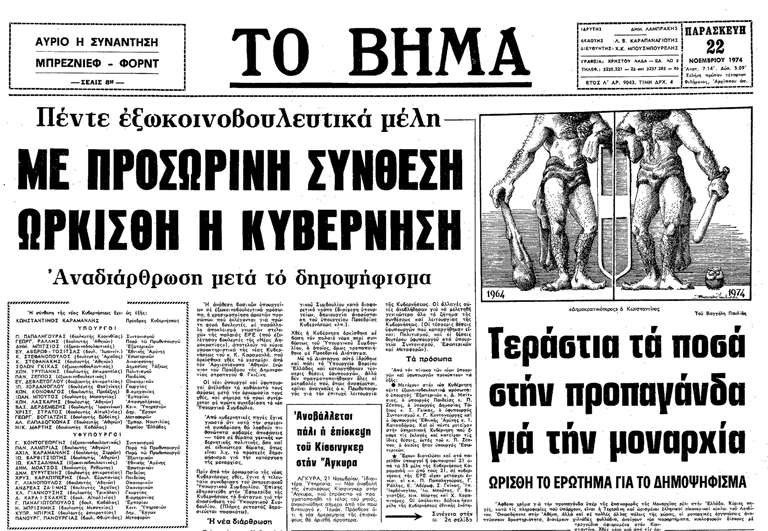
“The main features of Mr. K. Karamanlis’s new government are the assignment of key ministries to people from outside parliament, and the use of several people elected as MPs for the first time. At the same time, well-known figures of the old National Radical Union (ERE), who were elected as New Democracy MPs, were left out. The government was sworn in yesterday at noon by the Archbishop of Athens, in the presence of the President of the Republic, General Ph. Gizikis.
“The new ministers and deputy ministers took up their duties immediately after being sworn in yesterday, and the new Cabinet holds its first meeting this morning.
“Government sources said that serious decisions will most likely be taken at today’s meeting, both on matters of general government policy and on more specific issues, such as the upcoming referendum on abolishing the monarchy.
“Before the new government was sworn in yesterday, the caretaker Cabinet held its last meeting. The decree reorganizing the Cabinet was also published in the Government Gazette.”
“ΤΟ ΒΗΜΑ,” November 22, 1974, ΤΟ ΒΗΜΑ Historical Archive | “TA NEA”
The New Structure
“It should be noted that pro-government circles consider the makeup of the government temporary, and a reshuffle is expected in the not-too-distant future. This information fits with yesterday’s government announcement, according to which ‘a possible restructuring of the Cabinet will be combined with the overhaul of the various ministries’ organizational charts, which will of course require relevant study.’
“As is known, Mr. K. Karamanlis intends to structure the Cabinet differently, for example by splitting ministries and creating a Ministry to the Prime Minister’s Office.
“Yesterday, the government was sworn in under the old law on the composition of the Cabinet, which, however, was amended by Presidential Decree.”
“ΤΟ ΒΗΜΑ,” November 22 1974, ΤΟ ΒΗΜΑ Historical Archive | “TA NEA”
The Farewell Of The National Unity Government
What was said when the Cabinet of the National Unity government resigned, so that the newly elected government could take office, is of particular interest.
ΤΟ ΒΗΜΑ wrote:
“The Cabinet of the caretaker government met yesterday at 11 a.m., chaired by Mr. Karamanlis, for its last session. During the meeting, all members of the government submitted their resignations to the Prime Minister. They wished him success in the very heavy task he would take on as head of the new government.
“Mr. Karamanlis thanked the members of the caretaker government for the services they had offered to the country, and also to him personally, in fulfilling his mission.
“‘This government,’ Mr. Karamanlis stressed, ‘conducted the first elections after the tyranny not only flawlessly, but in a way that sets an example for the future.
“‘It was not satisfied with restoring formal legality. It gave real and complete legality, and real and complete freedom, to the expression of the people’s will.
“‘Despite the difficulties the past had naturally piled up, this government dealt with all the problems related to its special mission in a spirit of impartiality. And it did everything possible so that the Greek people could reach their verdict free even of the most indirect psychological influences.
“‘You can be proud,’ Mr. Karamanlis emphasized, ‘of the work that each of you, and all of you together as a government, have accomplished. At a critical moment in history, you helped secure the supreme right of the Greek citizen: to vote freely, peacefully and according to their conscience.
“‘In this, however,’ Mr. Karamanlis continued, ‘you had a valuable helper: the people themselves. Their political maturity gave you the basis for your great success. After the overthrow of the tyranny, it was possible, and there was indeed a danger, that outbursts of joy or anger and unrest would break out. The Greek people showed enthusiasm, but without the old and unhealthy fanaticism.
“‘It is precisely this political maturity of our people, which the tyrants always denied, that should make us optimistic about the future. Because, as I have already stressed, the problems our country faces are great and hard to solve.
“‘Only by uniting all our forces as a nation, and by being aware of our responsibilities, can we face and solve them, so that better and safer days may come to this land.
“‘The anonymous people,’ Mr. Karamanlis concluded, ‘have shown this sensitivity. If the prominent follow their shining example, our optimism, on the day after the people’s verdict, will prove fully justified.’
“Ministers Xenophon Zolotas, Panagiotis Zeppos and Dimitrios Vlachos responded to Mr. Karamanlis.”