 Μake us preferred on Google
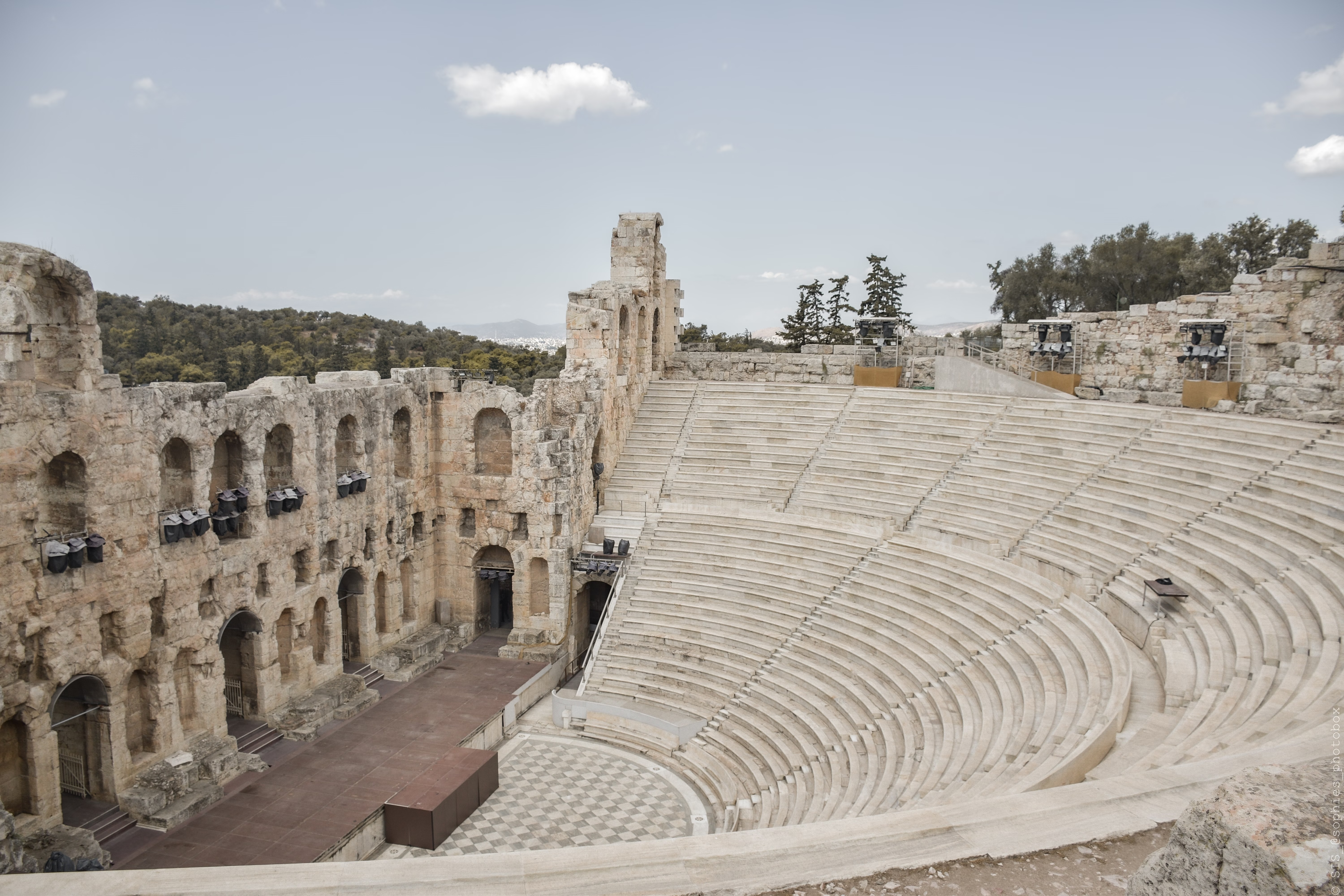
 The Athens Festival launched in triumphant fashion at the Odeon of Herodes Atticus (commonly known as the Herodeion), the ancient stone amphitheater beneath the Acropolis, on August 24, 1955, running until October 2 of the same year. It hosted a total of 12 productions by the National Theatre of Greece, the Greek National Opera, the State Orchestra of Athens, and even the New York Philharmonic Orchestra. The festival’s first “coordinator” or, in today’s terms, artistic director, was Dinos Giannopoulos, the distinguished Greek stage director of New York’s Metropolitan Opera. The inaugural program featured world-renowned Greek conductors Dimitris Mitropoulos and Filoktitis Economidis, celebrated theatre director Alexis Minotis, and legendary tragedienne Katina Paxinou.
The Expansion of the Athens Festival
Over the decades, the Athens Festival expanded significantly with the addition of venues at the Piraeus 260 complex, and correspondingly, the number of performances held at the Herodeion increased.
As Eva Georgousopoulou (Archives and Publications Department, Athens Epidaurus Festival) explains, “In the summer of 2025, six performances were presented at the Herodeion in June and 11 in July as part of the Festival, while from September to October the venue was granted by the Ministry of Culture, outside the Festival framework, for another 41 performances. In total, 58 performances were hosted at the Herodeion last year.”
Maria Panagiotopoulou, Director of Communications at the Athens Epidaurus Festival, clarifies that the Festival uses the Herodeion “from early June until the end of July. Decisions regarding performances after this period are made by the Ministry of Culture, while the Festival participates in an executive and organizational capacity, providing ushers, stage organization, and technical support.”
From Calvin Klein to Gala Events
In November 2008, in his landmark essay published in To Vima, titled “What Is the Fox Doing in the Marketplace?”, sociology professor emeritus at the London School of Economics, Nikos Mouzelis, raised the enduring issue of the “colonization of the cultural by the commercial,” prompted by a 1998 request from fashion designer Calvin Klein’s company to use the Herodeion for a runway show. Greece’s Central Archaeological Council (KAS) initially approved the request despite widespread backlash, though Klein ultimately canceled the event.
Before and after Calvin Klein, the Herodeion has been periodically granted by the Ministry of Culture for events of questionable artistic value, as well as for philanthropic and high-society galas. Critics argue that organizers are effectively able to “purchase” the cultural prestige and symbolic capital of this iconic ancient monument.
“We Must Reflect on What It Really Is”
We posed this issue to Michail Marmarinos, artistic director of the Athens Epidaurus Festival, asking how he felt about controversial non-festival events held at the Herodeion with KAS approval.
“Extremely uncomfortable,” he said. “We all need to think about what the Herodeion actually is. Is it a space we rent out for weddings, baptisms, concerts, and anything else one can imagine? I support diversity and the idea that a cultural monument should be democratically accessible to many types of audiences, but it requires serious, curated selection—which clearly was not happening as it should. It was handled by ministries and ‘people with connections.’ If we continue like this, the Herodeion risks losing its added cultural value. That is why, when I learned it would be closed for several years, I said: finally, a necessary pause that will benefit the monument and its legacy, allowing reflection on new terms of management.”
Asked how urgent the closure is, Marmarinos stressed that “the monument has reached its limits in every respect. So yes, the planned conservation works are absolutely necessary. These are not superficial fixes, but a redefinition of the monument within its wider archaeological environment.”
The Herodeion is a key revenue source for the Festival, with a capacity of around 5,000 seats, making its closure financially significant. “Of course,” he added, “but the scheduled works must be done. It is in no one’s interest to delay restoration. We hope it will take around three years.”
The Ministry of Culture fully supports the intervention. Minister Lina Mendoni has stated that the Herodeion is “a major cultural asset for the city of Athens, of great historical significance and supra-local value. These characteristics guide the framework of every modern intervention. The proposed works are aligned with internationally recognized principles of monument protection as well as the contemporary use of a performance and cultural venue.”
The Works and the Road Ahead
Academician and project advisor Manolis Korres also supports the restoration, noting that once completed, the monument and its surrounding archaeological site will be fully enhanced, offering visitors a completely new experience. He also pointed out that the Herodeion will become accessible even outside Festival events, as until now the public could only enter its interior during performances.
As for the total cost of the project, Korres offered an initial estimate of around €5 million, though he suggested that, given the scope of the works, additional funding will likely be required.
Speaking to To Vima, academic and KAS member Michalis Tiverios cited causes of deterioration at the site, including “chewing gum that people still stick under the marble seats of the Herodeion, as well as the destructive high heels worn by women—though recently this has somewhat decreased. You see, people come to walk the runway at the Herodeion without realizing the significant damage they cause to the monument.”