 Μake us preferred on Google
 The perception of cultural heritage protection has changed radically in recent decades, as historic buildings are no longer treated as sterile exhibits. Since the 1972 UNESCO Paris Convention, cultural heritage management has defined landscapes and buildings as an ongoing, open “process.” When institutions “freeze” a monument by excluding citizens, they alienate it. By contrast, the modern trend demands the organic reuse of spaces, with the most emblematic global example being the glass pyramid of the Louvre, which proved that bold architectural intervention can modernize a site’s functionality without cannibalizing its historical identity. In the everyday life of the city, monuments function as meeting points and spaces where collective memory is negotiated.
On the question of where the line is drawn between this healthy social reuse and violent distortion, Professor of Architecture Panagiotis Tournikiotis makes a clear institutional distinction:
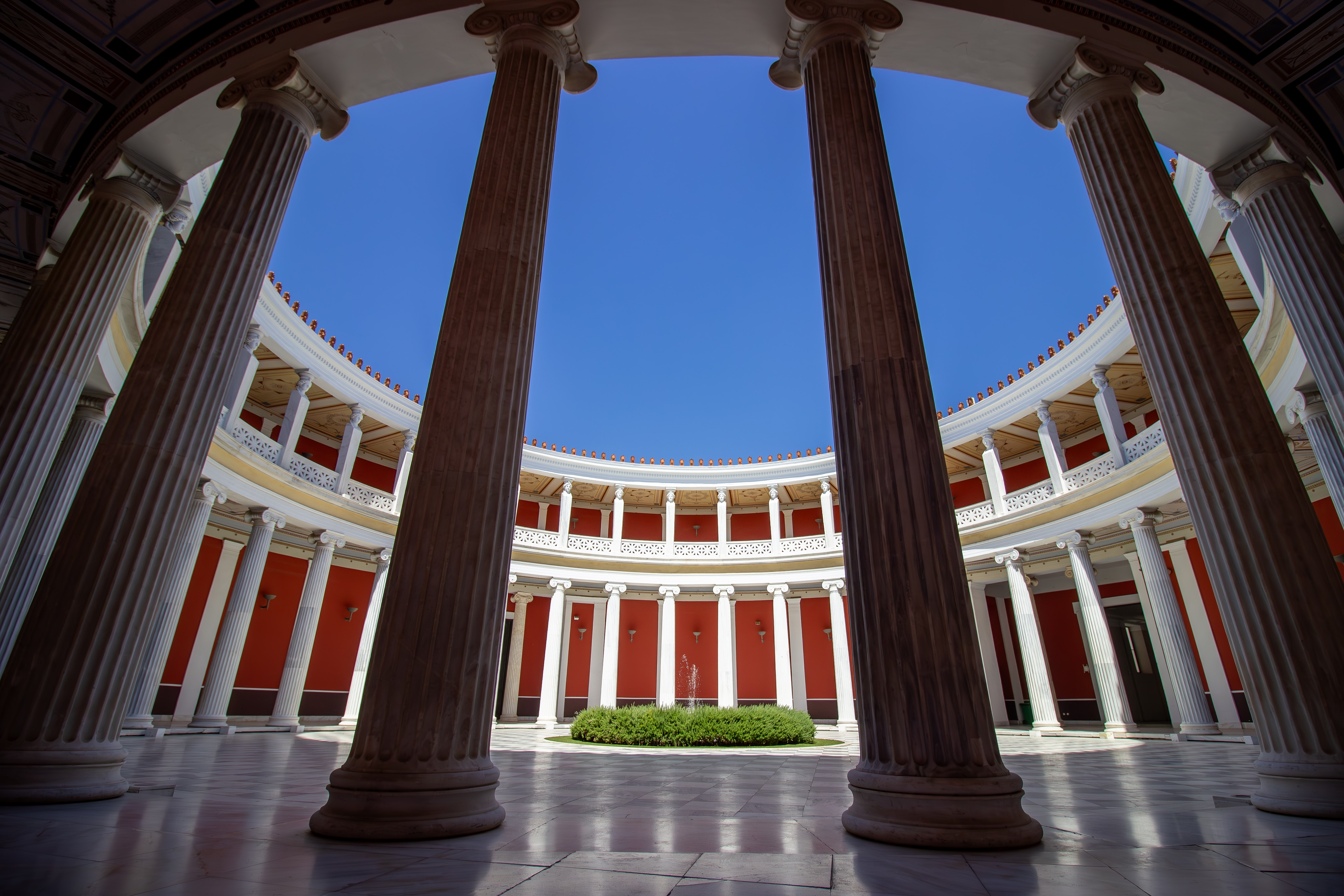
“Monuments are buildings divided into at least two categories. One category is established monuments that belong to History and ‘present themselves.’ The Acropolis is such a monument, which can undergo restorations, reconstructions, improvements, but in the end it always presents itself. That carries a sense of sacredness. On the other hand, there are monuments characterized as works of art whose function remains active. These are buildings constructed mainly in the last 200 years, after Greece’s independence, such as the Zappeion, along with its gardens and Ardittos Hill. We continue to use this monumental complex according to the terms of its endowment, as an exhibition space that showcases the arts, commerce, industry, and the country itself.”
The Zappeion Megaron, completed in 1888 to the designs of Danish architect Theophil Hansen, is the first building in the world constructed exclusively for Olympic purposes, thanks to the bequest of Evangelos Zappas. Until its recent suspension of operations, the Megaron was an extremely active hub, hosting more than 180 events annually during 2025–2026, ranging from political debates and international conferences such as The Hellenic Initiative, to major exhibitions like “Oenorama” and “Art Athina.”
The Chronology of a Fiasco
This balance was recently violently disrupted with the sudden cancellation of the “Olympia Festival.” The Zappeion administration erected in the square a heavy metal platform of over 1,000 seats, which completely obscured the historic façade. The construction was carried out without the opinion of the Central Council for Modern Monuments (KSMN). When the controversy erupted and dismantling of the platform began 24 hours before the premiere, the Committee issued a brief statement in which it did not admit to the institutional misstep, but vaguely cited “technical reasons concerning the site.” The sole organizer was the Committee, while the Municipality of Athens clarified that it had no involvement. The production cost, assigned through direct award, amounted to €21,150 plus VAT, while production companies are urgently relocating performances to other theaters in Attica.
Regarding this installation, Mr. Tournikiotis states:
“The design could have been acceptable if it had gone through full planning and approvals. If there is no structured study, then we have a problem. Submitting a proposal does not automatically mean approval. We recall cases where proposals were not approved, such as with Lanthimos at the Acropolis. In any case, if the design had come to me, I would say that such a heavy installation is not necessary there, and I have doubts whether it would highlight the space. Athens has countless venues for events. There is no need to create temporary, large-scale structures in such sensitive places. I believe it was a wrong move.”
What Constitutes “Damage”?
The professor emphasizes the importance of respecting the visual identity of buildings:
“We can make interventions and host events, but always with respect for the overall identity of the buildings. ‘Damage’ to a monument is not only material. It is also ideological, symbolic. Even its temporary concealment can be considered damage. That is why the way events are organized is extremely important. We want both events and cultural goods. There must be balance.”
He also notes that the trend toward strict protection is a common European policy, but one that still allows boldness:
“We can create within creation, but with respect for the past and with modern adaptation to needs. The goal is to preserve the image and identity of the monument, but to improve its ‘internal’ functions.”
This need for internal modernization is the official reason for the suspension of all events at the Zappeion until March 2028. It concerns a radical technical upgrade with a budget of €29 million, so that the building can operate as the operational center for the Greek Presidency of the EU in the second half of 2027. The renovation, however, is accompanied by intense institutional controversy, as the Zappeion Committee was recently transformed into a Legal Entity under Private Law (NEPL). The regulation triggered strong reactions over alleged privatization planning, while scrutiny has focused on the fivefold increase in the new administration’s payroll at a time when endowment reserves are declining. Critics argue that the Committee treats a historic monument as a makeshift “showcase” for ephemeral, noisy events, undermining the capital.
The Unauthorized Parking Lot
At the same time that its institutional safeguarding is being debated, one of the most provocative everyday issues remains the transformation of the historic garden into an informal, unauthorized parking area. In reality, there is no official permit for a public parking operation, and the presence of vehicles is de facto illegal.
This situation is linked to a broader trend of commercialization, as the Zappeion is systematically used as a “backdrop” for companies with a high economic footprint. Large multinational corporations consistently choose the Megaron for conferences and receptions, during which large sections of the garden are fenced off. Characteristic examples of this management approach include the 2025 Acropolis Rally, where 70 racing cars passed next to the historic “Discobolus,” requiring heavy constructions, as well as a promotional campaign by a sportswear company, which launched drones to project a massive shoe hologram against the backdrop of the Acropolis.