Ancient Nicopolis, a site of exceptional historical, archaeological and cultural significance, has been returned to the local community following the completion of major protection, restoration, conservation and enhancement projects by Greece’s Ministry of Culture.
The completion of the projects marks another step toward protecting and showcasing one of the most important archaeological complexes in the Epirus region of northwestern Greece.
A central objective of the ministry’s broader strategy is to prepare Nicopolis for inclusion on the UNESCO World Heritage List. The ministry has already submitted a preliminary dossier for evaluation, beginning the international organization’s required process.
President Konstantinos Tasoulas and Culture Minister Lina Mendoni at the inauguration of restoration works at Ancient Nicopolis on Monday, September 28, 2026 (Giorgos Efstathiou/Eurokinissi)
Culture Minister Lina Mendoni described Nicopolis as a monument complex of exceptional importance that documents the transition from the Hellenistic world to the Roman Empire and, later, to the Christian era.
“The surviving Roman and early Christian monuments, together with the exceptionally preserved natural landscape, constitute a heritage of international significance,” Mendoni said.
Restoration supports UNESCO candidacy
The ministry has implemented a coordinated program for the protection, restoration and enhancement of Nicopolis in recent years, using funding from Greece’s Recovery and Resilience Facility and the European Regional Development Fund (ESPA).
It is also planning measures to protect the archaeological site from the effects of climate change, in cooperation with other ministries, research centers and universities.
Mendoni said these interventions are strengthening the basis of Nicopolis’ UNESCO candidacy.
“The preparation of the dossier has already begun and the preliminary dossier has been submitted, marking the start of a demanding and lengthy process,” she said.
She noted that during the seven years of Prime Minister Kyriakos Mitsotakis’ government, Greece submitted three UNESCO candidacies — the Zagori cultural landscape, the Minoan Palace Centers of Crete and Mount Olympus — the maximum number permitted, according to her statement, and all three were inscribed on the World Heritage List.
“We are working with the same dedication for Nicopolis,” Mendoni said, describing its UNESCO inclusion as a national objective requiring unity, cooperation and an effort to rise above individual or political interests.
She also warned that attempts to claim early “ownership” of a candidacy could create problems in a process requiring unity and a shared effort.
“The inclusion of Nicopolis on the UNESCO World Heritage List is a goal of national importance,” she said. “With cooperation, consistency and dedication, we are all working so that this unique heritage can receive the international recognition it deserves.”
Road diversion restores archaeological site’s unity
A major factor in the UNESCO candidacy has been the construction of a road bypass around the archaeological site.
The project removed the passage of the national highway through Nicopolis, restoring the unity and integrity of the archaeological area.
President Konstantinos Tasoulas and Culture Minister Lina Mendoni at the inauguration of restoration works at Ancient Nicopolis on Monday, September 28, 2026 (Giorgos Efstathiou/Eurokinissi)
The project was planned, funded and implemented by the Region of Epirus and represents a significant investment in protecting and showcasing the site.
Mendoni thanked the Region of Epirus and Regional Governor Alexandros Kachrimanis, the Ephorate of Antiquities of Preveza, the Municipality of Preveza and everyone involved in the restoration and promotion of Nicopolis.
Great Theater of Nicopolis
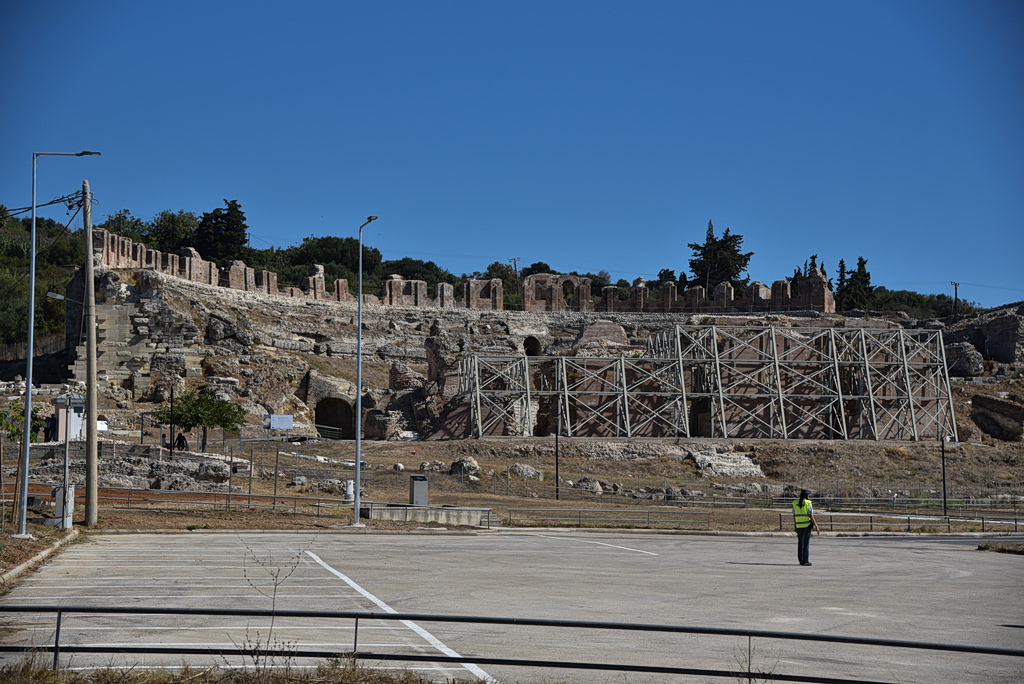
One of the major projects was the second phase of the Protection, Conservation and Restoration of the Great Theater of Nicopolis, with a budget of €3.377 million.
The project was funded through the 2014–2020 ESPA program for the Epirus region.
The work included removing accumulated soil deposits, restoring the infrastructure of the lower seating area and masonry, and restoring retaining walls. Temporary metal supports were also installed on the stage building to protect the monument.
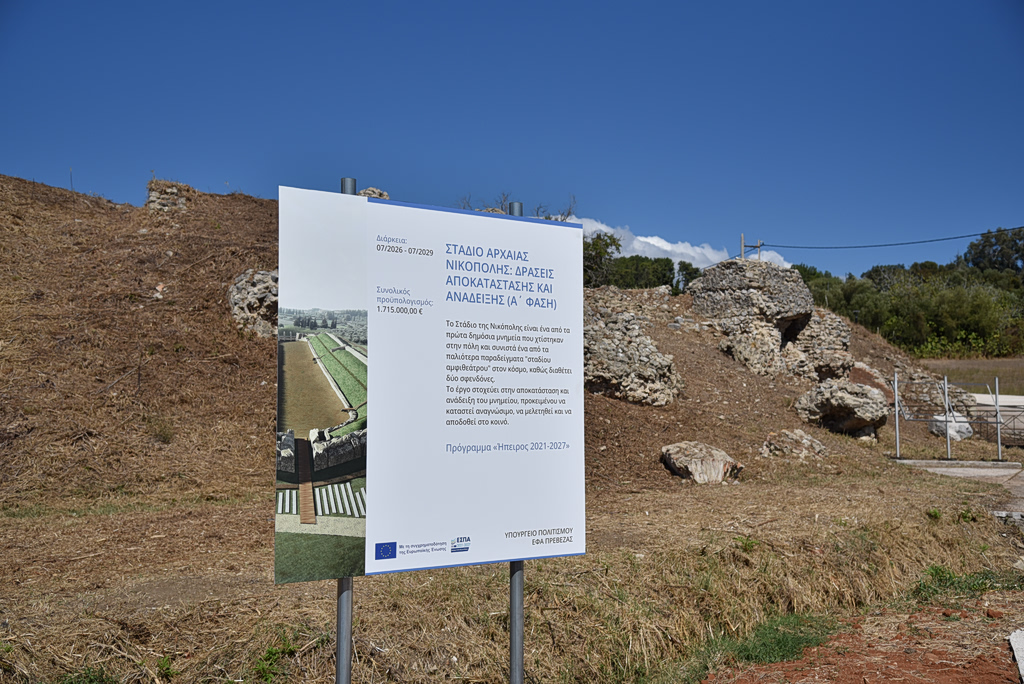
The next stage of the project was secured on April 8, 2026, when the third phase was included in the 2021–2027 ESPA program, with a budget of €3.5 million.
The next phase includes restoration of the stage building and backstage areas, restoration of the orchestra and completion of the seating, accessibility infrastructure for people with disabilities, a drainage system, and completion of archaeological excavation, conservation and documentation work.
The theater forms part of Nicopolis’ Augustan building program and underwent extensive renovation in the second century A.D. It could accommodate approximately 8,000 spectators.
Palace complex reveals 36 new rooms
The project for the overall enhancement of the Palace complex, known as the House of the Ekdikos Georgios, was funded by Greece’s Recovery and Resilience Facility with a budget of €503,452.02.
During the work, archaeologists uncovered 36 new spaces and rooms, restored sections of masonry and reconstructed two columns.
The project also included conservation of Nicopolis’ only surviving wall mosaic, located at the Small Nymphaeum.
The approximately 10-acre complex occupies an entire city block of the Roman city. It is a large Roman residence built across different levels and underwent successive phases of repair from the first through the seventh century A.D.
Early Christian mosaics restored
A separate project focused on the conservation and enhancement of the mosaics of Basilica A of Bishop Dometius and Basilica D.
The project had a budget of €550,000 and was funded through the Recovery and Resilience Facility. An accessible route was also created around Basilica D.
Basilica A is one of Nicopolis’ most important early Christian monuments. Its mosaics are of high artistic quality and feature plant and animal motifs, hunting scenes and marine subjects.
Inscriptions associated with Bishop Dometius provide important information about the history and function of the church.
The ceremony concluded with a performance by the internationally award-winning Armonia Children’s Choir of Preveza, conducted by Anelia Stefanova.