The scene is well known, so let’s recall it: a minor king somewhere deep in the East gives instructions to the engraver of his coins. The diadem should look Greek, the inscription must be in Greek and, for God’s sake, the word “Philhellene” must not be left out. Because every now and then some sophists come over from Syria, and he does not want to become a “laughingstock.”
Cavafy’s “Philhellene” came to mind for the Consul General of Greece in Sydney, Georgios Skemperis, when, “from the perspective of a historian and political scientist,” as he put it, he raised a question that directly concerns the Greek diaspora: what makes languages spread and become spoken by very large numbers of people, and what makes them decline at some point? His answer: languages spread when they carry a culture that others want to be part of. For this reason, he noted that “preserving Greek in Australia is an uphill battle.”
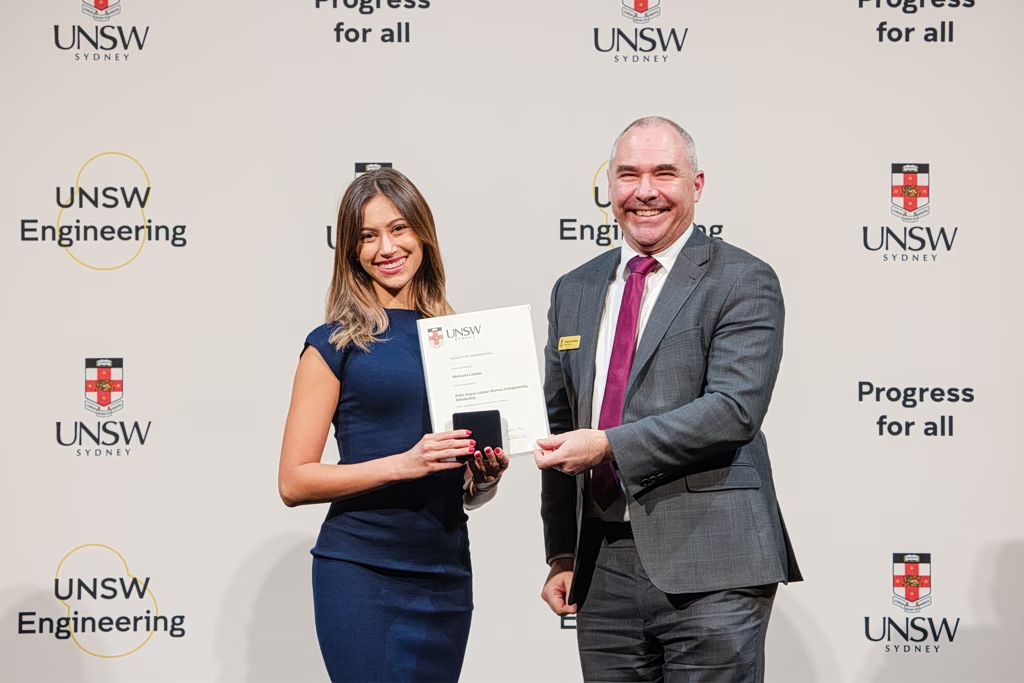
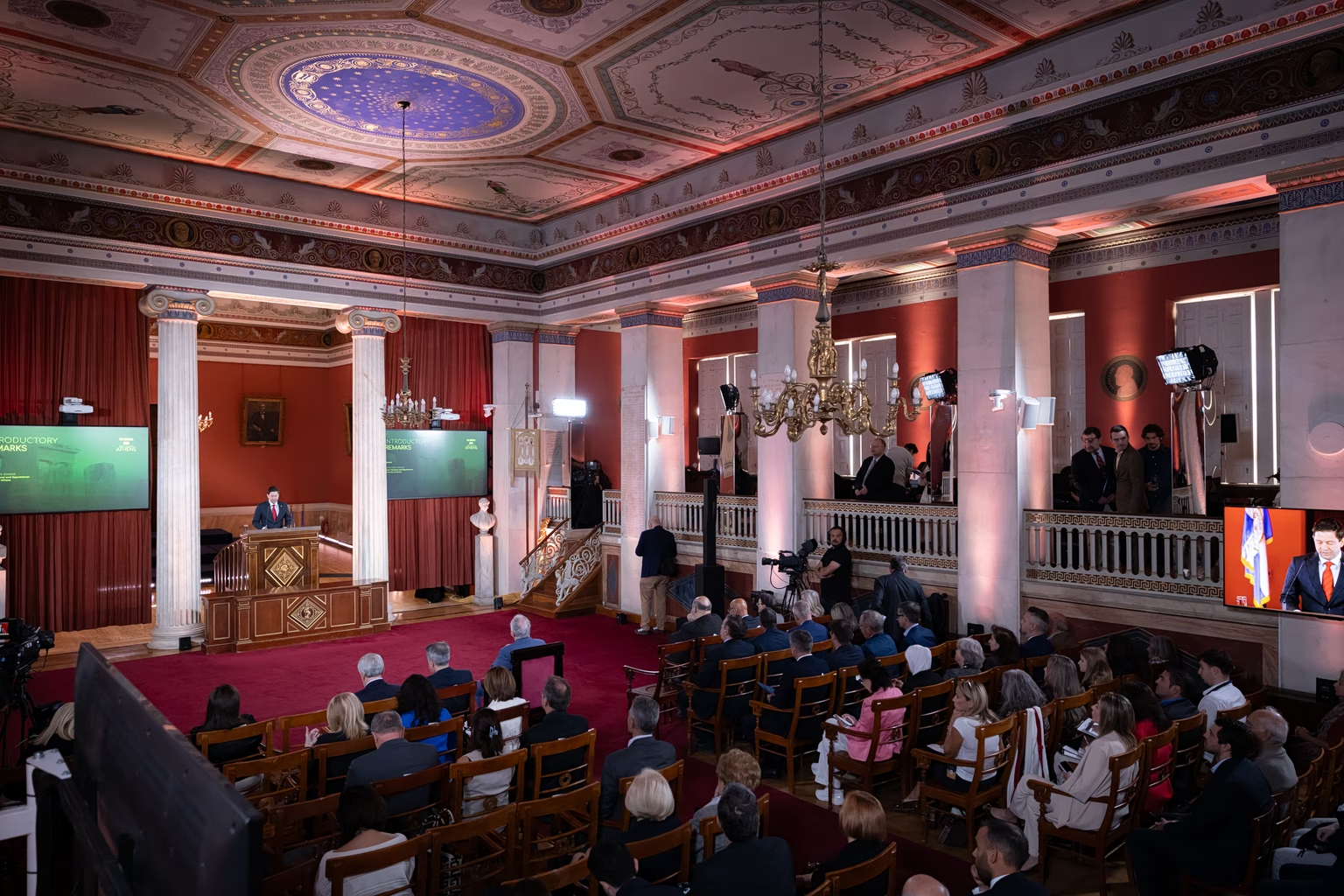
This question ran through the proceedings of the 12th International Summer University, held from September 6 to 11 at the University of New South Wales (UNSW) under the title “The Greek Language in Australia: From Memory to the Future.” After two years in Boston, the “little boat” that serves as the event’s emblem arrived in the Antipodes. ΤΟ ΒΗΜΑ was also present, through its initiative ΤΟ ΒΗΜΑ tis Omogeneias (of the Greek Community Abroad).
“To Begin the Day It Ends”
With more than 120 speakers, the sessions were hosted at the Rex Vowels Theatre at UNSW and streamed live online. Academics and educators came not only from Sydney but also from Adelaide, Darwin, and Melbourne, presenting the long history of Greek programs in the country’s schools and universities, without, however, glossing over the critical state of Greek language learning in Australia.
The event was organized by the Laboratory for the Study of Social Issues, Media and Education of the University of Ioannina, in cooperation with the Hellenic Studies Program at UNSW and Unity in Philia, under the auspices of the President of the Hellenic Republic Konstantinos Tasoulas and with the support of the General Secretariat for Greeks Abroad and Public Diplomacy.
Messages were sent by, among others, former President of the Hellenic Republic Prokopios Pavlopoulos, Minister of Education Sofia Zacharaki, and Deputy Minister of Foreign Affairs Giannis Loverdos. The Ambassador of Greece to Australia Stavros Venizelos and the Rector of the University of Ioannina Anna Batistatou also spoke. The organizing director in Australia was Vassilis Adrahtas, head of the Hellenic Studies Program at UNSW.
“We want this program to begin the day it ends,” said Nikoletta Tsitsanoudi-Mallidi, founder and academic director of the Summer University and Dean of the School of Education at the University of Ioannina, at the opening. The goal, she explained, is to leave “a seed in the community”: to start collaborations, to help educators get to know one another, to bring schools together. And not “a nice firework display, after which everyone goes back home with their nice photos,” she added.
According to the organizing committee, some results were visible even before the curtain fell. Collaborations were launched between academics and secondary schools. A separate roundtable discussed the role of business in promoting the Greek language, in light of the Australia-European Union Free Trade Agreement. The proceedings of last year’s event were also presented in the volume “Diaspora Media and the Greek Language” (Pedio Publishing). Among other side events, an exhibition of political cartoons by Ilias Makris, Andreas Petroulakis, and Stathis was held at the Greek Orthodox Community.
What Keeps a Language Alive
Whether Greek will continue to be spoken by future generations was a concern in many of the presentations. Academician Christoforos Charalambakis took part online, as he was unable to travel. He described the path of migrant generations: the first takes refuge in memory, the second balances between two homelands, the third feels more Australian, and the fourth is almost completely cut off.
In his view, neither teaching materials nor teaching staff are, on their own, the key to Greek language learning. “The strongest factor is motivation,” he noted. As an example, he pointed to the dominance of English, which is not due to any merits of the language itself but to the power of the United States.
Mr. Skemperis reached a similar conclusion. If one looks at history, he said, “the omens are not very positive.” Wherever people migrated as a minority to a country with a different language, “time has not been kind to language preservation.” He also recalled Isocrates, who considered Greeks to be “those who share in Greek education.” His proposal was practical: to show young people that modern Greek culture is attractive and that it is worth the effort to learn Greek in order to be part of it.
The data are telling: according to a study by the Hellenic Studies Foundation, in the state of South Australia, over a 20-year period from 2003 to 2023, the number of students learning Greek fell by 40%.
Other presentations showed that the picture regarding the preservation of minority language varieties is quite complex. Joseph Lo Bianco (University of Melbourne), presenting the Pharos Alliance, a volunteer network for the revitalization of Greek in Australia, described the language as “locally endangered but globally vibrant.”
For his part, Vassilis Adrahtas questioned in his presentation the very interpretive framework of so-called “language attrition,” which dominates the study of migrant languages. Through three case studies, he showed that speakers in Sydney, mainly of the second generation, retain in their speech forms of local dialects as their parents spoke them in rural Greece.
Nancy Karvouniari presented the Hellenic Studies Foundation’s initiatives to date across all levels of education, from early childhood to higher education. These programs have raised more than 4 million Australian dollars over the past 8 years. They include a collaboration with the popular group The Wiggles and the creation of a video series, “Learning Greek with Lucia,” which has gathered more than 2.3 million views on YouTube. As Ms. Karvouniari noted, “It is not enough for children to be able to learn Greek. They need to want to, and be able to continue.”
The Role of the Church
Archbishop Makarios took a different approach, describing talk of “saving” Greek as “inelegant and out of place.” As he noted, the language “is not some half-dead patient or, even less, an embalmed museum exhibit.” For him, the Church remains the main home of the Greek language. The Archdiocese of Australia, he added, maintains Greek as the language of worship “almost universally” and insists on this “non-negotiably.”
More specifically, students can no longer graduate from its Theological College unless they have B2-level proficiency in Greek. He cited America as a counterexample, where, in his view, the adoption of English in worship “decisively harmed the Greek identity of the faithful.” He also stressed that insisting on Greek is not “nationalist elitism” but “a counterweight to the homogenizing melting pot of modern society.”
Greek Learning and Artificial Intelligence
Artificial intelligence was at the center of many presentations, sometimes as an opportunity and sometimes as a threat to literacy. Mr. Charalambakis noted that AI must be used appropriately and cannot replace human beings.
An imaginative approach came from the Consul General of Greece in Adelaide, Alexandra Theodoropoulou. The Greek alphabet, she argued, was the first to “digitize” knowledge: it separated knowledge from the memory of the expert and made it, at least in principle, accessible to everyone. Plato, however, warned in the “Phaedrus” that “writing can give rise to the conceited,” meaning people with the appearance of learning but without true knowledge. Ms. Theodoropoulou closed with a question that could sum up the entire conference: “If technology multiplies access to knowledge, does it also multiply wisdom?”
In her address, the Secretary General for Greeks Abroad and Public Diplomacy, Maira Myrogianni, recalled UNESCO’s decision in November 2025 to establish February 9 as World Greek Language Day. Among the Secretariat’s initiatives, she also mentioned ΤΟ ΒΗΜΑ tis Omogeneias (of the Greek Community Abroad), the digital student newspaper of the diaspora carried out in cooperation with ΤΟ ΒΗΜΑ.
ΤΟ ΒΗΜΑ tis Omogeneias (of the Greek Community Abroad)
ΤΟ ΒΗΜΑ tis Omogeneias (of the Greek Community Abroad) was also presented during the event. This publishing and educational initiative was launched in 2025 by ΤΟ ΒΗΜΑ together with the General Secretariat for Greeks Abroad and Public Diplomacy. Students at Greek-language schools around the world create their own school newspapers, applying the principles of media literacy. The initiative builds on ΤΟ ΒΗΜΑ’s Student Newspapers program. The second cycle has been announced (fill out the participation form), while the first cycle, for the 2025-2026 school year, included 12 schools (two of them from Melbourne and Perth) from 9 countries on 4 continents.
Beyond the lecture hall, ΤΟ ΒΗΜΑ visited four schools in Sydney: All Saints Grammar in Belmore, St Euphemia College, St Spyridon College, and the community’s Saturday school in Clemton Park. It held productive discussions with the educational community about both the long-standing and the current challenges of Greek language learning in Australia. It also met students in person, who learned with great interest about To Vima of the Diaspora and expressed a desire to take part in the initiative with their own journalistic writing.
From Memory to the Future
The title of this year’s event already contained an answer to Mr. Skemperis’s question. Greek in Australia is at once memory, through the schools the communities founded and the worship that insists on Greek, and an open bet on the future. Cavafy’s king wanted Greek on his coins so he would not become a “laughingstock” in front of the sophists from Syria. For the new generations of the diaspora, the goal is the opposite: not to show off their Greek, but to need it, to speak, to write, to joke, to disagree.
“Multilingualism is the magic of watching a child whisper a secret in Greek, ask for help with homework in French, and laugh out loud with friends in English,” wrote four diaspora students in “ΤΟ ΒΗΜΑ of Montreal.” Although they were thousands of kilometers away from Sydney, they share the same concerns as students in Australia.
And that may be where the future will be decided: in cultivating a multilingualism that embraces difference, honestly highlights the connection and relationship of the diaspora with Greece, and looks beyond narrow utilitarianism or easy folklore when it comes to what knowing a language can offer.