 Μake us preferred on Google
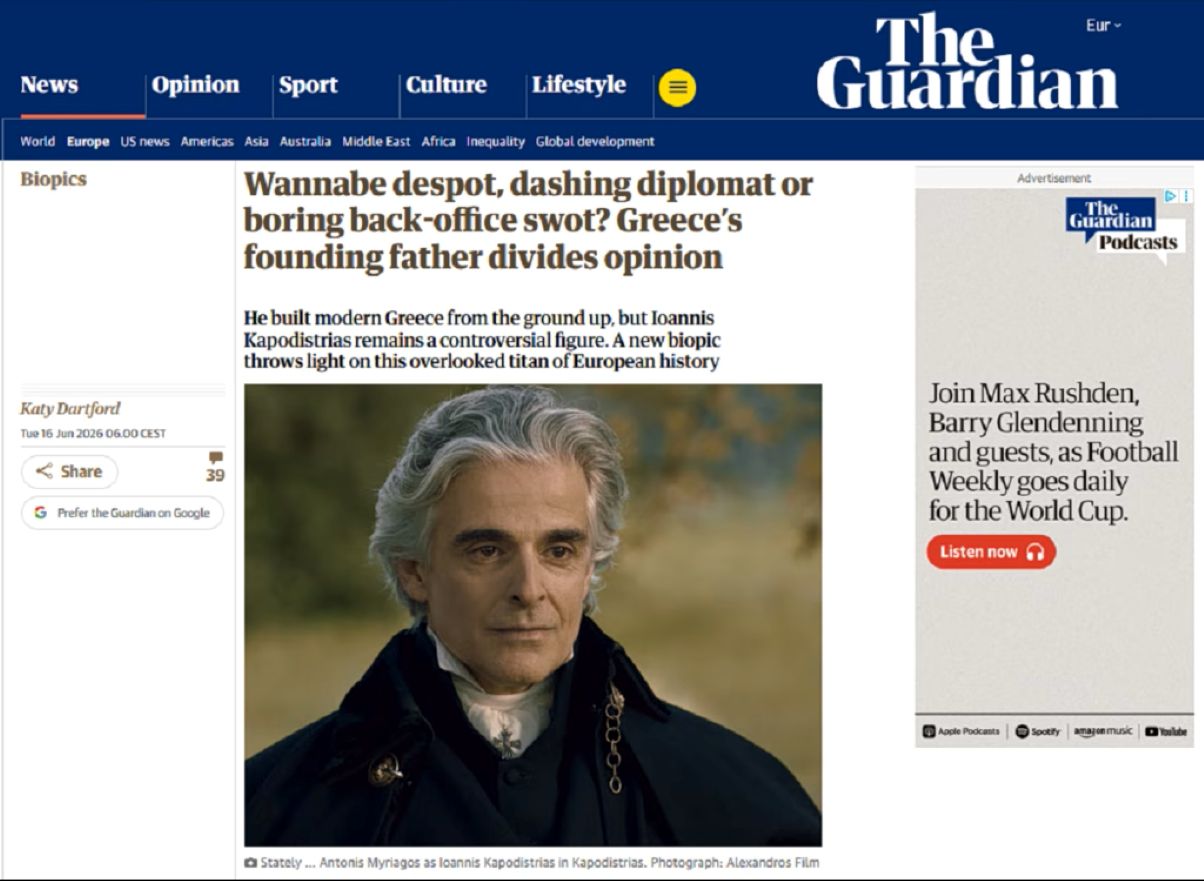
 Following its remarkable success in Greece, Kapodistrias, the latest film by Greek director Yannis Smaragdis, is continuing its international journey with its release in the United Kingdom this week. The film has already attracted the attention of the British press.
A substantial feature published by The Guardian on 16 June traces the life and legacy of Ioannis Kapodistrias, from his years in Switzerland and, most notably, Russia, to his involvement in the Greek War of Independence, his return to Greece, his political career, and ultimately his assassination in Nafplio in 1831.
While the article is neither overtly celebratory of the historical figure nor of the film itself, it presents a balanced account of what its headline describes as “the founder of Greece who divides opinion.” At the outset, journalist Katie Dartford argues that, without Kapodistrias, a modern Greek state might never have emerged and that the map of Europe could look very different today.
After outlining his contribution to Greece, she cites the Swiss philhellene Jean-Gabriel Eynard, who, upon learning of Kapodistrias’ assassination, wrote that the man who killed Kapodistrias had, in effect, killed his own homeland.
The article also features the perspective of British historian Jonathan Bond, who has spent years researching and studying Kapodistrias. Bond suggests that, in the aftermath of the War of Independence, Greeks sought larger-than-life heroes, a role Kapodistrias did not fit.
He notes that Kapodistrias never took up arms during the revolution and, perhaps more significantly, attempted to curb the influence and image of the charismatic military leaders who had done so. In Bond’s assessment, he remained a behind-the-scenes diplomat whose contribution was never fully acknowledged.
Dartford further observes that, nearly two centuries after his death, Kapodistrias remains one of the least familiar political figures of post-Napoleonic Europe outside Greece—and often within Greece as well.
It is precisely here that the significance of the film, and the power of cinema more broadly, becomes evident. Regardless of whether audiences embrace or reject it—and the article notes the divisions the film sparked in Greece—Kapodistrias has achieved something few Greek productions manage.
Beyond stimulating public debate about a figure many Greeks know far less about than they should, it has introduced Kapodistrias to countless people who, despite professing strong patriotic sentiments, had little understanding of who he was or the role he played in shaping modern Greece.