
 Μake us preferred on Google
The development confirms the operation of the undersea cable system installed by Greece’s Independent Power Transmission Operator (IPTO or ADMIE) as part of the southern Cyclades interconnection project, which also includes Santorini, Milos and Serifos. Construction of the new links was completed in June.
The Santorini-Folegandros section uses a 60-kilometer, 150-kilovolt cable incorporating fiber-optic lines. It was laid at a maximum depth of 340 meters and buried along its underwater route for protection.
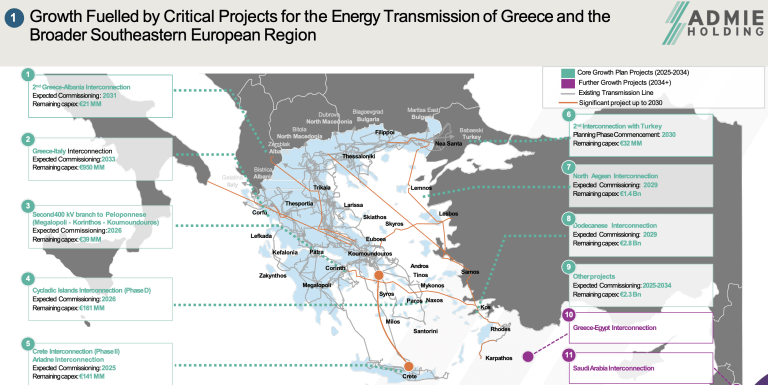
ADMIE’s major electricity interconnection and infrastructure projects
IPTO has also built a high-voltage substation on Folegandros using gas-insulated switchgear technology to minimize its environmental and visual impact. The building’s stone cladding was designed to help it blend into the island’s natural and built environment.
The project was financed with 164.5 million euros from the EU’s Recovery and Resilience Facility through the Greece 2.0 program. Financing also includes a 157-million-euro direct loan from the European Investment Bank (EIB) and a further 108.4-million-euro loan supported by Recovery Fund resources.
Environment and Energy Minister Stavros Papastavrou said the connection would improve electricity supply security, reduce power generation costs and protect Folegandros’ natural environment.
IPTO Chairman and CEO Manos Manousakis said the island was now part of the interconnected electricity system, strengthening energy security for Cycladic destinations that make a significant contribution to Greece’s tourism industry, including during periods of high demand.
The southern Cyclades link forms part of the wider program to connect the islands to the mainland grid, following earlier interconnections involving Syros, Paros, Tinos, Mykonos and Naxos. The project includes approximately 294 kilometers of submarine and underground cables and four digital substations.
Beyond improving supply reliability, particularly during the summer tourism season, the interconnection is expected to reduce reliance on high-polluting, oil-fired power stations on the islands, cut carbon dioxide emissions and lower electricity system costs.