 Μake us preferred on Google
 Energy security and the cost of fuels and natural gas are turning into a serious headache for the government. The war in the Middle East remains uncertain both in terms of its duration and its outcome.
Although officials from the Ministry of Environment and Energy, as well as energy companies, the regulator and DESFA, note that there is no issue of energy security as there was during the war in Ukraine, sources from the ministry, the aforementioned companies and market bodies do not hide their concern.
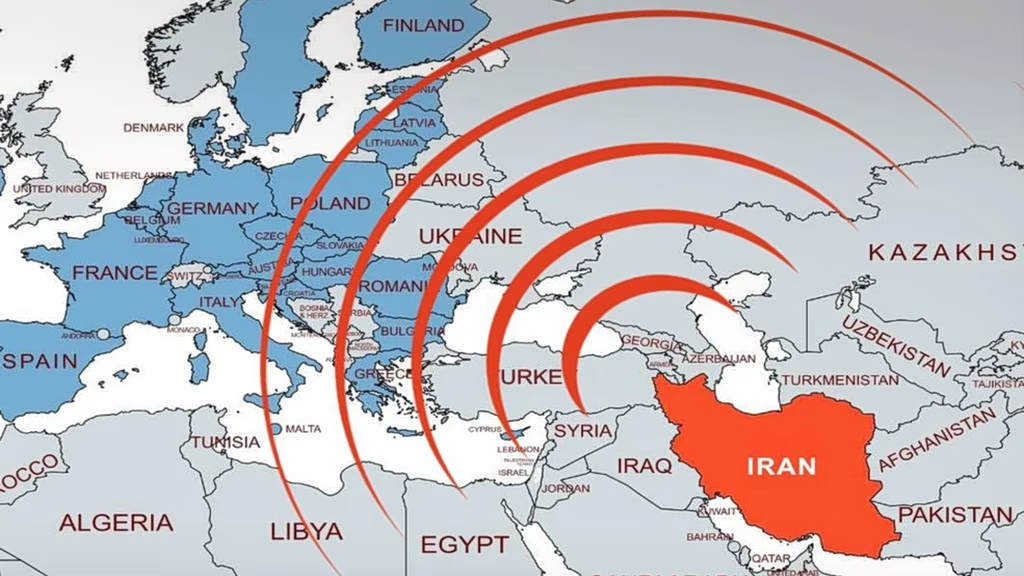
Iran is responding to the attacks by the United States and Israel with asymmetric strikes, intensifying uncertainty over the scale of the energy crisis.
The Crisis Management Task Force for energy security
According to information, even the convening of the Crisis Management Task Force is on the table to assess energy security, both in terms of market supply and infrastructure.
This body is convened by the Regulatory Authority for Waste, Energy and Water (RAAEY), although in previous crises, such as heatwaves and forest fires, it was convened in a smaller formation by the Minister of Environment and Energy, Stavros Papastavrou.
While information suggests there is currently no immediate need to convene the body, sources do not rule it out at any moment. Developments in the Middle East will determine when the Crisis Management Task Force meets.
The Strait of Hormuz key to energy security
Sources from the natural gas market stress that, for now, the country’s energy security does not appear to be at risk.
The two refineries of HELLENiQ ENERGY and MOTOR OIL procure crude oil from countries not directly affected by the war in the Middle East, particularly by a possible closure of the Strait of Hormuz.
Greece’s supplies of liquefied natural gas (LNG) from Qatar—which halted LNG production yesterday, March 2, following a strike on its production facilities—are negligible.
Scenarios drawn up by energy companies point to extreme situations only if the Strait of Hormuz remains closed until next winter.
Fuel and natural gas prices
The number one problem for Greece’s energy sector is prices.
The state of war in the Middle East is driving up crude oil and natural gas prices. Brent crude was trading yesterday at around 80 dollars per barrel.
Sources from domestic petroleum trading companies speak of increases starting tomorrow, Wednesday, of around 2 euro cents per liter for unleaded gasoline. Its price is expected to rise to approximately 1.77 euros per liter. The increase will be greater for diesel fuel, which will become about 5 euro cents per liter more expensive, bringing its price to 1.46–1.47 euros per liter.
The price of natural gas on the Dutch TTF platform surged by more than 35%. April contracts, after jumping yesterday to 49 euros per megawatt hour, fell back to around 43 euros per megawatt hour—still higher than levels before the outbreak of hostilities. Scenarios involving a prolonged closure of the Strait of Hormuz foresee the TTF climbing to 100 euros per megawatt hour.
For now, no intervention in the fuel and natural gas markets is being considered. However, if natural gas prices continue yesterday’s rally, they are expected to affect the cost of electricity.