 Μake us preferred on Google
In Shenzhen this week, global leaders will experience first-hand what it might be like to live in a world led by China if the US one day cedes its hegemony and the liberal international world slides into terminal decline.
The Asia-Pacific Economic Cooperation summit to be held in the glittering south China technology hub will be one of the most tightly controlled since the 21-member organisation began meeting in 1989, say people familiar with the matter.
With US President Donald Trump and Russian leader Vladimir Putin expected to be among the guests, the meeting has been heavily truncated. Unlike usual arrangements for such summits, there are no informal “retreats” for leaders to interact informally.
Instead, leaders will have to travel 20 minutes for bilateral meetings with their host, China’s President Xi Jinping, at the palatial Kylin Villa, a state guesthouse nestled in lush hills beside Shenzhen’s tiger safari park, according to people familiar with the matter.
The heavily abridged forum — which diplomats grumble seems designed to reduce the free-flowing discussion characteristic of prior editions — comes as Beijing increasingly portrays itself as the centre of the multilateral system, filling the leadership vacuum left by the US under the Trump administration.
President Xi last year launched the so-called “global governance initiative”, a diplomatic proposal to create a “more just and equitable” international system, while opposing “all forms of unilateralism, hegemony, dominance by a few countries and bloc politics” — a dig at the US.
But while Chinese analysts hail Beijing’s growing push to change the global order to better represent developing countries, collectively known as the global south, western analysts and diplomats question whether Beijing’s version of multilateralism fits the usual understanding of the term.
The Shenzhen Apec meeting — the first to be held in the country since 2014 — is a good illustration of how China emphasises the appearance of global harmony while reducing the space for genuine international debate and joint decision-making, they say.
While espousing multi-polarity, they argue, China is laser-focused on the underlying great power competition. The real business of the Apec meeting, for example, is expected to be a potential trilateral meeting between Xi, Putin and Trump, and a bilateral session between the US and Chinese leaders, their third since May.
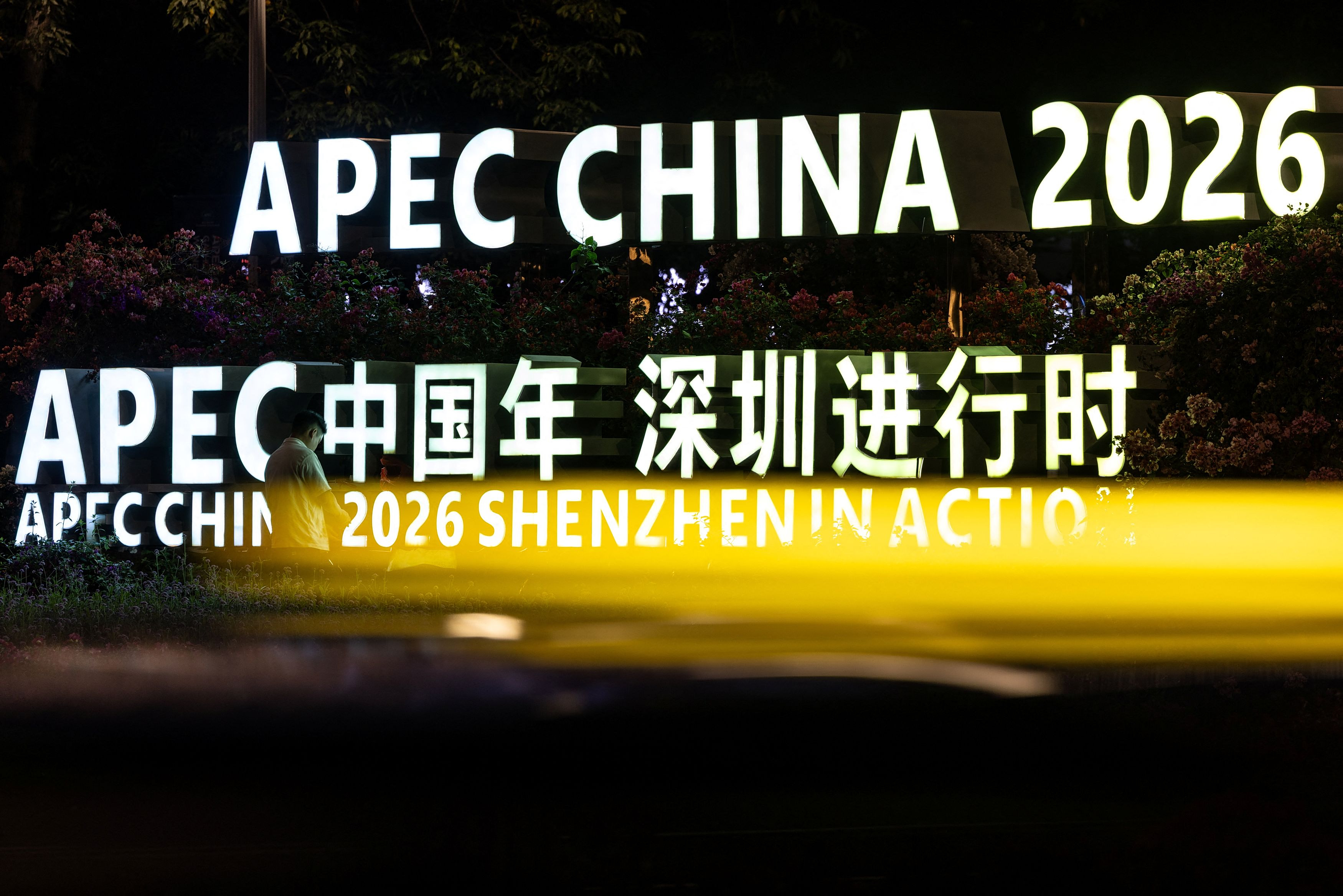
A worker adjusts elements of a giant illuminated sign of the 33rd Asia-Pacific Economic Cooperation (APEC) Economic Leaders’ Meeting, in Shenzhen, China, November 15, 2026. Picture taken with long exposure. REUTERS/Maxim Shemetov
The underlying message is that China will be a different kind of hegemon from the US. It is keen to maintain multilateral institutions such as the UN and the World Trade Organization, but western analysts argue it wants to mould them to fit its Leninist system, where the rules are set top-down by Communist Party leaders.
“China is pretty committed to becoming the leading power in Asia and a leading power on the world stage,” says Ryan Hass, director at the John L Thornton China Center at the Brookings Institution. “It expects and wants deference to itself on its core interests and it wants to hollow out the liberal core of the international order.”
But while China is steadily putting in place the building blocks for this new order, courting the support of developing countries and capitalising on its huge trading power, its success is far from assured. Even if the US was prepared to cede its dominance, it is far from clear that economic strength alone will give Beijing hegemonic power.
While China has one of the world’s largest militaries, it seems unwilling to project military power beyond its immediate region or play a decisive role in solving geopolitical conflicts beyond its borders, analysts say. It wants to use international institutions such as the UN to change the rules to suit its agenda, but it seems unwilling at this stage to invest in global public goods such as international security in the same way as the US or previous hegemons.
“China’s ambitions are definitely coming into focus. But I think it remains an open question whether or not they will be able to realise them,” says Hass.
Outwardly, the Communist Party is sounding supremely confident about its global stature.
After the fifth plenum last month, a gathering of the party’s powerful Central Committee, a study meeting at the foreign ministry explained China’s lessons for the rest of the world.
“We must actively carry out the external publicity [and] . . . fully demonstrate General Secretary Xi Jinping’s glorious image and noble stature as a world-class leader of a major party and a major country,” a statement about the meeting said. “Push the international community . . . to ‘look to the East’, ‘learn from China’, and ‘learn from the [party]’”.
Since coming to power as general secretary in 2012, Xi has pursued what analysts call a more assertive foreign policy, abandoning his predecessors’ “hide and bide” strategy of playing down China’s growing strength and ambition to avoid alerting opponents in the west.
Analysts point to landmarks in this new, more muscular posture, from China’s increasing military exercises around Taiwan and the building of artificial islands in the South China Sea to economic conflict with the US.
This culminated in Beijing’s use of export controls on rare earths critical to manufacturing to fight Trump to a halt in his trade war last year, a feat that many in China felt made the country a peer of the US at least economically.
But in contrast to Beijing’s robust rhetoric, scholars in China engage in more nuanced debate about what sort of power the country should be and how it should compete with the US.
In a study of 100 Chinese scholarly articles by Jing Men of East China Normal University in Shanghai, published in the book, The Transatlantic Community and China in the Age of Disruption: Partners, Competitors, Rivals, Chinese analysts say China does not want to confront the US or completely overturn the existing international system of which it has been a key beneficiary.
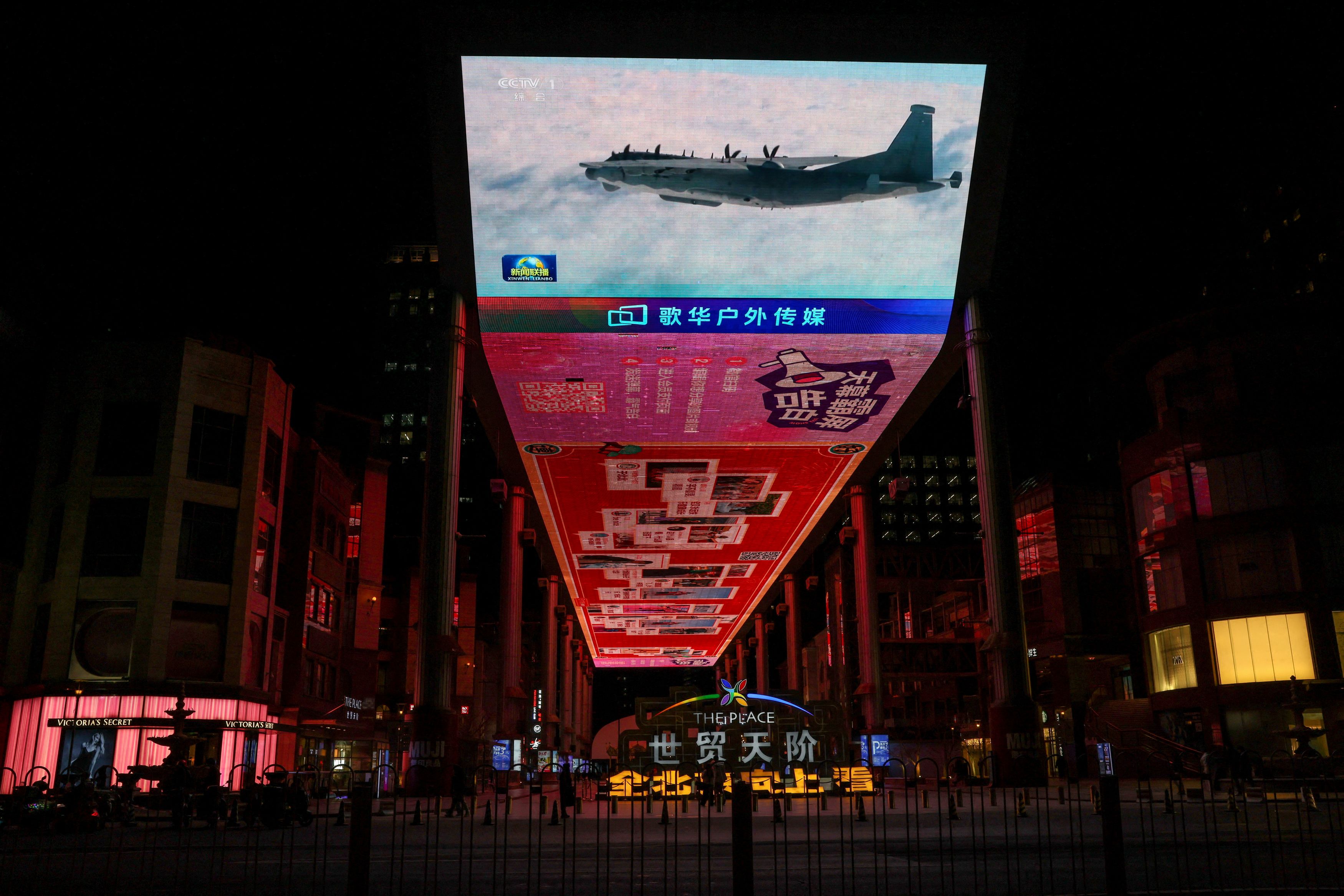
FILE PHOTO: A giant screen shows a news report on China’s “Justice Mission 2025” military drills around Taiwan, in Beijing, China December 30, 2025. REUTERS/Tingshu Wang/File Photo
What China wants is to “exert more influence in international decision-making”, Jing writes.
At the same time, Russia’s invasion of Ukraine has “strengthened the sense of ideological competition between democratic and authoritarian states”, Jing writes, leaving China facing “more challenges” from the US and the European Union.
For decades, Chinese thought on international diplomacy has been defined by what some domestic scholars call US-centrism — a focus on competition with the US, and Sinocentrism, an inherent belief in the superiority and exceptionalism of China.
A 2008 paper on Chinese policy issues, for example, highlighted a “mindset of ‘if America declines, who but us can lead?’” Written by Tang Shiping of Fudan University and Qi Dapeng of the National Defence University of the People’s Liberation Army and republished by Pekingology, the paper warned against a “G-2” mentality, in which China and the US try to run the world between themselves.
But that notion has re-emerged in China and abroad following last year’s détente between Trump and Xi.
Trumpism is “further shifting . . . the centre of gravity of great power competition towards . . . a so-called ‘de facto G2’ structure”, wrote Zheng Yongnian of the Chinese University of Hong Kong, Shenzhen and Sun Yixin of the Shanghai Academy of Social Sciences in a recent paper.
Xi’s answer to the US retreat from the international system it created after the second world war is the global governance initiative, alongside others in a series covering international development, security and civilisation.
The governance initiative advocates for a more genuinely multi-polar order, says Yu Jie, senior research fellow for China at Chatham House. It retains the UN as still the central institution of international governance but also gives the global south group of nonaligned developing countries greater influence in setting rules and priorities.
“China is not really a new world hegemon” in the likeness of the US, Yu says. She says the US pushed open military alliances and “relentless” economic transactions among partners, whereas China argues that it wants “to design how the game is played” and have a louder voice “in defining what are the international institutions”.
At the Global Governance Initiative Forum last month in Xiong’an, Xi’s utopian city being built near Beijing, foreign minister Wang Yi directly linked Apec and reform of the UN to the initiative.
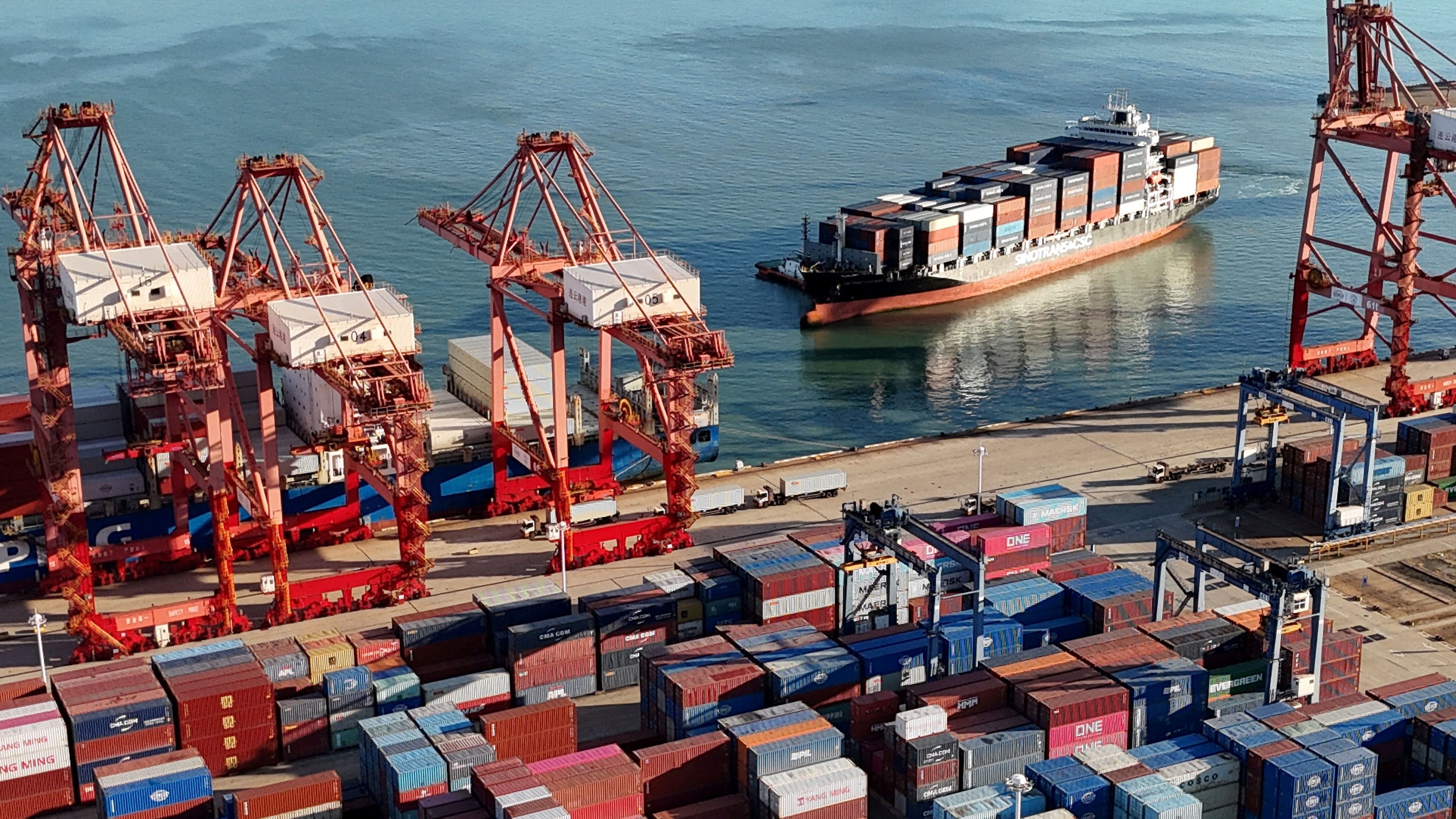
FILE PHOTO: A drone view shows a cargo ship approaching a container terminal at Lianyungang port, Jiangsu province, China October 14, 2026. China Daily via REUTERS ATTENTION EDITORS – THIS IMAGE WAS PROVIDED BY A THIRD PARTY. CHINA OUT. NO COMMERCIAL OR EDITORIAL SALES IN CHINA/File Photo
He also laid out a wishlist of other areas for greater “governance”, including the international maritime, seabed, space and polar domains. He also said China wants to change “global human rights governance” to put “development” as a “high priority”. China has long disputed the western emphasis on individual civil and political rights and universal human rights standards. He said China would hold a workshop to help “other developing countries in building capacity” on its view of human rights.
Aside from bodies such as Apec and the UN, where China rallies the global south through the G77 bloc of developing countries, Beijing also uses non-western multilateral groupings, such as the Brics group of emerging nations, to exert influence.
The sheer diversity of such organisations, which include rivals such as India, makes it difficult for them in practice to unite behind practical policies. But such groupings allow China to accumulate sufficient leverage to force other countries to internalise its core priorities, says Jon Czin of Brookings, who was a former director for China in the National Security Council, such as its claim on Taiwan.
“They want to have sufficient power that they don’t even have to [communicate to] other countries about what China’s interests are. They want countries to internalise China’s preferences and self-censor,” he says.
In addition, the mere display of unity is important for China. “With multilateralism or multilateral organisations, what the Chinese are trying to create is an image of China representing the global south. Or that China still cares about the global south’s perspective while the other great powers are essentially walking all over the world,” says Yun Sun, director of the China programme at the Washington DC-based think-tank the Stimson Center.
Developing countries have also been the largest recipients of the global “public goods” China has offered the world. Its Belt and Road programme has seen it invest more than $1tn in infrastructure for transportation, energy and more. While Beijing is accused of miring the recipients in a debt trap, some proponents argue many of these countries would otherwise not have received such large investments.
While BRI spending is no longer what it was, China this year launched a new programme to help developing countries with AI, offering to train thousands of people from the global south to use its models through the establishment of international “application co-operation centres”.
“If China can present itself as the leader of what it refers to as the global majority, it will have succeeded in rebalancing global affairs away from the post-World War II international order that’s sort of stacked in favour of liberal democracies towards an arrangement that China feels much more comfortable in,” Brookings’ Hass says.
While China’s superpower status as an economic and trading country is indisputable, others say Beijing’s ambition of building a new world order with China at the centre has some way to go.
Aside from the Belt and Road, its global policy initiatives come with little concrete investment, analysts say, unlike the US, which, for better or worse, backed its vision of the world order with the Marshall Plan, the US dollar financial system, security alliances, large amounts of global aid and other involvement.
“While China increasingly presents itself as a champion of global governance reform and a defender of multilateralism, it remains reticent to commit the scale of financial resources historically associated with global leadership,” says Yu of Chatham House in a recent paper.
Some also question whether Beijing is willing or able to project its power to provide the world with greater geopolitical stability.
“The bumper sticker for how they would behave if they ever became the hegemon would be power without responsibility,” says Czin of Brookings.
He says the series of initiatives that Xi has launched in the past few years is “ornamental”, while realpolitik governs Beijing’s actions when it comes to areas of live conflict.
On Ukraine, for example, it has never condemned Russia’s full-scale invasion despite insisting that countries observe the UN Charter, which protects national sovereignty. The same passivity can be seen on Iran, where China has had little discernible impact on negotiations to bring about a peace.
“They’re just very parochial about their own interests,” Czin says.
Scholars in Beijing counter that China ultimately does not have the power to bring an end to these conflicts, pointing to the futile efforts of Trump since he came to power to stop the Ukraine war and his own conflagration with Iran.
Czin adds that Beijing’s more passive policy on global conflicts is perhaps serving China well. As the second superpower, it does not need to take on extra responsibilities and can let the US make mistakes while it accumulates influence.
“They’re content to just kind of hit singles and doubles,” he says, employing a baseball term for small, incremental wins. “The effect that this has over time is just to chip away at US advantages” without provoking a violent backlash from Washington, he says.
The idea, in the long term, is to introduce an international system with elements of tianxia — “all under heaven” — the historical idea that when the Chinese empire was rich, powerful and technologically more advanced, other countries naturally deferred to it and looked to it for guidance, argue Steven Tsang and Olivia Cheung in a new book, China’s Global Strategy Under Xi Jinping.
Apec, then, offers just the kind of multilateral forum where China can put its approach to hegemony into practice — preaching its gospel of multi-polarity while attempting to ease ahead in the great power stakes.
No matter that free discussion will be limited — even a customary session from the Apec Business Advisory Council to brief the leaders has been scrapped, according to one person familiar with the matter.
“The way they are running it is definitely ‘Apec with Chinese characteristics’,” says one senior foreign diplomat from an attending country, of the abridged programme.
“Shortening things and even having the bilaterals up the mountain . . . it’s [all] focused on the host.”
Copyright The Financial Times Limited 2026
© 2026 The Financial Times Ltd. All rights reserved. Please do not copy and paste FT articles and redistribute by email or post to the web.