
Traditional Greek Spit-Roasted Lamb (Arni sti Souvla)
This is the ultimate guide to mastering spit-roasted lamb—juicy, flavorful, and crispy on the outside. Whether it’s Easter or a festive gathering, this is your step-by-step recipe to roast like a pro, the traditional Greek way.
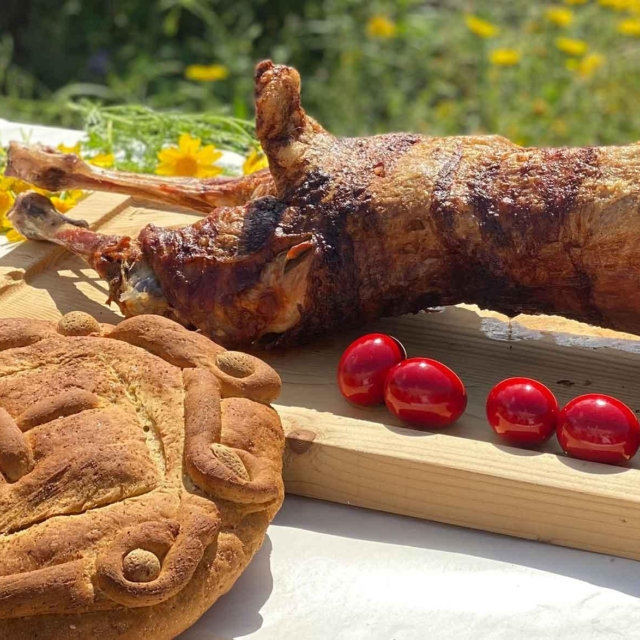
This is the ultimate guide to mastering spit-roasted lamb—juicy, flavorful, and crispy on the outside. Whether it’s Easter or a festive gathering, this is your step-by-step recipe to roast like a pro, the traditional Greek way.
Info
Prep Time:
60mCook Time:
240mDifficulty Level:
Ingredients
Serves ~20
- 1 whole lamb, ideally female, approx. 12–14 kg
- 100 g salt
- 80 g black pepper
Equipment
- Charcoal spit (manual or with motor)
- Long metal spit rod
- Stainless steel or fire-safe wire
- Butcher’s twine & needle
- Large working surface
- Toothpicks
- Large baking paper or butcher paper
- Thick branch (~25 cm) for stabilization
- Sharp knife and wire cutter
Directions
Choosing the Right Lamb
Female lamb is preferred (less gamey aroma).
Choose 12–14 kg for ideal fat-to-meat ratio.
You can use goat, but it’s leaner and best roasted in the oven, not on a spit.
Fattier lambs stay tender and taste better even the next day.
Clean & Season
Order the lamb 2–3 days in advance so it can dry out.
Lay it on a large surface covered in butcher paper.
Remove the kidneys – if roasted, they alter the lamb’s flavor.
Mix salt and pepper in a bowl and generously season the inside, focusing on the legs, shoulders, and back.
Skewering & Binding
Insert the metal spit from the rear through to the mouth.
Lift the head and carefully thread the spit through the center of the skull.
Secure the rear and legs tightly with double wire.
Pierce both shoulders in 3 points each.
Place a thick stick along the backbone and tie the shoulders tightly to it with wire. This prevents the meat from spinning separately from the spit.
Tie the neck and jaws securely.
Sew the belly shut using butcher’s twine and a needle—this traps the juices.
If the caul fat (mbolia) has come loose, wet it and pin it closed with toothpicks.
Fire Setup
Light a charcoal fire and let it burn down to embers.
Once white-hot, split the coals in two, focusing heat behind the legs and shoulders—the thickest parts.
Keep no coals directly under the spine at the start.
When the meat pulls back from the bones, the lamb is ready.
Roasting
Start the lamb high above the embers.
If using a manual spit, turn quickly at first. With a motor, maintain a slow, steady rotation.
Gradually lower the spit as the lamb cooks. Add salt and pepper externally as the surface heats—this helps the seasoning stick.
Keep adjusting coal placement for even cooking.
Doneness Check
After 3–3.5 hours, the skin blisters and bones begin to show—especially on the back and legs.
When the meat pulls back from the bones, the lamb is ready.
Rest & Serve
Place the cooked lamb on a wooden board or large surface.
Let it rest for 15 minutes to allow the juices to redistribute. The lamb may still sizzle and contract—this is normal.
Let the roast master carve it—traditionally, they handle the knife for best portions and respect.
Recipe Tips
Serve with lemon wedges, crusty bread, and traditional sides like tzatziki, horiatiki salad, and roasted potatoes. Don’t forget the wine or tsipouro!