Few institutions have shaped modern Greek education as profoundly as the Panhellenic Examinations. For decades they have provided a transparent and merit-based mechanism for allocating scarce university places, ensuring that all students compete under the same national rules.
Yet the challenges facing higher education today extend well beyond the question of how students enter university. They include how education systems support lifelong learning, respond to changing labour-market needs and enable people to develop new skills throughout their lives.
Viewed through this broader lens, the comparison between Greece and Australia is about more than university admissions. It reveals two different philosophies of educational reform: one that concentrates on refining the mechanism of selection, and another that progressively expands the pathways through which people can access higher education.
Greece: a system built around national selection
Access to higher education in Greece is centred on the Panhellenic Examinations (Πανελλαδικές Εξετάσεις). Students are ranked nationally according to their performance, and university places are allocated on the basis of those results and their stated preferences.
The Ministry of Education determines the framework, administers the examinations and allocates students to degree programs. Universities themselves play only a limited role in admissions decisions.
The result is a system that is transparent, nationally consistent and widely accepted as an expression of meritocracy. Every student sits the same examinations under identical conditions, and admission is determined by measurable academic performance.
The same strengths, however, also create rigidity. Educational trajectories are often shaped at around eighteen years of age, with comparatively limited opportunities for students to change direction or re-enter higher education later in life.

Why this model emerged
This structure did not emerge by accident. Following the restoration of democracy in 1974, demand for university education expanded rapidly while institutional capacity remained limited. The state required a mechanism that could allocate scarce places in a way that would be widely regarded as fair, objective and transparent.
National examinations provided that solution. Over time, the Panhellenic system became not only the principal gateway to university but also one of the strongest institutional expressions of meritocracy in modern Greece.
Reform without new pathways
Successive reforms have largely preserved this central logic. Rather than creating new routes into higher education, they have primarily reorganised institutions within the existing framework.
The 2018 reforms, which incorporated the Technological Educational Institutes (TEIs) into the university sector, illustrate this approach. Although presented as an upgrade of technological education, they largely increased institutional uniformity rather than creating new educational pathways. Students continued to enter through the same national examination system, with access remaining closely tied to national ranking and central allocation.
This reflects a recurring feature of Greek education policy: governments repeatedly revisit the rules governing the gate, while devoting far less attention to building alternative pathways around it.
Australia: multiple routes into higher education
Australia has adopted a fundamentally different model. While it also uses a school-leaving ranking system—the Australian Tertiary Admission Rank (ATAR)—the ATAR is only one component of a much broader admissions framework.
Universities establish their own entry requirements and offer a variety of routes into degree programs, including foundation studies, vocational qualifications, mature-age entry, prior tertiary study and credit-transfer arrangements.
This reflects a broader understanding of merit. Academic achievement remains important, but it is not regarded as the sole measure of potential. Students can demonstrate their capabilities at different stages of life and through different forms of learning.

A defining feature of the Australian model is the integration of vocational and university education. TAFE institutions (Technical and Further Education), broadly comparable to the former role of Greece’s TEIs, offer certificates and diplomas that frequently provide direct pathways into university degree programs.
Alongside this, dual-sector institutions such as RMIT University, Swinburne University of Technology and Victoria University combine vocational and university education within a single institutional framework, enabling movement between training and academic study.
The scale of these alternative pathways is often overlooked. Recent research suggests that only around half of commencing domestic bachelor students are recent school leavers. Among those school leavers, a substantial proportion enter university without an ATAR being used for admission. As a result, only about one-third of commencing domestic bachelor students now enter university through the traditional ATAR-based route alone.
The Australian system functions less as a single gateway than as a network of interconnected pathways extending throughout life.
Why the distinction matters
The implications extend well beyond university admissions.
They influence how societies develop human capital, support social mobility and adapt to technological and economic change.
A system centered on a single point of selection is effective at allocating scarce university places, but it can also make educational and professional outcomes more dependent on decisions made at the end of secondary school.
A pathway-based system distributes opportunity across multiple stages of life, enabling individuals to acquire new qualifications, change careers and return to education as labor-market demands evolve.

This distinction becomes increasingly important in economies characterized by rapid technological change, workforce transitions and lifelong learning.
The challenge extends beyond admissions to what happens after students enter university. Access is only the beginning of the educational journey. A well-functioning higher education system must also support student progression, timely completion and successful transition into employment.
Recent European Commission data reinforce this broader argument. Greece records the lowest rate of on-time degree completion in the European Union, suggesting that expanding access alone is insufficient if students struggle to complete their studies. Greece also has the lowest employment rate for recent graduates in the EU, pointing to broader structural weaknesses in the relationship between higher education, skills development and labor-market outcomes.
Fairness, merit and opportunity
Ultimately, the comparison between Greece and Australia reflects two different conceptions of fairness and educational opportunity.
In Greece, fairness is achieved primarily through uniform assessment. Every student sits the same examination, under the same conditions, and access is determined by national ranking.
In Australia, fairness is understood more broadly. Academic performance remains important, but merit can also be demonstrated through vocational education, previous study, work experience and alternative pathways. Rather than being assessed once, potential can be recognized and developed throughout life.
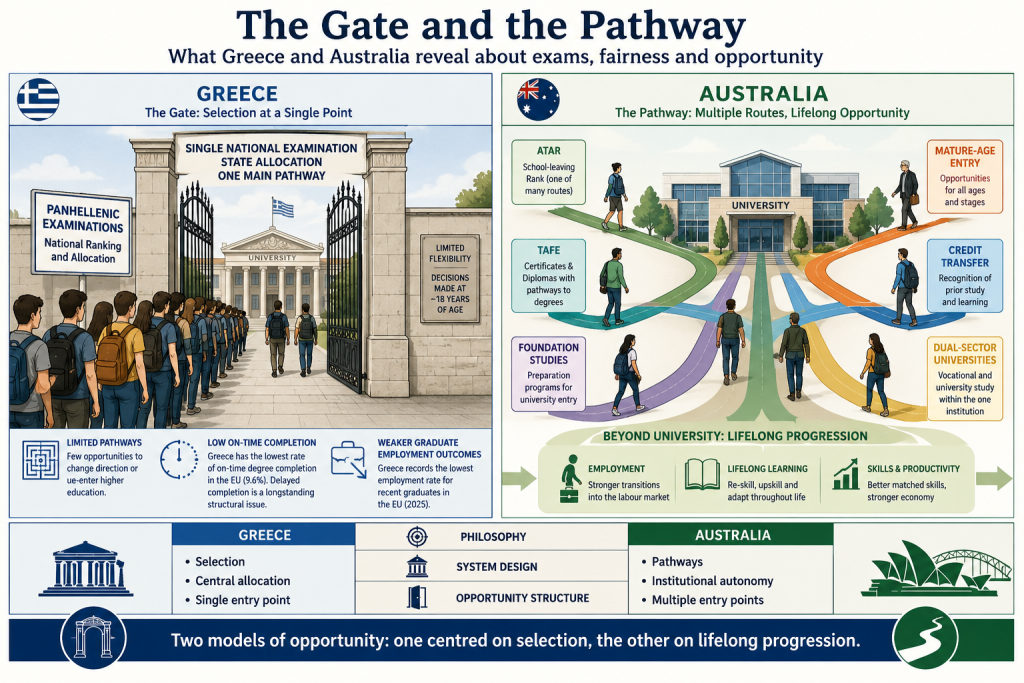
Neither model is inherently superior; each embodies a different understanding of how fairness and opportunity should be organized.
The Greek system offers transparency, consistency and a strong national standard.
The Australian system offers flexibility, mobility and multiple opportunities for progression.
Each answers the same question differently.
Should higher education be organized around a single competitive gateway, or around a network of pathways that allows people to continue developing throughout their lives?

A question for Greece
The issue facing Greece is not whether the Panhellenic Examinations should be abolished. They continue to perform an important public function by providing a transparent and nationally accepted mechanism for allocating university places.
The more important question is whether this mechanism should remain the dominant organizing principle of the higher education system. The future of higher education policy may depend less on how efficiently the gate operates than on how many people are able to reach it through different pathways.
Around the world, higher education policy is gradually shifting from designing better systems of selection to building stronger educational pathways. The challenge is no longer simply to identify talent at the age of eighteen, but to create institutions that enable people to acquire new skills, change direction and continue learning throughout increasingly longer working lives.
Australia does not offer a blueprint that Greece should simply copy. It does, however, demonstrate that merit can be preserved while opportunities for progression are progressively expanded.
For Greece, the next stage of reform may therefore lie not in redesigning the gate once again, but in building more pathways around it. In the decades ahead, the success of higher education will be measured not only by how fairly it selects students at eighteen, but by how effectively it enables people to continue learning, adapt to change and contribute throughout their working lives.
*Dr Steve Bakalis is a specialist in international education and higher education administration, with extensive experience in Australia and across the Asia-Pacific region and the Arab Gulf States. He has held senior administrative roles responsible for the strategic planning and management of student recruitment, admissions, selection, and enrolment.