 Μake us preferred on Google
 Much has been written about Plato in East Asia. In China, Singapore, and Japan, Platonic thought is often approached through the lens of administrative competence, social order, and technocratic governance. The emphasis frequently falls on the idea of the “wise ruler” and the state’s capacity to maintain stability in periods of uncertainty.
Far less attention has been given to Australia as a philosophical case study, despite its geopolitical and economic significance. This article emerges from the broader research agenda developed in collaboration with George Bitros in the joint study Overhauling Democracy: Layered State Authority, Corporate-Style Accountability, and the Free Market Economy, which explores how contemporary democracies navigate the persistent tension between participation, state capacity, and executive authority across differing institutional environments. It is also informed by sustained engagement with the Indo-Pacific region over the past four decades, offering not a purely abstract theoretical reading, but an analysis grounded in observation of how democratic institutions function in practice.
Within this framework, Australia appears as a particularly revealing Indo-Pacific case: a liberal democracy deeply integrated into Asia economically and strategically, while simultaneously functioning as a multicultural society shaped by strong civic institutions and home to one of the world’s largest Greek diasporas.
At a time when many democracies are marked by polarisation, declining institutional trust, and expanding executive power, Australia offers a distinctive example of a system seeking to reconcile high electoral participation with institutional equilibrium.
Participation and Institutional Equilibrium
Australia offers one possible answer. Unlike many Western democracies, it treats political participation not merely as an individual freedom, but as a civic obligation embedded in the constitutional culture of public life.
Voting has been compulsory at the federal level since 1924 under the Commonwealth Electoral Act, and turnout has remained consistently above 90 percent (Australian Electoral Commission). Over time, voting has become a normalized civic expectation—widely regarded as part of citizenship itself, comparable to taxation or jury duty. The penalty for non-participation at the federal election is modest, suggesting that compliance rests less on coercion than on habit and social convention.
This distinguishes Australia from voluntary voting systems, where participation varies sharply with income, age, and levels of political engagement. Comparative evidence shows that compulsory systems significantly reduce these inequalities and produce more uniform participation across social groups (International IDEA). In this sense, Australia broadens the social base of democratic legitimacy.
Participation is also institutionally facilitated in practical terms. Early voting centers operate for roughly a week before election day, alongside postal voting options (AEC – Voting Options). The electoral process is therefore extended rather than episodic, lowering barriers to participation.
Yet Australia’s democratic stability does not rest on participation alone. It is reinforced by the dispersion of political authority across multiple institutional layers.
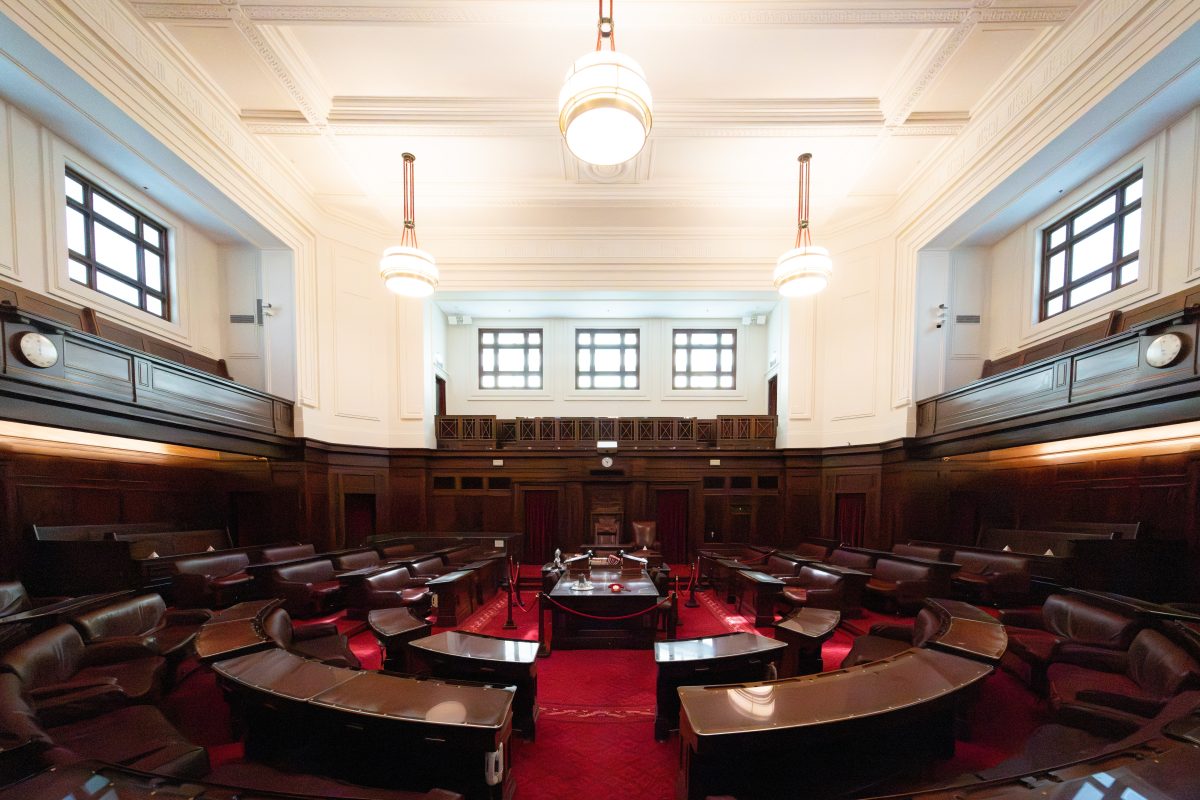
Federalism divides power between the Commonwealth and the states, preserving regional autonomy across key policy areas (Parliament of Australia). Within the Commonwealth Parliament itself, this logic of dispersion is reinforced through a bicameral structure: the House of Representatives (lower house), where government is formed, and the Senate (upper house), which operates as a powerful review chamber capable of scrutinizing, amending, and at times blocking legislation.
Preferential voting moderates the dominance of Australia’s two major parties—the Australian Labor Party and the Liberal–National Coalition—by allowing voters to rank candidates in order of preference rather than casting a single decisive vote. This system creates space for smaller parties and independents, who are not formally affiliated with any political party (AEC – Preferential Voting). As a result, independents and minor party representatives on the crossbench can become pivotal in closely contested or minority parliaments, often holding the balance of power and reinforcing negotiation, bargaining, and compromise over straightforward executive dominance.
Together, these mechanisms produce a system of distributed governance in which power is continuously checked rather than concentrated. Authority is not eliminated but diffused across institutions that interact, constrain, and review one another.
The result is a democracy in which legitimacy derives not only from elections, but from the interaction between mass participation and dispersed authority. Stability depends less on majority rule alone than on institutional equilibrium.
This matters because high participation does not automatically ensure meaningful democratic control. A system may achieve near-universal turnout while still concentrating decision-making power in a highly centralized executive structure. Australia’s significance lies in combining broad participation with structural limits on the accumulation of power.
What kind of democracy can preserve both participation and restraint? This question becomes particularly salient when viewed through the lens of Greece, where contemporary debates on the evolution of the executive state (επιτελικό κράτος) reflect ongoing tensions between democratic participation and administrative coherence (as discussed in “What Kind of Democracy?” )
In this sense, it reflects a civic-republican logic closer to Plato and Aristotle than to many modern liberal models: political freedom is understood not simply as individual choice, but as participation within a regulated civic order sustained by obligation, restraint, and balance.
Emma Goldman, Mark Twain, and the Limits of Elections
“If voting changed anything, they’d make it illegal,” the feminist–anarchist Emma Goldman once remarked. Around the same period, Mark Twain is widely associated with a closely related sentiment: “If voting made any difference, they wouldn’t let us do it.” The line, deliberately cynical, captures a recurring anxiety in modern democracies—that elections can become ritualised performances while real political power gradually shifts elsewhere.
This concern echoes an older critique found in Plato. Writing after the collapse of Athenian democracy and the execution of Socrates, Plato feared that political systems driven by rhetoric, factionalism, and unchecked popular passions could destabilize themselves from within.
Importantly, Plato was not opposed to participation as such. His concern was whether democracies possessed sufficient institutional and moral restraints to preserve civic order and prevent political life from dissolving into volatility.
In his later work, Laws, Plato moved away from the ideal of philosopher-kings toward a more practical constitutional vision grounded in law, mixed government, and dispersed authority. Political stability, he increasingly argued, depended less on exceptional rulers than on durable structures capable of restraining human ambition.
Aristotle and Civic Responsibility
Aristotle approached democracy more moderately than Plato, but reached a related conclusion. Stable political systems required broad civic participation combined with institutional arrangements capable of preventing domination by narrow factions. A society becomes unstable when power—whether held by elites, factions, or majorities—ceases to be moderated through law and constitutional structure.
For Aristotle, citizenship was not passive. Human beings were “political animals” because participation in public life forms part of collective flourishing itself. Democracy therefore requires not only freedom, but civic responsibility.
Australia’s compulsory voting system reflects something close to this older civic tradition. Participation is embedded within structures designed to prevent excessive concentration of authority. The combination of mass participation, dispersed authority, and institutional restraint produces a political culture that is neither purely technocratic nor purely majoritarian.
An Indo-Pacific Democratic Model
Australia occupies an increasingly important position in the Indo-Pacific because it sits between competing political models.
The United States represents intense electoral competition marked by deep polarization. China emphasises centralised state coordination and administrative continuity, privileging long-term planning over electoral fluidity. The European Union combines multi-level governance with growing institutional and bureaucratic complexity. Greece—historically regarded as the birthplace of democracy—occupies a distinct position within this landscape today, where debates around the emergence of an executive state (επιτελικό κράτος) reflect an ongoing effort to strengthen central coordination, administrative coherence, and policy execution within a parliamentary democratic framework.
Australia, by contrast, sits between these models: a highly participatory liberal democracy with constitutionally dispersed authority and strong institutional counterweights that limit executive concentration.
It is not a perfect system. Like all democracies, it faces pressures from executive centralisation, media concentration, and economic inequality. Yet its constitutional architecture still makes the consolidation of unchecked authority comparatively difficult.
That may ultimately be the deeper connection between Australia and the classical tradition stretching from Plato to Aristotle: the recognition that democracy survives not through elections alone, but through distributed governance capable of balancing participation with restraint.
In an age of democratic uncertainty, that lesson feels increasingly contemporary.