Indeed, language often wobbles when dealing with similar-sounding names. And yes, it can happen that even a vowel, as simple as “i,” sounds out of place in the sequence of letters. “That one—what’s his name—Dilian or Dylan.” Tal or Bob.
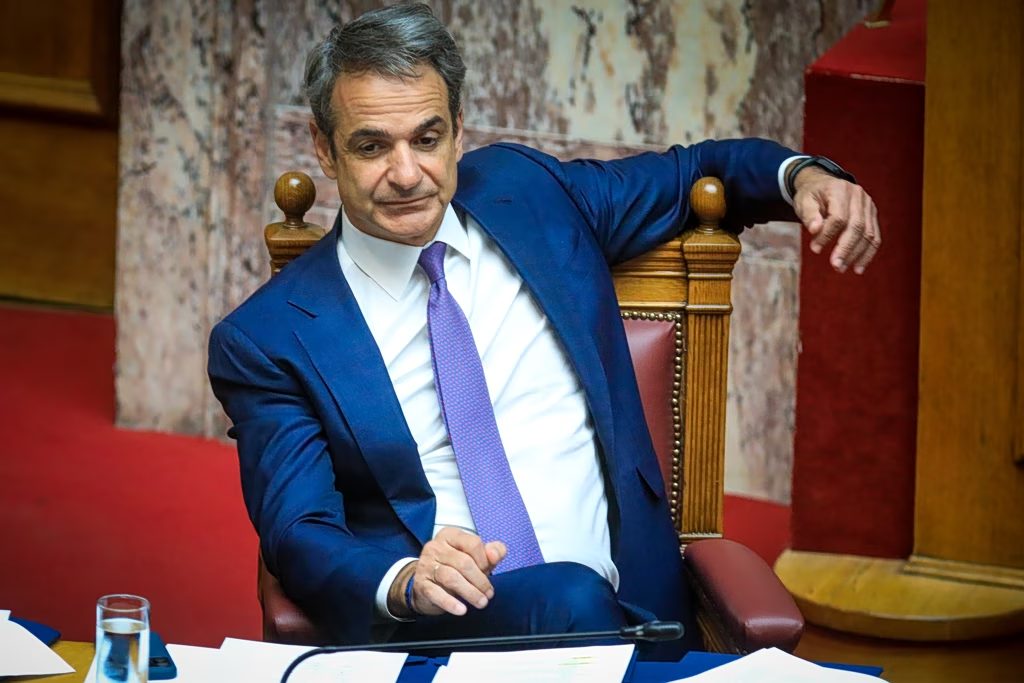
In the parliamentary debate on the rule of law, the Prime Minister rejected the alleged blackmail through distortion and the supposed connection through ignorance. We know the great artist, not some shadowy figure who sells spyware and claims to work “only with governments and law enforcement agencies.” But is a distortion, deployed as a slip of the tongue, enough to close the wiretapping case? Can one be done with it through a linguistic wobble that sounds like a deliberate mistake?
At most, it may serve as a momentary escape. A calculated mistake serves a brief evasion, just as others—unintentional ones—create conditions of entrapment. One such case was the “incompatibility,” the idea that members of parliament cannot become ministers, that if they do, they must resign their seat; that when they resign, they will be replaced in Parliament by their substitutes; that if they lose their ministerial office, they will return to their parliamentary benches, and the substitutes will go back to the party’s storage until perhaps the sirens of ministerial appointment are heard again.
The “incompatibility” was formulated as a televised address, but in the parliamentary debate it was not even heard as a lapsus linguae. The reformist zeal that was advertised as a “constitutional counterattack” was reduced to a call for a pre-arranged agreement—“come, let us agree on the constitutional revision to change the country”—with one side taking all the credit and the others sharing the losses down to the last cent. Who in the opposition would make the mistake of consenting and putting their seal on an agreement that would be like writing on a blank napkin?
NEWSLETTER TABLE TALK
Never miss a story.
Subscribe now.
The most important news & topics every week in your inbox.
The opposition has made its mistakes, but this would be excessively naïve. It followed the familiar path of the “hard line,” though without that sense of superiority that, in other times, would be offered by the spectacle of a disheartened parliamentary group of those in power. The morale of the “blues” may be dragging, but that of the “greens” is not exactly soaring either. The Left is barely heard, and the rest, however loudly they shout, are mostly heard only by their own audience.
In Parliament, the Prime Minister did not only deploy a lapsus linguae to fend off the opposition’s attacks. He also adopted a newspeak. Rule of law becomes the faster issuance of pensions and the banning of social media for teenagers; unity means that others should forget the wiretappings and the favors; toxicity is the health ordeal of his associate; a problem is only what concerns those gathered at the Easter table. The real issue is the turmoil of the planet, so that we should not waste time on matters such as college degrees.
Yet no democracy in Europe has forced itself into a kind of political quarantine in the name of a pandemic of wars. Moreover, Giorgia Meloni rebelled like a freed slave against Donald Trump when he interfered with the Pope. Which means that everyone, both within and beyond borders, has their own red lines.
The question, therefore, ahead of the elections is whose red lines the Prime Minister has crossed. Certainly those of the leader of PASOK, who, as a victim of Tal Dilian or Bob Dylan, called him in Parliament the “Orbán of the Balkans” and the “Nixon of Greece.” But probably also those of some of his own MPs. As it seems, the road to the ballot box is paved not only with slips of the tongue, but also with answers that are blowin’ in the wind.