As the world races to harness artificial intelligence, few are pausing to ask a critical question: What is AI doing to the planet?
AI is being heralded as a game-changer in the global fight against climate change. AI is already assisting scientists in modeling rising temperatures and extreme weather phenomena, enabling decision-making bodies to predict and prepare for unexpected weather, while allowing energy systems to become smarter and more efficient. According to the World Economic Forum, AI has the potential to contribute up to 5.1 trillion dollars annually to the global economy, under the condition that it is deployed sustainably during the climate transition (WEF, 2025).
Beneath the sleek interfaces and climate dashboards lies a growing environmental cost. The widespread use of generative AI, in particular, is creating a new carbon frontier, one that we’re just beginning to untangle and understand.
Training large-scale AI models is energy-intensive, according to a 2024 MIT report. Training a single GPT-3 sized model can consume enough electricity to power almost 120 U.S. homes for a year, which totals up to 1.300 megawatt-hours of electricity. AI systems, once deployed, are not static, since they continue to consume energy each time a user interacts with them. For example, an AI-generated image may require as much energy as watching a short video on an online platform, while large language model queries require almost 10 times more energy than a typical Google search (MIT, 2024).

As AI becomes embedded into everything from online search to logistics and social media, this energy use is multiplying at scale. The International Energy Agency (IEA) warns that by 2026, data center electricity consumption could double globally, driven mainly by the rise of AI and cryptocurrency. Taking into account the recent developments regarding the Digital Euro, the discussion instantly receives more value. Without rapid decarbonization of energy grids, this could significantly increase global emissions, undermining progress on climate goals (IEA,2024).
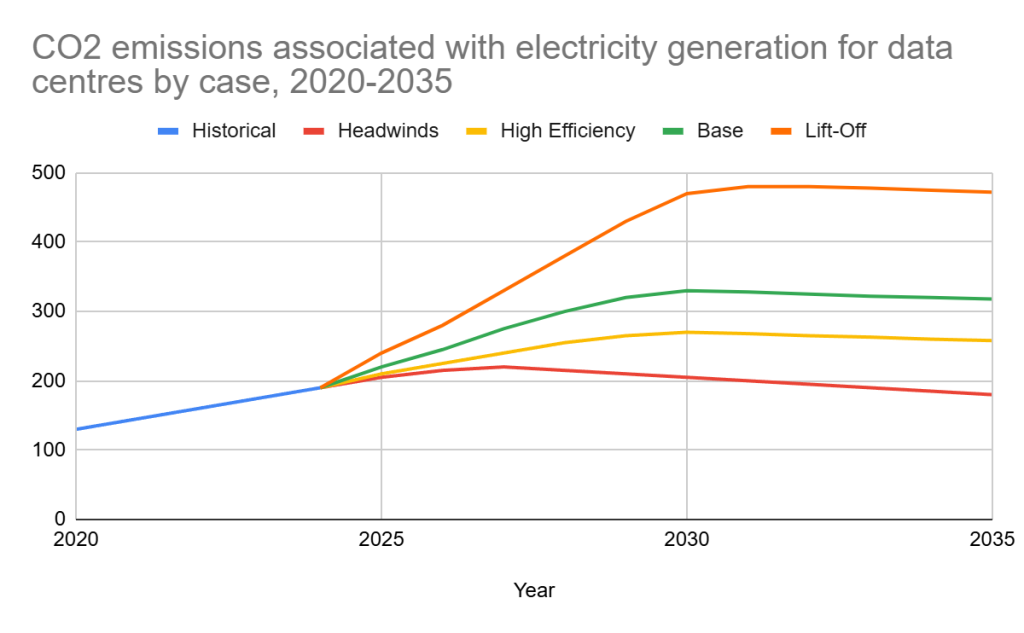
Sotiris Anastasopoulos/ With data from the IEA’s official website.
The climate irony is real: AI is both the solution and the multiplier to Earth’s climate challenges.
Still, when used responsibly, AI remains a powerful ally. The UNFCCC’s 2023 “AI for Climate Action” roadmap outlines dozens of promising, climate-friendly applications. AI can detect deforestation from satellite imagery, track methane leaks, help decarbonize supply chains, and forecast the spread of wildfires. In agriculture, AI systems can optimize irrigation and fertilizer use, helping reduce emissions and protect soil. In the energy sector, AI enables real-time management of grids, integrating variable sources like solar and wind while improving reliability. But to unlock this potential, the conversation around AI must evolve, from excitement about its capabilities to accountability for its impact.
This starts with transparency. Today, few AI developers publicly report the energy or emissions cost of training and running their models. That needs to change. The IEA calls for AI models to be accompanied by “energy use disclosures” and impact assessments. Governments and regulators should enforce such standards, similarly to industrial emissions or vehicle efficiency (UNFCC, 2023).
Second, green infrastructure must become the default. Data centers must be powered by renewable energy, not fossil fuels. AI models must be optimized for efficiency, not just performance. Instead of racing toward ever-larger models, we should ask what the climate cost of model inflation is and if it’s worth it (UNFCC, 2023).
Third, we need to question the uses of AI itself. Not every application is essential. Does society actually benefit from energy-intensive image generation tools for trivial entertainment or advertising? While AI can accelerate climate solutions, it can also accelerate consumption, misinformation, and surveillance. A climate-conscious AI agenda must weigh trade-offs, not just celebrate innovation (UNFCC,2023).
Finally, equity matters. As the UNFCC report emphasizes, the AI infrastructure powering the climate transition is heavily concentrated in the Global North. Meanwhile, the Global South, home to many of the world’s most climate-vulnerable populations, lacks access to these tools, data, and services. An inclusive AI-climate agenda must invest in capacity-building, data access, and technological advancements to ensure no region is left behind (UNFCC, 2023).
Artificial intelligence is not green or dirty by its nature. Like all tools, its impact depends on how and why we use it. We are still early in the AI revolution to shape its trajectory, but not for long.
The stakes are planetary. If deployed wisely, AI could help the transition to a net-zero future. If mismanaged, it risks becoming just another accelerant of a warming world.
Technology alone will not solve the climate crisis. But climate solutions without responsible technology are bound to fail.
*Sotiris Anastasopoulos is a student researcher at the Institute of European Integration and Policy of the UoA. He is an active member of YCDF and AEIA and currently serves as a European Climate Pact Ambassador.
This op-ed is part of To BHMA International Edition’s NextGen Corner, a platform for fresh voices on the defining issues of our time