 Μake us preferred on Google
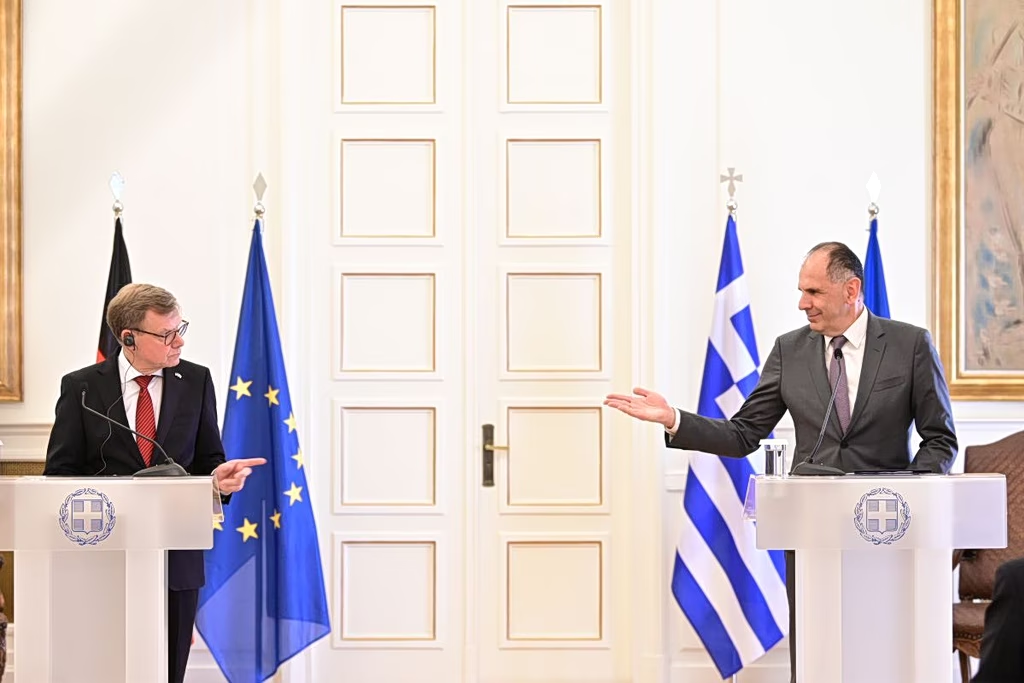
 Given the mutual praise heaped on the state of bilateral relations, it was striking that the one-day stopover at the foot of the Acropolis marked the first official visit by a member of the German cabinet since the Merz government took office almost exactly a year ago. Wadephul had already attempted a visit in October; at the time, the Greek side canceled at short notice because Foreign Minister Giorgos Gerapetritis had to accompany his prime minister to a Gaza conference in Egypt convened by Donald Trump – a decision that, by some accounts, caused irritation in German government offices.
None of that tension was visible this time. In front of the press, both ministers celebrated the “excellent” quality of relations and spared no effort in affirming their sense of closeness and friendship. Gerapetritis invoked the German philhellenism of the classical era, even referencing Johann Wolfgang von Goethe. Wadephul responded by calling Greece the cradle of democracy and “the origin of our humanist thinking,” which continues to shape today’s system of values – and which must be defended. On the major questions of global politics – from Iran and the Strait of Hormuz to Sudan and Gaza – both sides, he said, were “pulling in the same direction.”
The real news lies in the agreement to elevate relations to an even higher level. Under a new formula, the two countries will now speak of a “partnership for strategic cooperation.” This rests on a fundamentally revised ten-year action plan, replacing the 2016 document. Notably, both ministers repeatedly emphasized the term “strategic,” while references to the military dimension – new in both frequency and tone – stood out.
That German-Greek relations are increasingly acquiring a security dimension reflects a shifting geostrategic landscape: the war in Ukraine, tensions surrounding Iran and their repercussions for the Middle East – and, by extension, the eastern Mediterranean, which has become a sensitive zone for Greece. “In a world full of crises, we must safeguard Europe’s security,” Wadephul said, stressing that this effort extends not only to the north and east but also to “credible deterrence on NATO’s southeastern flank.” Germany and Greece, he added, intend to cooperate more closely both within Europe and the alliance. In unusually candid terms, the minister noted that Germany is keen to “significantly expand defense cooperation with Greece.”
In competition with France, Israel and the United States, Germany’s defense industry had recently fallen behind. In recent months, however, it has staged a remarkable comeback. While German firms have not secured the largest, multi-billion-euro procurement deals, they have nevertheless won lucrative follow-on contracts tied to the urgently needed modernization of aging Greek frigates, submarines and armored units. In the military high-tech sector as well, German providers are quietly operating at the forefront.
That Wadephul, before returning to Berlin, made a stop at the Skaramangas shipyard – described by the Foreign Office as the global market leader in submarine maintenance – amounts to a political signal. Berlin intends to secure a role in the Greek navy’s planned investments in ultra-modern submarines. The fact that German suppliers have now joined forces with a French arms manufacturer is likely to significantly improve their chances of coming out ahead.
Dr. Ronald Meinardus is a senior research fellow at the Hellenic Foundation for European and Foreign Policy (ELIAMEP).