 Μake us preferred on Google
 This week began in Westminster not with ceremony, but with unease. In a charged session before the Foreign Affairs Committee, MPs turned their attention to the government’s handling of one of its most sensitive diplomatic appointments.
Sir Olly Robbins, the former top civil servant at the Foreign Office, told MPs that Downing Street had taken a “dismissive approach” to the vetting of Lord Peter Mandelson, whose tenure as UK Ambassador to Washington has since unravelled.
“There was a strong expectation… that Lord Mandelson needed to be in post and in America as quickly as humanly possible,” he said.
His account suggested an atmosphere shaped by urgency and insistence.
Officials, he noted, were under “constant pressure” over the timing of the process. “There was never any interest, as far as I can recall, in whether, but only an interest in when.”
Despite this, Robbins stressed institutional resolve: “Whilst I think the department felt under pressure, we were proud of the fact we’d not bowed to that pressure.”
Downing Street rejected claims of a “dismissive attitude”, but the episode has sharpened questions about political judgement at a moment when Britain’s diplomatic credibility is under strain.
Α royal visit amid turbulence
Against this backdrop, King Charles III and Queen Camilla will arrive in Washington from 27 to 30 April for the most high-profile visit of his reign, marking the 250th anniversary of American independence.
The symbolism is striking. A British monarch will commemorate the moment the American colonies broke away from King George III – his own ancestor – while seeking to reinforce the modern alliance that replaced imperial rule.
Yet the visit comes at a moment of acute tension. Donald Trump’s criticism of the UK government’s stance on the Iran conflict has pushed transatlantic relations to what some describe as their lowest point in decades. Calls to cancel or postpone the visit have surfaced, particularly within Labor ranks.
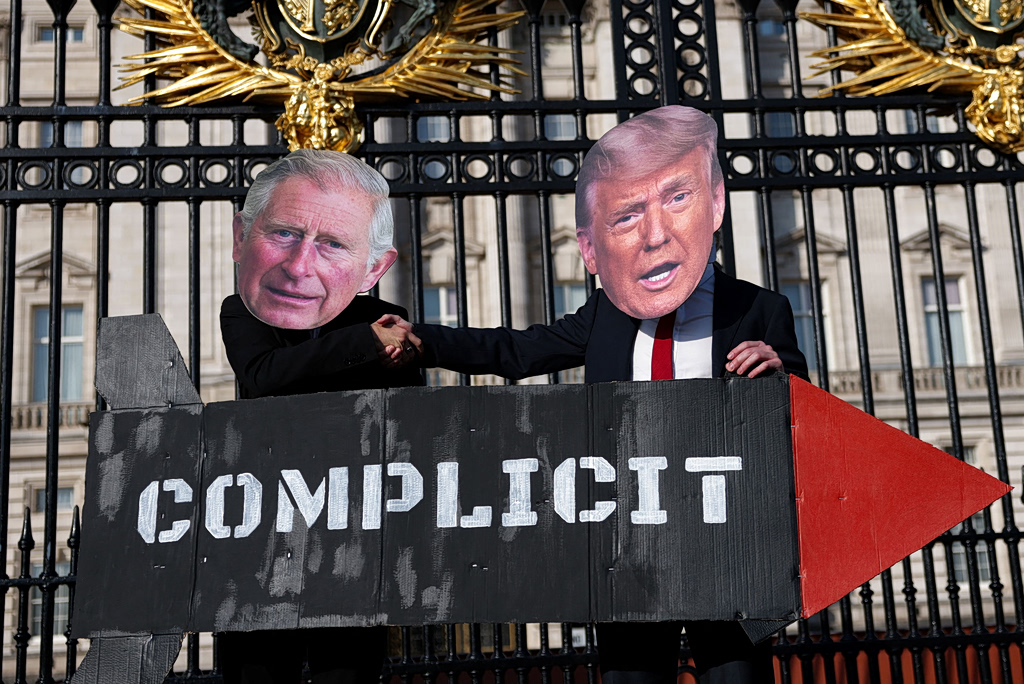
People from The Stop Trump Coalition dressed as Britain’s King Charles and U.S. President Donald Trump hold a prop missile outside Buckingham Palace as the group opposes the bombing of Iran and calls on the UK to stop allowing use of UK military bases by U.S. aircraft, in London, Britain, April 27, 2026. REUTERS/Hannah McKay
Professor Andrew Gamble, Emeritus Professor of Politics and International Studies at the University of Cambridge, tells TO VIMA: “I think the King would have been in a very difficult position had the visit been cancelled… it would have been treated as an incredible snub… they would have wanted to avoid that at all costs.”
Ceremony, choreography and quiet diplomacy
The visit’s programme is both traditional and strategic. The royal couple will meet the US President, attend a White House banquet, and King Charles will deliver an address to the US Congress.
There are also quieter gestures. The head gardener at the British Embassy in Washington has confirmed that its grounds are pesticide-free and organic – mirroring Highgrove and hinting at the King’s long-standing environmental convictions.
It is even suggested the royal couple could walk barefoot on the lawns.
Such details form part of Britain’s “soft power”: symbolic, cultural and personal influence operating alongside formal diplomacy.
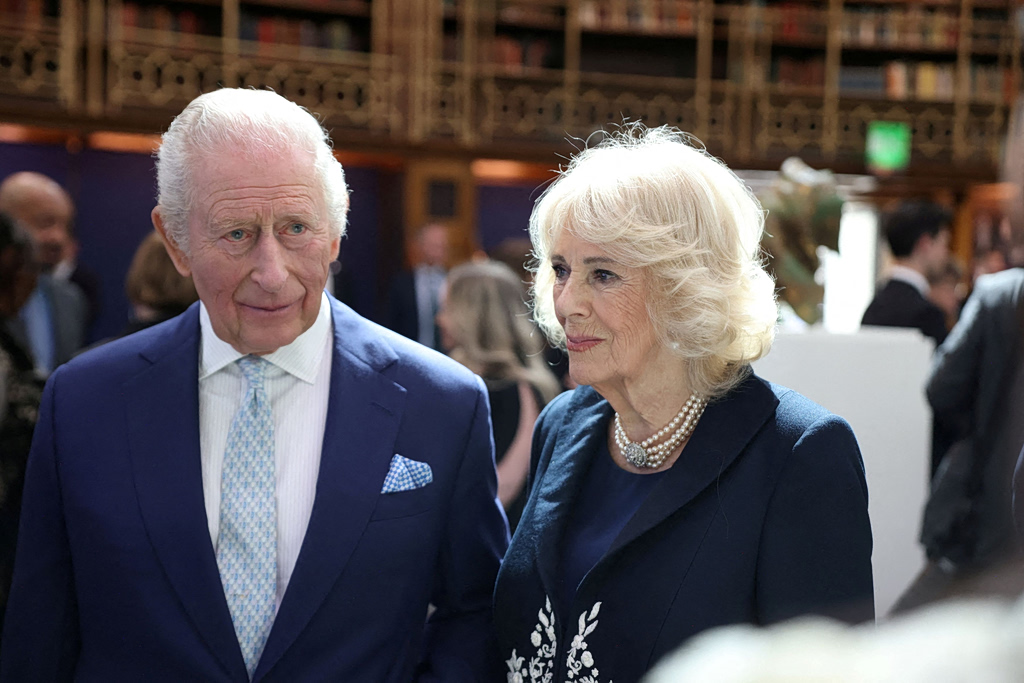
King Charles and Queen Camilla visit the British Museum to view the final design for the Queen Elizabeth Memorial, on the 100th anniversary of the late queen’s birth, in London, Britain April 21, 2026. Ian Vogler/Pool via REUTERS/File Photo
But the King’s role remains tightly constrained.
“The King has to stay as a constitutional monarch and can’t speak publicly about political issues,” Professor Gamble notes. “He’s not able in public to make any criticism.”
A short period of influence
Can such symbolism make a meaningful difference?
Professor Richard Toye, Professor of Modern History at the University of Exeter, is sceptical.
Speaking to TO BHMA, he says: “At the margins, they can help smooth things along… but it doesn’t really address the underlying issues.”
On Donald Trump, he is more pointed: “He’s very susceptible to things which look like flattery… very luxurious or special occasions… it can work to make him happy for a sort of a short period.”
But the limits are clear:
“Because Trump is so incredibly transactional… anything that you think that you’ve got out of him… he won’t be sticking to it the next day.”
Toye also places the relationship in a broader historical context: “Britain has been essentially subordinate to the United States… and that kind of contract has been broken under Trump.”
Echoes of 1957 – but a different world
There are echoes of Queen Elizabeth II’s 1957 visit to the United States, which followed the Suez Crisis – a moment of profound strain between the allies.
Her visit helped restore goodwill. US President Dwight Eisenhower remarked at the time: “The respect we have for Britain is epitomised in the affection we have for the royal family, who have honoured us so much by making this visit to our shores.”
That moment remains a benchmark for the monarchy’s diplomatic potential.
Yet today’s environment is markedly different. As Toye observes:
“Even when… people flew around the moon… it was kind of like the fourth item on the news.”
Royal visits now struggle to command sustained global attention. Their impact, he suggests, is cumulative rather than decisive: “A sort of periodic reminder that Britain exists… creating warm feelings in people who otherwise don’t pay very much attention.”
Scandal and the limits of image
If symbolism is the monarchy’s strength, scandal remains its vulnerability.
The Mandelson affair—linked to the wider Jeffrey Epstein scandal—continues to cast a shadow. The issue is compounded by the lingering controversy surrounding Prince Andrew and his alleged connections to Epstein.

Former British ambassador to the U.S. Peter Mandelson walks outside his residence in London, Britain, April 17, 2026. REUTERS/Chris J Ratcliffe
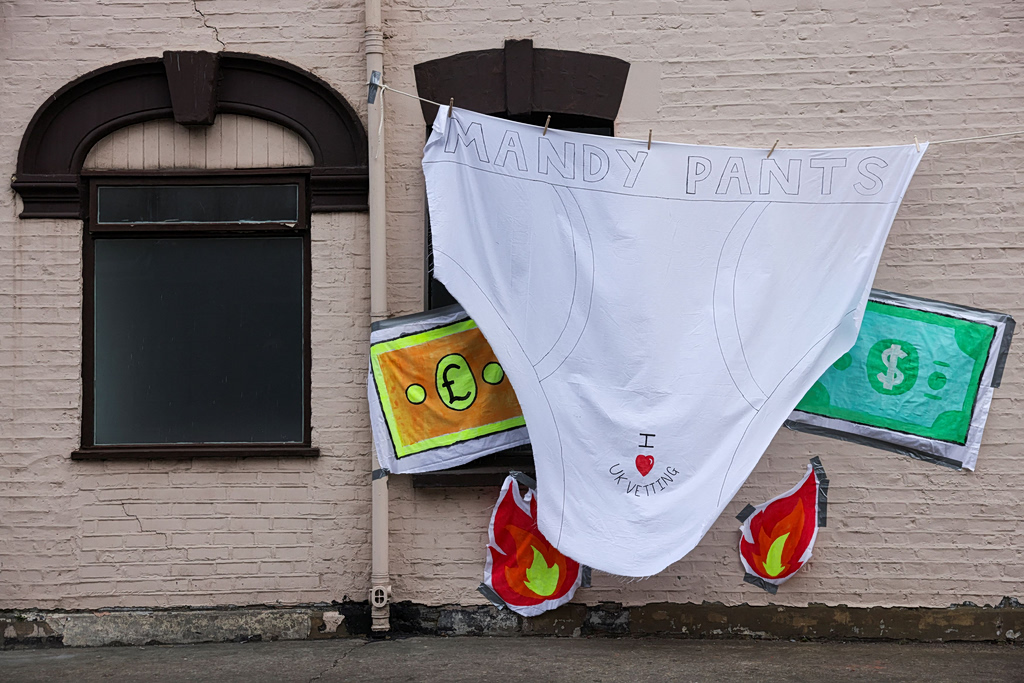
Signs are placed by protesters outside former foreign office official Olly Robbins’ residence, who faces questions from the Foreign Affairs Committee over the decision to appoint Peter Mandelson as British ambassador to the U.S. despite Mandelson’s failure to pass a vetting process, in London, Britain, April 21, 2026. REUTERS/Jack Taylor
Professor Robert Hazell, Professor of Government and the Constitution at University College London, tells TO BHMA: “For the American public, the controversy of greatest interest is the Epstein affair.”
He adds: “The contrast between the UK… and the US… where the only person to have been prosecuted is Ghislaine Maxwell.”
The unpredictability of the moment adds further risk: “Trump is so unpredictable, and so rude, that anything might happen… people will heave a sigh of relief if all goes according to plan.”
A relationship built on sentiment
The enduring fascination with the British monarchy remains a key asset in the United States.
Professor Christopher Hill, Emeritus Professor of International Relations at the University of Cambridge, tells TO BHMA: “There is often a very important sentimental element to the so-called special relationship.”
He notes that American audiences are drawn to “the pageantry… the sort of performative politics that people come across on TV”.
But such attention is fleeting: “This kind of thing… passes off very, very quickly.”
Hill also cautions against overestimating the relationship itself:
“Most professionals don’t really believe that it has a huge amount of political importance beyond certain intelligence and defense links.”
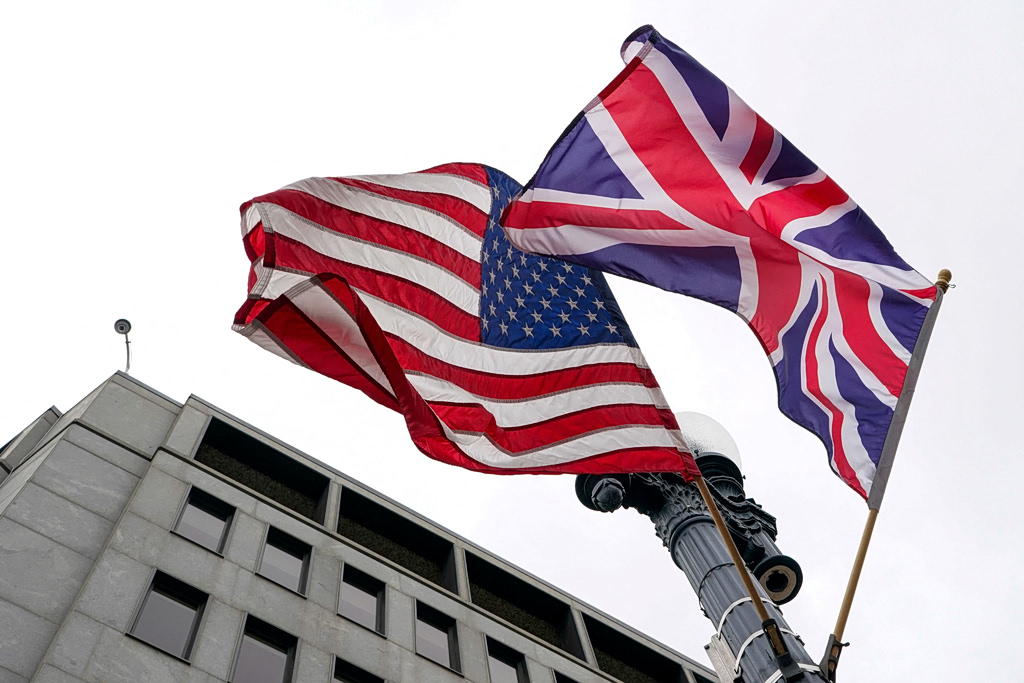
A U.S. flag and a Union Jack Flag fly in the wind near the White House ahead of Britain’s King Charles and Queen Camilla’s visit to the United States, in Washington, D.C., U.S., April 26, 2026. REUTERS/Elizabeth Frantz
The Monarchy: Asset and constraint
For Britain, the monarchy remains a distinctive diplomatic tool-but one with clear limits.
“The royal family is a remaining tool that the British have,” Toye says, “but it can’t… fundamentally alter anything on a permanent basis.”
Gamble echoes this duality: “These visits are largely ceremonial… they have no formal substance… but they express goodwill and build relationships.”
He also highlights a quiet tension: “The King is known to have views which clash very strongly with those of Donald Trump… but none of which he’ll be able to express.”
What success looks like
Expectations for the visit are deliberately modest.
“It is significant, not because it is likely to ease the current tensions, but for all the things that might go wrong,” Hazell observes.
In the short term, there may be a softening of tone.
“The president might tone down some of his sharper remarks… not wanting to make life difficult during the royal visit,” Hill suggests.
But beyond that, the outlook remains limited.
“Its impact will be largely symbolic,” Hazell concludes.
Between history and uncertainty
As King Charles arrives in Washington, the visit unfolds as a carefully managed performance – rich in symbolism, constrained in substance.
It will not resolve disputes over Iran, nor erase the shadow of Epstein, nor fundamentally reshape the balance of the transatlantic alliance.
But it may, briefly, steady a relationship under strain – offering a moment of continuity in an increasingly uncertain world.
For now, success may be measured not in what is achieved, but in what is avoided.