 Μake us preferred on Google
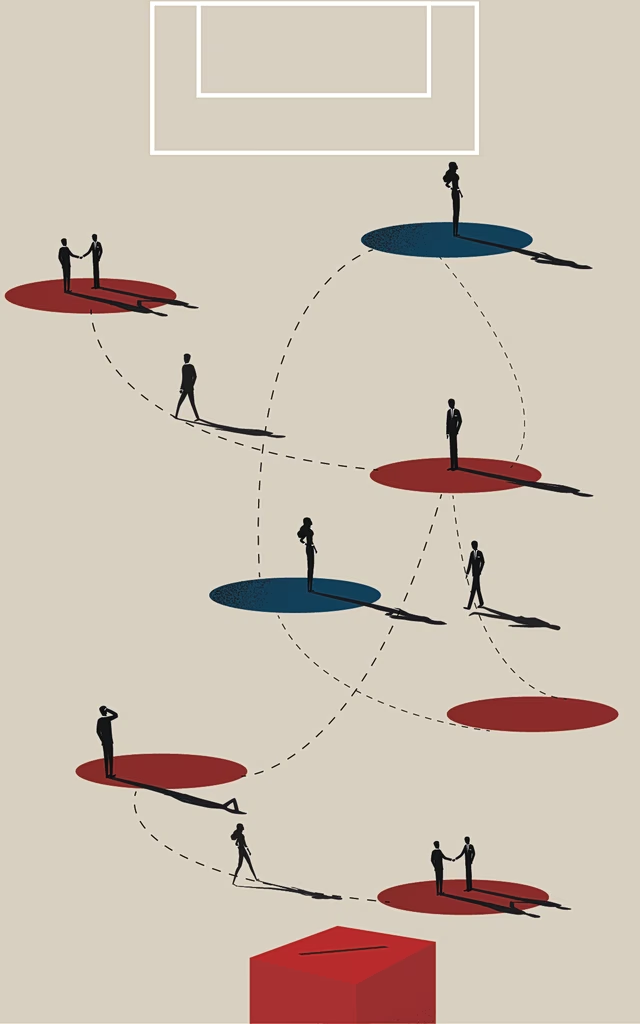
 “We are talking, yes,” says a politician. “But what are we talking about? We are only talking about ourselves.” The political system suffers from self-referentiality; political dialogue is a closed professional conversation. We are the subject of the discussion, we are also the object. And this is how the gap with the social body is created. Androulakis and Tsipras talk about Mitsotakis, Mitsotakis talks about the “Tower of Babel” or the “troupe,” and all of them together talk about themselves. Mitsotakis and his third term, Androulakis and his stuck needle, Tsipras and his rebranding. You scratch the surface and you fall back onto the surface. It is impossible for dialogue – this dialogue – to pierce the concrete of a country that remains unreformed.
“Nothing has changed,” says a businessman. “Corruption, clientelist relationships, networks, bureaucracy. You constantly stumble everywhere; the state and administration operate the way they have always operated.” The progress counter resets to zero in everyday life. 2026 is not 2015, nor even 2019; “steps have been taken,” according to the most modest government narrative, or “leaps,” according to the more aggressive marketing version. Yet in their everyday lives, the many – those outside the networks – live through Groundhog Day. They watch the self-referential dialogue. They do not participate in the conversation. And they stay away from the ballot boxes.
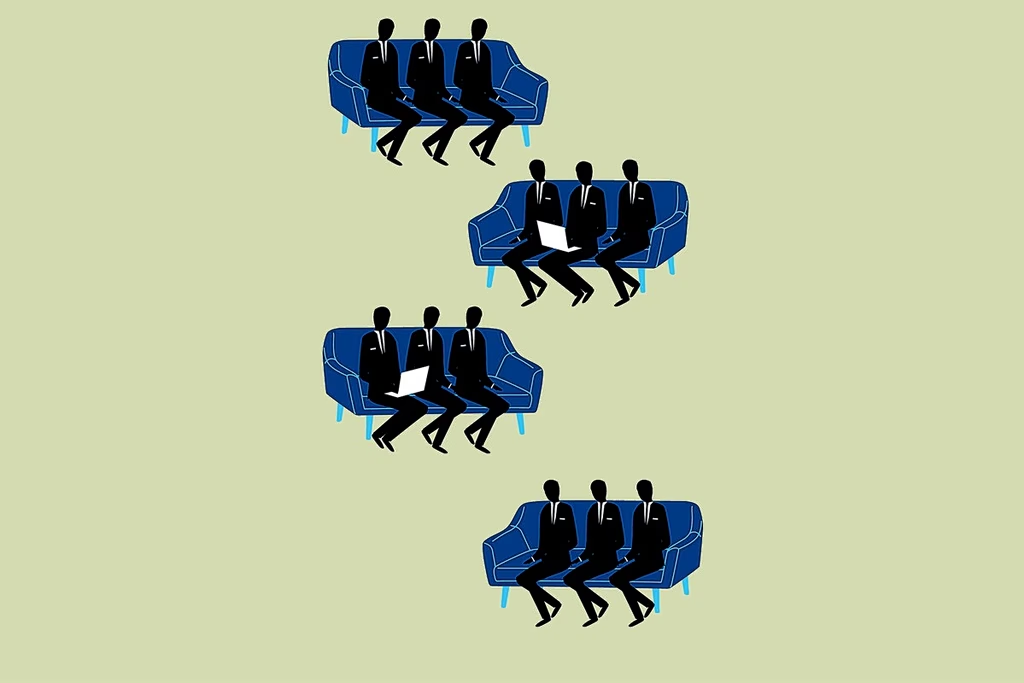
The abstention in the European elections was enormous enough that it cannot be made up only of all kinds of deniers, who have anyway already found their political expression in monastic-like formations, beeswax-ointment movements, and Aramaic prophecies. Sitting on their couches were political beings: young people grounded in reality, moderate, creative, well-travelled.
This positive spirit has been overwhelmed by the feeling of disappointment that pollsters measure. Not because all these people belong to a nation of complainers. But because they have enough experiences and points of reference to know that things are done differently elsewhere. That social prosperity is not identical with welfare-policy handouts – “painkillers” if you are in the opposition, or the “generous packages” announced at the Thessaloniki International Fair if you are in government. That wealth is a product of free creation and not of improper transactions. And that you build your life because of who you are, not because of who you know.
New Democracy believes that this audience belongs to it, and Kyriakos Mitsotakis, as a methodical campaigner, allows the ghost of early elections to hover while at the same time wearing his institutional hat and cultivating the slogan of his pre-election campaign: “Greece of 2030.”
“Give them a sense of perspective,” the imported spin doctor seems to say. Correct. The past says nothing to those who want to live; the present carries the burdens of high prices and corruption; only the future remains, however difficult it may be to convince someone that in the next three years he will do what he did not do in the previous eight.
It is precisely this difficulty, however, that will trap political dialogue once again in its self-referential nature. “Come and vote so that they do not come,” one side will say, because the opposition suffers even more when framed within the package and logic of “me and the others.” “Come and vote so that he leaves,” the opposition will say, because for eight years it has failed to convince people that it possesses an alternative plan for governing.
A political dialogue that is not only self-referential but also toxic is the safest method for making the many on the couch stay at home. To abstain from something that will appear to them as nothing more than a “surrounding stupidity.” Stupidity?
“The Italian computer scientist Alberto Brandolini once formulated the ‘bullshit asymmetry principle,’” says a newspaper addict. “It states that an infinitely greater amount of energy is needed to refute nonsense than to produce it…”