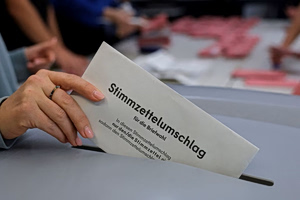
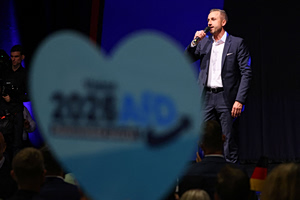
Rarely has interest in Germany’s domestic politics been as intense as it was before and after September’s state elections, which delivered historic victories for the Alternative for Germany (AfD). Amid the loud celebrations of the far-right winners in Berlin and Magdeburg, the capital of Saxony-Anhalt, where the AfD is laying the groundwork for the first state government under its leadership, the response from ideological allies elsewhere in Europe went largely unnoticed – for good reason. There was almost no response to hear.
Anyone expecting favorable reactions to the historic shift to the right in Europe’s heartland has been disappointed. Leading figures on Europe’s far right, including Britain’s Nigel Farage, Italy’s Giorgia Meloni and France’s Marine Le Pen, remained silent and have yet to comment on the AfD’s string of victories. Some voices on the far right did, however, speak up to distance themselves from the party. “We have real problems with both style and substance. We do not regard the AfD as our ally in Germany,” a lawmaker from Le Pen’s National Rally told the news agency Agence France-Presse.
Unlike France and Germany, where cohesive political forces to the right of the mainstream have a real prospect of taking power, Greece’s equivalent political camp is fragmented. Presently three parties with parliamentary representation are competing for public support. Even on Greece’s far right, enthusiasm for the AfD’s advance is limited. There is no sign of euphoria.
Among the more favorable comments were those of Kyriakos Velopoulos, leader of Greek Solution, the party that current polls show attracting the strongest support on the far right. In a television interview, Velopoulos, the German-born son of Greek guest workers, said his party was experiencing a “surge” similar to the AfD’s in Germany. He added that, in his view, the AfD would sooner or later take power in Germany.
Nor were there congratulations for the AfD from Voice of Reason, a relatively young party on the right. “I am glad when citizens wake up,” said its leader, Aphrodite Latinopoulou. Europe’s “patriotic parties,” she said, share a vision of fighting illegal immigration, the woke agenda and socialism. “Beyond that, of course, there are differences,” the European Parliament member added. Voice of Reason’s spokesman was more explicit: The party had no ties to the AfD and would not change that position for the foreseeable future – a clear distancing from the successful German party.
Europe’s far-right parties are far from speaking with one voice. Within the illiberal right, Germany’s election winners are outsiders whom the vast majority want nothing to do with. “The deeper reason is ideological, not tactical,” the German writer Jörg Bong wrote in an article titled “Nobody Likes Me,” describing the AfD’s isolation within the mainstream of Europe’s far right. “The AfD violates the fundamental rule on which the entire European New Right has rested for 50 years. That rule is: Never say blood. Never race, never biology. The AfD says it.”
These ideological divisions are plainly visible in the European Parliament, where three separate alliances occupy the space to the right of the center-right. For Greek politics, one point is particularly relevant: The three Greek parties each go their own way in Strasbourg. Greek Solution’s two lawmakers have joined the European Conservatives and Reformists (ECR), the national-conservative, Euroskeptic bloc that also includes Giorgia Meloni’s party. Voice of Reason belongs to Patriots for Europe, where Marine Le Pen’s party is a leading force. The lawmaker from NIKI has chosen not to join any group. As an unaffiliated member, he has, at best, very limited opportunities to make himself heard. Finally, at the far-right edge of the European Parliament’s political landscape sits Europe of Sovereign Nations (ESN). The AfD dominates this group, having fallen out with France’s National Rally over political differences.
Membership in one of these alliances is only one way to understand a party’s political position. Its voting record in Parliament is also revealing. Antonis Papacostas of the Athens-based think tank ELIAMEP examined these records and found a striking degree of alignment between Greek Solution and the AfD. “Greek Solution shows the most consistent alignment with the AfD. Of all the Greek parties, it is the closest to the AfD,” according to his analysis of the data. The alignment is particularly pronounced, Papacostas said, in votes concerning Russia and Ukraine. When it comes to opposing Western aid to Ukraine, the AfD and Velopoulos’s party speak virtually with one voice.
The AfD’s string of victories has triggered a political earthquake in Germany. It threatens not only the future of the government in Berlin but, in the view of some observers, the CDU’s very existence. In the words of AfD leader Alice Weidel, the declared goal is the “pulverization” of this historic broad-based party. She claims the AfD has already come very close. “We are the new broad-based party. We have replaced the CDU,” said the supremely confident politician.
Opinion polls show the AfD currently well ahead of the CDU. Yet there is a long way to go before the next federal election, which must be held by the spring of 2029 at the latest. The growing support for Germany’s far right is a source of concern that extends beyond the majority of Germans. The lack of enthusiasm for the AfD’s victories even among Europe’s far-right parties sends a clear signal.
Dr. Ronald Meinardus is a Senior Research Fellow at the Hellenic Foundation for European and Foreign Policy (ELIAMEP).