 Μake us preferred on Google
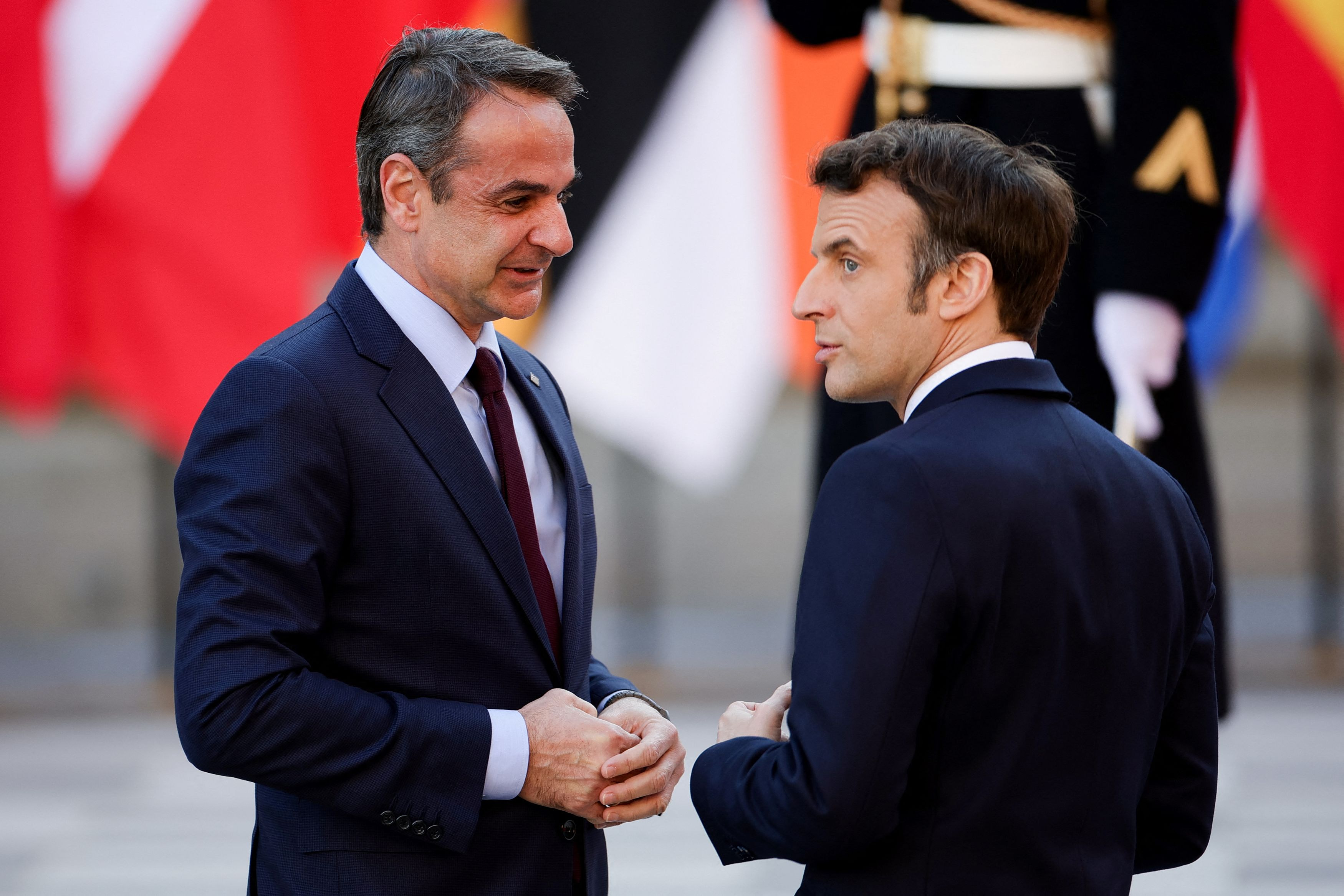
 The French–Greek defense agreement originally signed in 2021 is reportedly set to be renewed during French President Emmanuel Macron’s visit to Athens on April 24–25. The visit is expected to be accompanied by a large French delegation, including some of France’s largest companies and senior political figures.
The renewal of the agreement is expected to go beyond the framework of 2021, reflecting an expanded agenda shaped by recent geopolitical developments. These include shifting global dynamics such as renewed US strategic priorities, debates over European self-sufficiency, and ongoing regional instability linked to conflicts such as Iran and the Strait of Hormuz. Against this backdrop, the meeting between Prime Minister Kyriakos Mitsotakis and President Macron signals both a deepening bilateral relationship and a broader emphasis on European defense autonomy, particularly along the EU’s south-eastern frontier.
The 2021 Strategic Agreement and the Turkish Dimension
The 2021 defense agreement established deep institutional and operational ties between Greece and France. Mitsotakis emphasized at the time that the relationship extends beyond NATO and the EU, marking early steps toward European strategic autonomy. Macron at the time stressed the need for Europe to defend its interests in the broader neighborhood—including the Eastern Mediterranean, Middle East, and Sahel—while aligning geopolitical ambition with economic strength.
Defense Procurement and Legal Structure of the Agreement
The 2021 agreement included the acquisition of 24 Rafale fighter jets and 3+1 Belharra-class frigates for the Hellenic Navy. Advanced systems such as the FDI Belharra frigates, equipped with SeaFire radar systems and ASTER missile capabilities, further enhance Greece’s regional deterrence posture in the Eastern Mediterranean. The three frigates—Kimon, Formion, and Nearchos—form the core of this program, with Kimon already delivered to Greece, while the second FDI frigate, Nearchos, entered sea trials in February 2026.
The agreement also included a mutual defense clause (Article 2), which, while symbolically significant, remains legally more limited than NATO’s Article 5. It allows for assistance in the event of an armed attack but leaves room for joint assessment of the nature of aggression, meaning automatic military intervention is not guaranteed.
Importantly, the agreement is not a treaty in the strict legal sense and therefore does not constitute the highest form of state commitment. It also explicitly excludes territorial disputes such as Exclusive Economic Zones (EEZs), which under international law are not considered sovereign territory. France has clarified that defense obligations apply only to internationally recognized territory in accordance with the UN Convention on the Law of the Sea.
A Region of Strategic Recalibration: Eastern Mediterranean at the Centre
The Eastern Mediterranean is increasingly becoming a focal point of geopolitical transformation, marked by overlapping shifts in security, energy, and regional alignment. Macron’s visit highlights this broader geopolitical recalibration in the region, and reflects a maturing strategic partnership between Athens and Paris that extends beyond traditional defense cooperation.
The relationship is evolving into a more systemic framework that includes industrial cooperation, maritime research, deterrence and regional connectivity. It reflects not only security convergence but also a broader alignment of strategic outlooks in a region shaped by competing interests and persistent instability.
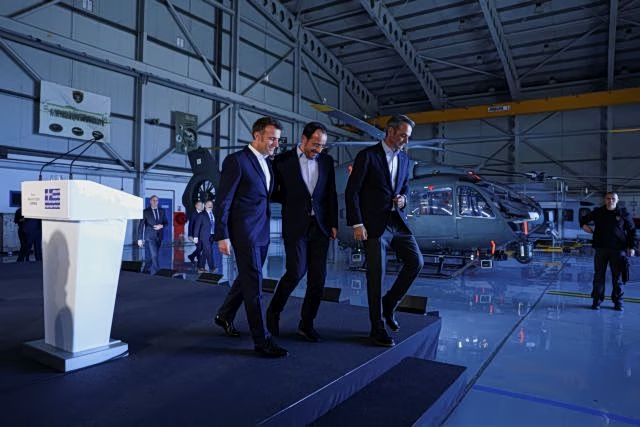
French President Emmanuel Macron, Cypriot President Nikos Christodoulides and Greek Prime Minister Kyriakos Mitsotakis leave after a joint press conference at Paphos military airport, on the day of Macron’s visit to show France’s solidarity after recent drone attacks amid the U.S.-Israeli conflict with Iran, and aimed at reinforcing European security in the Eastern Mediterranean, in Paphos, Cyprus March 9, 2026. REUTERS/Gonzalo Fuentes/Pool
This dynamic was further illustrated during a joint visit to Cyprus by Emmanuel Macron, Kyriakos Mitsotakis, alongside Cypriot President Nikos Christodoulides, amid heightened tensions linked to the Iran conflict. The leaders reaffirmed their partnership and coordination, highlighting the political significance of this emerging trilateral alignment and France’s stated solidarity with Greece and Cyprus in reinforcing European security in the Eastern Mediterranean.
The Turkish Dimension
France’s support for Greece was particularly evident during the Greek–Turkish tensions of summer 2020. Dispute arose over migration pressures at the Greek–Turkish border, and the deployment of the Turkish research vessel Oruc Reis, escorted by warships aimed to conduct exploration in areas claimed by Greece as part of its continental shelf. France expressed explicit political and military support for Greece and Cyprus. In response to escalating tensions, France increased its military presence in the Eastern Mediterranean in August 2020, deploying the frigate La Fayette and the amphibious helicopter carrier Dixmude to nearby waters, including areas overlapping with Turkish naval activity.
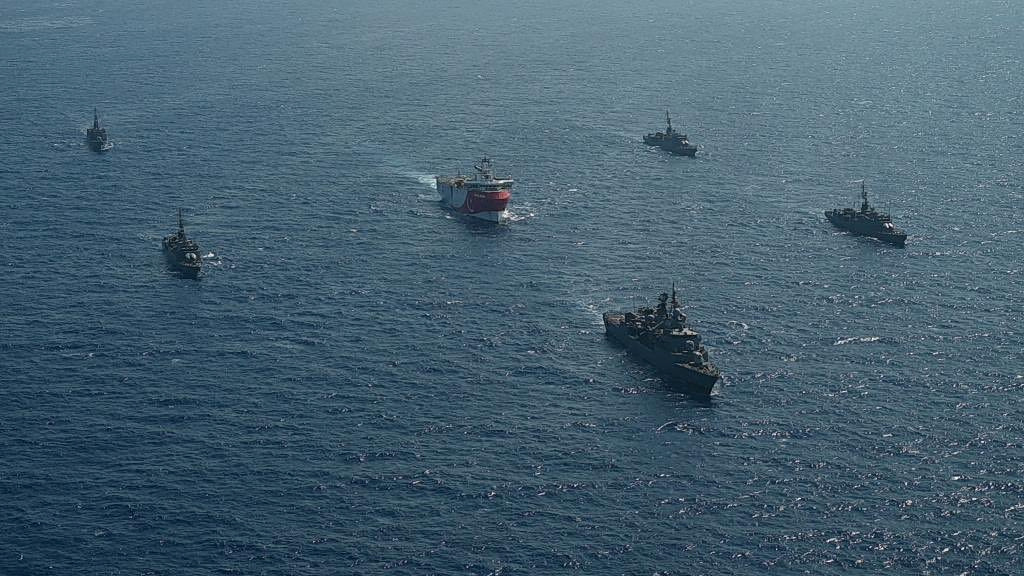
Turkish seismic research vessel Oruc Reis is escorted by Turkish Navy ships as it sets sail in the Mediterranean Sea, off Antalya, Turkey, August 10, 2020. Picture taken August 10, 2020. Turkish Defence Ministry/Handout via REUTERS ATTENTION EDITORS – THIS PICTURE WAS PROVIDED BY A THIRD PARTY. NO RESALES. NO ARCHIVE.
During the same period, French officials also voiced clear disapproval of the Turkey–Libya maritime agreement. France further reinforced its regional posture through participation in major exercises such as “Alexander the Great 2020,” while expanding its operational footprint in the Mediterranean. This included the training and deployment of the aircraft carrier Charles de Gaulle.
France nevertheless continued to pursue and maintain diplomatic and economic engagement with Turkey, as illustrated by a parallel visit during the period of the Greek–French defense agreement signing. At that time, French Minister for Foreign Trade and Economic Attractiveness Franck Riester travelled to Istanbul to participate in a Joint Economic and Trade Committee (JETCO) meeting.
France sees Greece as an Critical Regional Actor
Greece’s geopolitical position—situated between Europe, Asia, and Africa—places it at the center of multiple intersecting regional dynamics. Acting as a bridge across the Aegean and the wider Mediterranean, Greece is increasingly positioned as a bridge between energy routes, security frameworks, and regional markets.
Recent developments have strengthened this role, including progress in digitalization, renewable energy expansion, the Vertical Gas Corridor, offshore hydrocarbon exploration, and other projects such as the Great Sea Interconnector between Cyprus, Greece and Israel. Together, these initiatives enhance Greece’s comparative geopolitical advantage and reinforce its role as a key actor in South-Eastern Europe.
As an emerging energy gateway for Southeastern Europe, Greece connects LNG flows toward the Western Balkans, strengthening its energy infrastructure and positioning itself as a stabilizing node in Europe’s post-crisis energy architecture. Greece’s role as a bridge is further underscored by its support for European integration, with particular relevance to the Western Balkans. This was reinforced during the first day of the Delphi Economic Forum 2026, where Foreign Minister George Gerapetritis presented the Delphi Declaration on the Western Balkans, a renewed framework for regional integration and EU enlargement.
In this context, French strategic and industrial engagement aligns with Greece’s ambition to serve as an energy hub. France’s broader vision of European strategic autonomy places energy security at the intersection of defense, industrial policy, and state resilience.
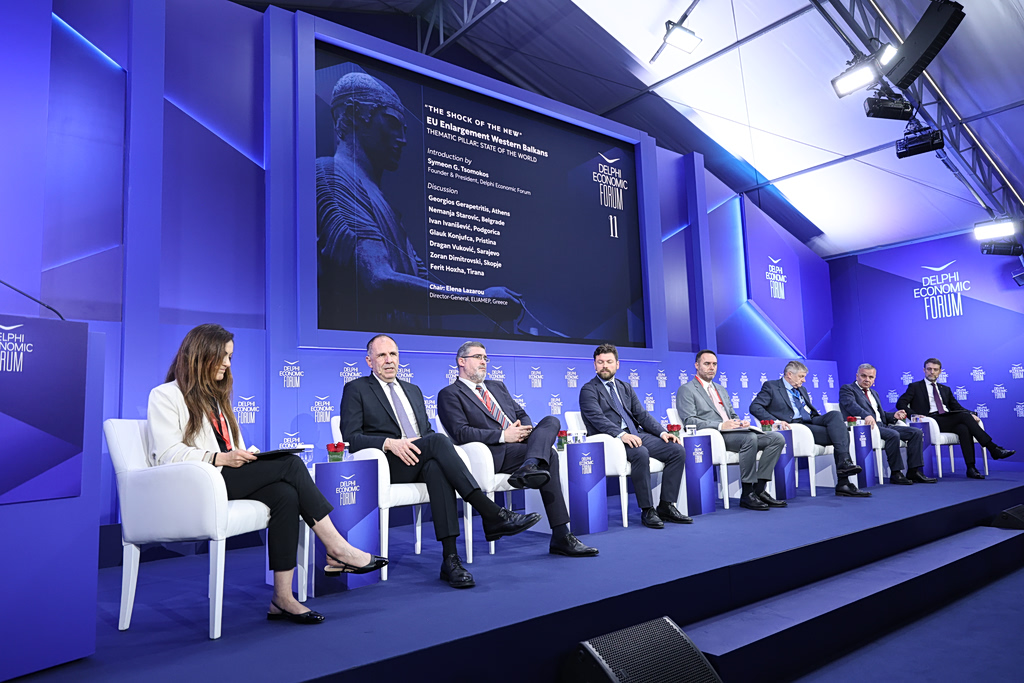
First Day of the 11th Delphi Economic Forum (ΓΙΑΝΝΗΣ ΠΑΝΑΓΟΠΟΥΛΟΣ/EUROKINISSI)
Military Cooperation Since 2021 Agreement
Defense cooperation between Greece and France has significantly expanded through sustained joint exercises and operational integration since 2021.
Operational interoperability has been strengthened through planning coordination, logistics support, and combined training activities. Exercises such as “ARGO-25,” conducted in Volos, included landing operations, special forces cooperation, and air defense drills, and “Orion 2026” saw Greek armored units deploy over 2,000 kilometers to France in what became one of the largest deployment of Greek armored forces.
Air force cooperation has also intensified. Within the ARGO-25 exercise, in July 2025, a joint training activity south of Crete involved a French A330 MRTT aerial refueling aircraft, escorted by two Rafale fighter jets, that conducted aerial refueling procedures and escort operations in coordination with a pair of HAF Rafale aircraft from the 332 Squadron.
In late 2024, Greek Defense Minister Nikos Dendias and then French Armed Forces Minister (current PM) Sébastien Lecornu also agreed on the purchase of 16 Exocet missiles, while defense innovation cooperation expanded, signaled by a Greek–French symposium announcement in 2024.
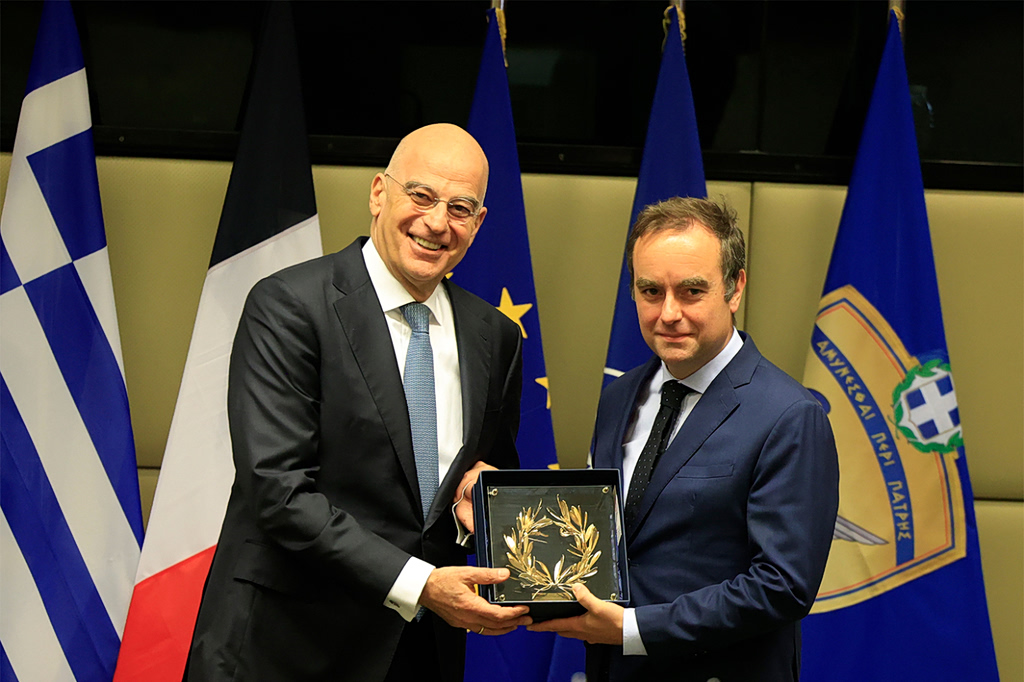
Dendias has repeatedly emphasized confidence in France as a key security partner. “Greece is always certain that France will take into account in its decisions the security of Greece and the need for our country to maintain a comparative technological advantage of deterrence against the forces of revisionism”.
The Nuclear Dimension and Emerging Strategic Depth
In March 2026, President Macron announced an expansion of France’s nuclear deterrence posture, with a significant increase in France’s nuclear warhead stockpile and the introduction of a doctrine of “forward deterrence” aimed at closer coordination with selected European partners.
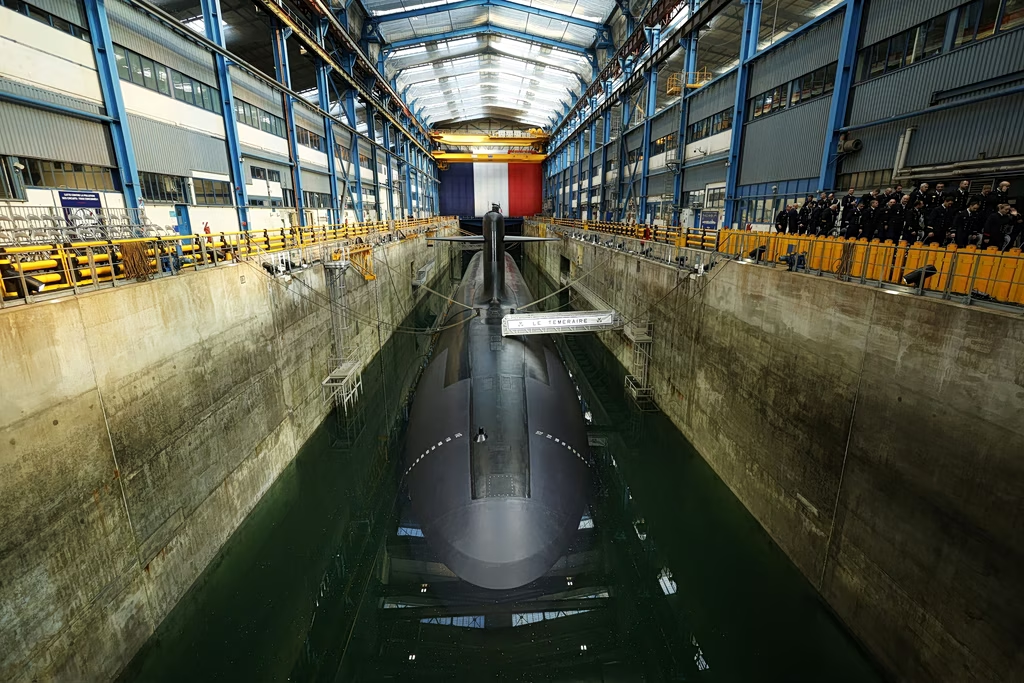
Greece is reportedly among the countries considered within this extended nuclear framework, though the arrangement remains politically and operationally undefined. If developed further, it could position Athens as a key strategic partner in the Eastern Mediterranean within a broader European deterrence architecture.
Reports also suggest that submarine cooperation may be part of ongoing talks, including the potential acquisition of Scorpene-Class submarines, further deepening defense-industrial alignment between the two countries.