 Μake us preferred on Google
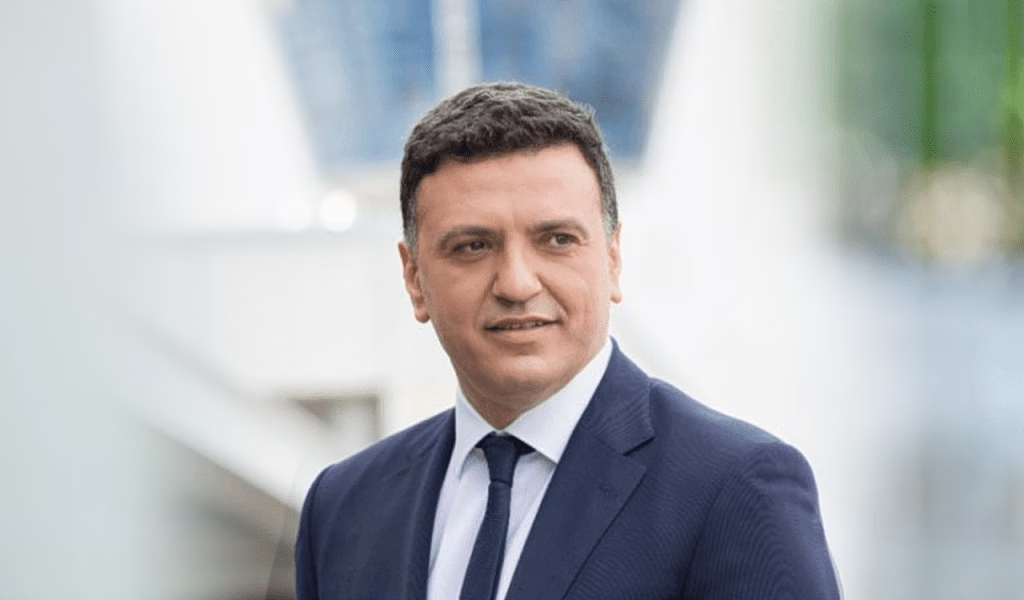
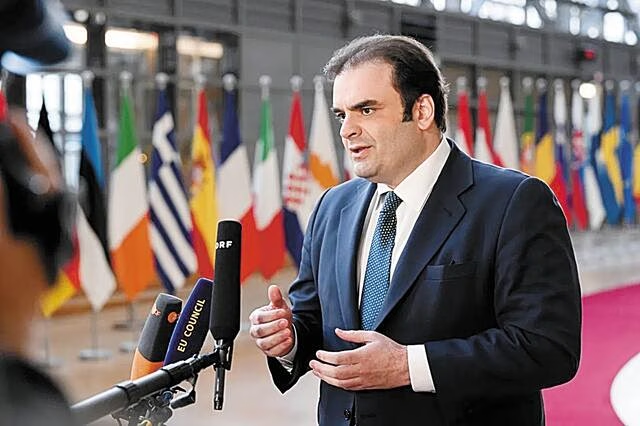
 Greek Finance Minister Kyriakos Pierrakakis has outlined a long-term vision for the country’s island regions, emphasizing investment, infrastructure and economic growth while describing Greece’s islands as “not the edge of the country, but its heart.”
Pierrakakis spoke in Rhodes at the “Four Regions, One Vision” conference, organized by the governors of Greece’s four island regions—South Aegean, North Aegean, Crete and the Ionian Islands—in cooperation with local business and professional chambers.
He began by expressing condolences to the families of firefighters who recently lost their lives battling wildfires in Crete and voiced support for residents affected by the fires. He also recalled the devastating wildfire that struck Rhodes several years ago, saying the island’s recovery demonstrated the value of planning, coordination and cooperation among government agencies, local authorities, volunteers and residents.
Islands as Drivers of Economic Growth
Pierrakakis argued that Greece’s islands should no longer be viewed solely through the challenges of remoteness and higher costs, but as major engines of national development.
He said the islands play a leading role in tourism, shipping, agriculture, clean energy and the blue economy while also serving as the European Union’s external borders.
Citing tourism data, he noted that the South Aegean accounts for 26.8% of overnight stays in Greece, followed by Crete with 22.5% and the Ionian Islands with 13%, meaning those three regions together generate more than 60% of the country’s overnight tourism.
He also highlighted strong tourism growth in the North Aegean, which recorded a 7.9% increase in tourist arrivals in 2025, attributing part of that growth to the introduction of an express visa program for visitors from Turkey.
“The next challenge is to increase the value produced on the islands even further,” he said, calling for stronger links between tourism, agriculture and manufacturing, longer tourist seasons, greater support for small and medium-sized businesses, and increased investment in technology and innovation.
Infrastructure and Investment at the Core
The minister said long-term development depends on investments in water supply, energy, ports, airports, roads, digital infrastructure, modern utility networks, waste management and civil protection.
He said Greece’s economic performance has created greater opportunities for investment, pointing to economic growth above the European average, rising investment, lower unemployment and a rapidly declining public debt.
Pierrakakis also highlighted the government’s National Development Program for 2026-2030, worth €23 billion ($26.4 billion), describing it as a key tool for financing regional priorities after the completion of the EU Recovery Fund.
He outlined major projects already underway across the island regions, including:
- More than 480 projects in Crete worth €7.7 billion, including the new Kasteli Airport, the Northern Road Axis of Crete (VOAK), and the Crete-Attica electricity interconnection.
- 504 projects in the South Aegean totaling €5.2 billion, focused on water infrastructure, connectivity and public works.
- 307 projects in the North Aegean worth €2.4 billion, including major road, dam, museum and energy network projects.
- More than 260 projects in the Ionian Islands valued at €1.8 billion, including the Lefkada undersea tunnel, water infrastructure in Corfu and other transport improvements.
He stressed that infrastructure projects on islands are often essential rather than simply important because of their geographic isolation.
Europe Must Support Island Regions
Pierrakakis said island regions should remain central to future European Union policies, arguing that greater competitiveness cannot come at the expense of regional cohesion.
He emphasized the importance of the EU’s cohesion policy and said the bloc’s next long-term budget should continue supporting regional development rather than widening inequalities.
He also reiterated Greece’s support for extending the tax exemption on shipping fuel for another decade, arguing that alternative marine fuels are not yet available on a sufficient scale and that removing the exemption prematurely would increase transportation costs for island residents.
“The Heart of Greece”
Concluding his address, Pierrakakis called for a unified long-term strategy to create better-connected, greener, more productive and more digitally advanced islands with stronger infrastructure and greater investment opportunities.
“Our islands are not the edge of Greece. They are its heart,” he said. “They are not the edge of Europe. They are the front line of its future.”