 Μake us preferred on Google
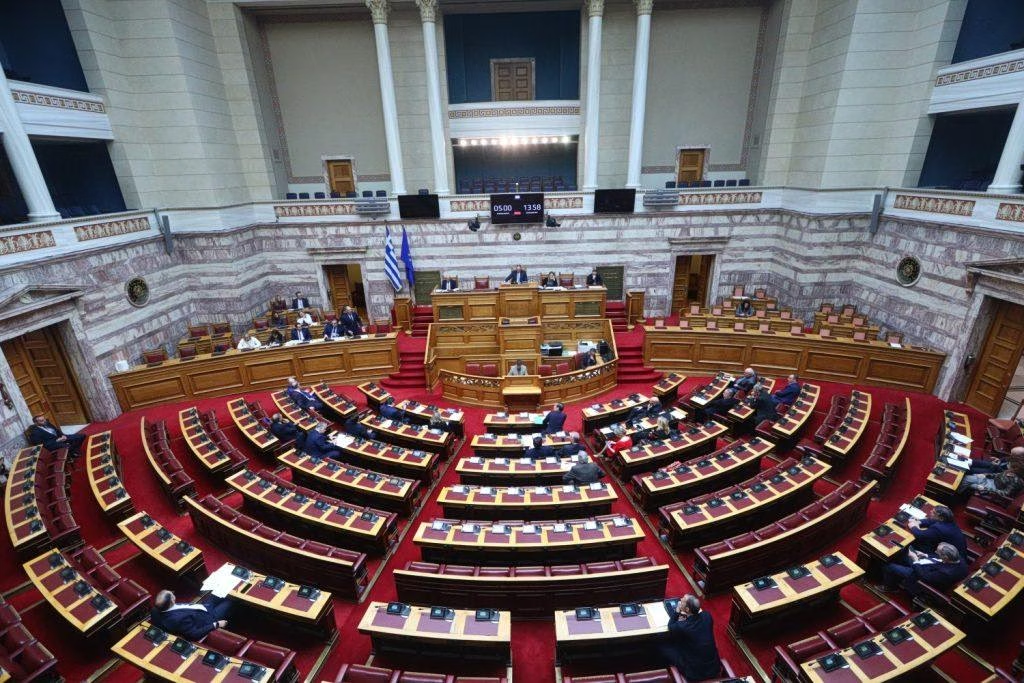
 Greece’s Ministry of Environment and Energy has submitted a bill to Parliament that would expand the responsibilities of the country’s two main water companies, EYDAP and EYATH, while introducing broader changes to the management and regulation of water services.
The bill, titled “Expansion of the responsibilities of the Athens Water Supply and Sewerage Company and the Thessaloniki Water Supply and Sewerage Company, strengthening of the Regulatory Authority for Waste, Energy and Water, regulations for the Thessaly Water Management Organization and other provisions,” will begin examination by the relevant parliamentary committee on Friday, July 24, 2026.
Modernizing Greece’s water management framework
According to the bill’s explanatory report, the legislation seeks to modernize and unify the institutional framework governing water services in Greece.
The government identifies several challenges, including the fragmented structure of water service providers, differences in administrative capacity, infrastructure gaps and the need to ensure reliable and sustainable water supply, wastewater management and irrigation services while maintaining the public character of water management.
To address these issues, the bill provides for the expansion of the geographical responsibilities of EYDAP, which serves the Athens region, and EYATH, which serves Thessaloniki.
It also includes provisions for transferring relevant responsibilities and assets from existing providers, establishing procedures for the valuation and transfer of property, protecting the rights of local authorities and employees, and allowing additional providers to voluntarily join the new system.
Stronger regulation and water resilience
The proposed legislation also updates the operating framework of EYDAP, EYATH and EYDAP’s fixed assets company, while strengthening the role of the Thessaly Water Management Organization.
At the same time, the regulatory powers of the Regulatory Authority for Waste, Energy and Water (RAAEY) would be expanded to improve oversight, transparency in pricing policies and protection for water service users.
The bill also introduces faster procedures for projects aimed at tackling water shortages, with the goal of improving the resilience of Greece’s water infrastructure against the effects of climate change.
Broader environmental and planning reforms
The legislation also includes updates to spatial planning, urban planning, environmental and energy regulations.
Among other measures, it addresses the sustainable development of abandoned and declining small settlements, aiming to protect architectural heritage, natural landscapes and the environment through stricter planning rules designed to prevent uncontrolled construction.
The bill also updates responsibilities related to the protection of biodiversity and natural areas, including the Natural Environment and Climate Change Agency (OFYPEKA) and management units for protected areas.
Additional provisions concern environmental protection issues in the Natura 2000 area of Mount Athos, as well as specific urban planning matters and pending issues in energy legislation.
These include regulations for renewable energy projects, electricity storage facilities, self-consumption procedures, quarrying activities, organizational changes at Greece’s electricity distribution operator and transitional licensing procedures for heat pumps.
The government says the proposed framework is intended to create a more coordinated and efficient system for managing water resources while addressing wider environmental and development challenges.