 Μake us preferred on Google
 The situation in terms of irregular migration flows throughout the eastern Aegean has reached historic lows amid closer cooperation with Turkey, Migration and Asylum Minister Thanos Plevris said Thursday, while at the same time he warned that Crete has emerged as the country’s main pressure point for migrant smugglers operating from Libya.
According to Plevris, the contrast between Crete and the eastern Aegean is stark, as Greece’s large island has become the main destination for migrant boats departing from eastern Libya, particularly the area around Tobruk. He said more than 12,000 people have reached Crete and nearby Gavdos so far this year.
The route has accounted for more than half of the sea arrivals to Greece and has increasingly involved foreign nationals from Sudan, Bangladesh, Afghanistan and other countries across Africa and Asia.
The surge has also been uneven, with periods of relatively limited arrivals followed by concentrated waves of migrant boats. May saw a particularly sharp increase, while July was comparatively quieter than the same month last year. Arrivals accelerated again in August, he said, with hundreds of people reaching or being picked up off southern Crete in a series of incidents over recent weeks.
The scale of the movement has placed additional pressure on reception facilities on the island. Authorities have been using a temporary facility at the port of Heraklion, while a new reception and identification site is being prepared at Achanes, near the city. The existing facility at Agia also remains part of the island’s migration-management infrastructure.
Plevris, speaking during a television current affairs program on Thursday morning, said the government’s approach is to distinguish between arrivals who appear to have a “refugee profile” and those considered primarily as seeking better economic conditions in Europe. Under the new EU migration framework, those with a “refugee profile” can be transferred to available facilities on the mainland, while others are held in closed facilities while their asylum claims are processed and, if rejected, arrangements are made for their return.
He pointed to the handling of arrivals of Egyptian nationals as an example of the government’s tougher approach, arguing that the use of closed facilities and increased returns had helped reduce the number of Egyptians illegally arriving in Greece. He said the number fell from about 3,500 in the first half of 2025 to around 820 in the corresponding period this year, while returns rose from 49 to more than 300.
The minister identified Sudan as a key source of current arrivals and said Bangladesh was also a prominent source of people trying to enter Greek and EU territory via the Crete route. He argued that several migration corridors remain active and that Greece, Italy and Spain are particularly exposed because foreign nationals view them as transit countries into the wider European Union.
Greece faces an additional geographic challenge, with maritime approaches from Turkey, Egypt and Libya as well as a land border with Turkey. Athens has therefore sought to curb departures from Libya through increased cooperation with authorities in eastern Libya, while pressing European partners to adopt a coordinated approach.
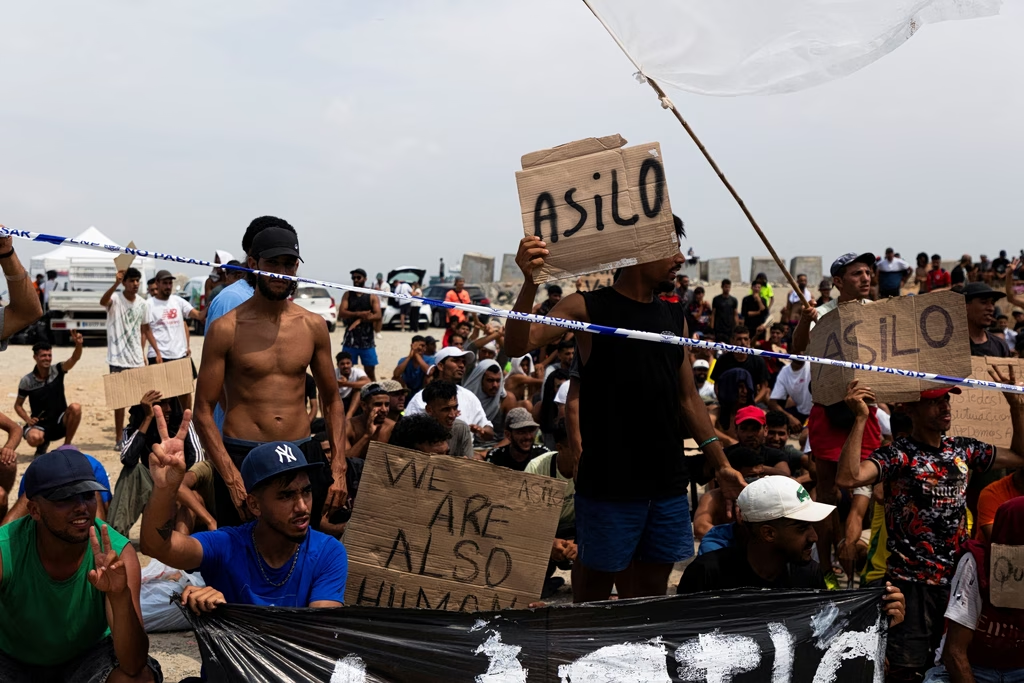
Foreign nationals that swam into the Spanish enclave of Ceuta from Morocco, on the North Africa coast, demand “Asilo,” Spanish for “asylum,” as they gather in Ceuta, Spain, August 16, 2026. REUTERS/Maria Alejandra Cardona.
Moreover, Plevris also criticized the socialist Spanish government’s migrant “regularization policies”, arguing that broad legalization measures could encourage more people to attempt the Mediterranean crossing. With large migrant populations concentrated in eastern and western Libya, he warned that changes perceived as offering a rapid path to legal status could further increase departures toward Europe.