 Μake us preferred on Google
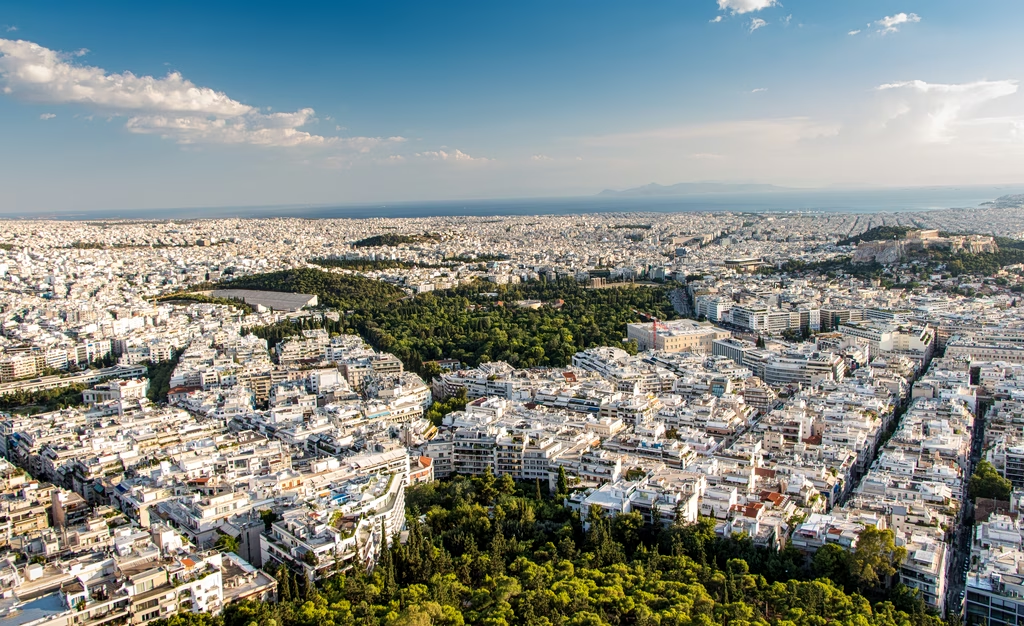
 Could the answer to Greece’s housing crisis lie two floors up? Prime Minister Kyriakos Mitsotakis’ proposal at the TO BHMA conference, offering zoning and financial incentives for buildings constructed exclusively for affordable long-term rental, has taken on a new dimension as Athens confronts not only soaring housing costs but also the consequences of climate change.
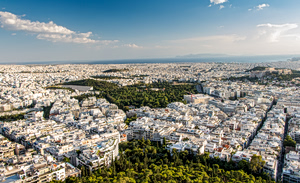
The scale of the challenge was laid bare Thursday at Prodexpo 2026 by Konstantinos Kartalis, professor of environmental and climate physics at the National and Kapodistrian University of Athens (NKUA). “We have built our cities for a climate that no longer exists,” he said. Construction, he explained, is not climate-neutral: depending on its design, it can either strengthen or undermine a city’s resilience, and taller buildings may worsen conditions in certain neighborhoods.
Mitsotakis has made expanding the housing supply a priority, championing the build-to-rent model, in which properties are developed from the outset for long-term leasing rather than sold off unit by unit. According to government sources, the framework under development would offer additional building rights, possibly one or two extra floors, along with tax breaks, favorable financing, and faster permitting. In return, developers would have to offer affordable rents and keep the units on the long-term rental market for a set period.
Athens Mayor Haris Doukas has pushed back, arguing that the housing crisis cannot be solved with “more concrete” and that the priority should be putting the city’s vacant homes back into use.
Kartalis added a critical variable to the debate. Rising urban temperatures, he noted, stem not only from climate change but also from how the city functions, with vehicle traffic alone generating about 20% of the heat produced in the urban environment. Extreme weather, meanwhile, demands a fundamentally different approach to urban engineering. He also called for a new Master Plan for Athens, arguing that key factors have shifted since the current framework was adopted in 2012, from construction and traffic patterns, shaped by the new city rising at Hellinikon and the planned government park on Mount Hymettus, to climate risk itself.
The real question, then, is not how many homes are added to the market, but where they are built, on what terms, and with what infrastructure. Tackling the housing crisis cannot be separated from the resilience of a city that will absorb more affordable housing while having suffered a shortage of public green space for decades.
Renovation Programs Under Scrutiny
The next critical chapter concerns the “Exoikonomo” energy-efficiency subsidy programs. Findings presented at Prodexpo suggest they need a broader scope, covering not only energy upgrades but also summer thermal comfort, indoor air quality, and structural safety.
Margarita Niki Assimakopoulou, a professor in NKUA’s Department of Physics, noted that most buildings examined by researchers overheat in summer, because renovations focus mainly on winter heating needs. Without adequate solar shading, an energy-upgraded property can still face serious problems in the hot months. Poor indoor air quality, particularly in offices, further underscores the need to weigh more factors when planning renovations.
Another gap concerns structural integrity. Exoikonomo does not generally require a full structural assessment of subsidized homes, raising the risk that energy upgrades are funded in older buildings whose structural safety has never been evaluated. Giorgos Stasinos, president of the Technical Chamber of Greece (TEE), has repeatedly urged that energy upgrade programs be tied to structural inspections and, where necessary, structural and seismic reinforcement.
The issue is whether European funds earmarked for renovating the building stock are being used in an integrated way, or whether the programs must be redesigned to address energy efficiency, resilience, and safety together. Otherwise, public money risks being spent on interventions that ignore a building’s most serious weaknesses.
Energy upgrades will nonetheless remain central to planning in the years ahead. On August 6, Greece asked the European Commission to extend its national escape clause to cover spending that strengthens the country’s energy resilience; the EU Council approved the request just days ago. According to the Ministry of National Economy and Finance, the new investments are expected to exceed 1 billion euros by 2028, covering energy storage, energy efficiency, and energy infrastructure, among other areas.
Unlocking Public and Church Property
The debate at Prodexpo 2026 also turned to public property, and to how idle assets can become productive capital that generates revenue, jobs, and socially beneficial infrastructure.
Michalis Anagnostakos of the National Development Fund (formerly the Superfund) said public property is treated as national capital rather than a collection of individual assets, and is assessed against broader criteria to maximize the benefit to citizens. He cited the 200 million euros redevelopment of the Thessaloniki International Fair grounds, which will create new jobs, more than 1,000 parking spaces, and 12 hectares of green space. A 400 million euros tender to develop landmark railway stations is slated for launch by the end of 2026. To accelerate investment, however, he said lingering permitting issues must be resolved, as they limit flexibility and drag out timelines.
A different perspective came from Bishop Nikodimos of Epidaurus, director general of the Church of Greece’s Central Ecclesiastical Financial Service. The Church, he said, views its property as a legacy to be safeguarded, grown, and handed down to future generations with social benefit in mind. Only 4% of its once-vast historical holdings remain, and much of what is left is tied up. He pointed to Evangelismos Hospital, built on land belonging to the Petraki Monastery, as well as the Sotiria and Asklepieio Voulas hospitals, whose contracts with the state have expired.
The Church aims to resolve ownership disputes over these sites and develop the rest of its property for the public good, with options under consideration including affordable housing for students and workers.