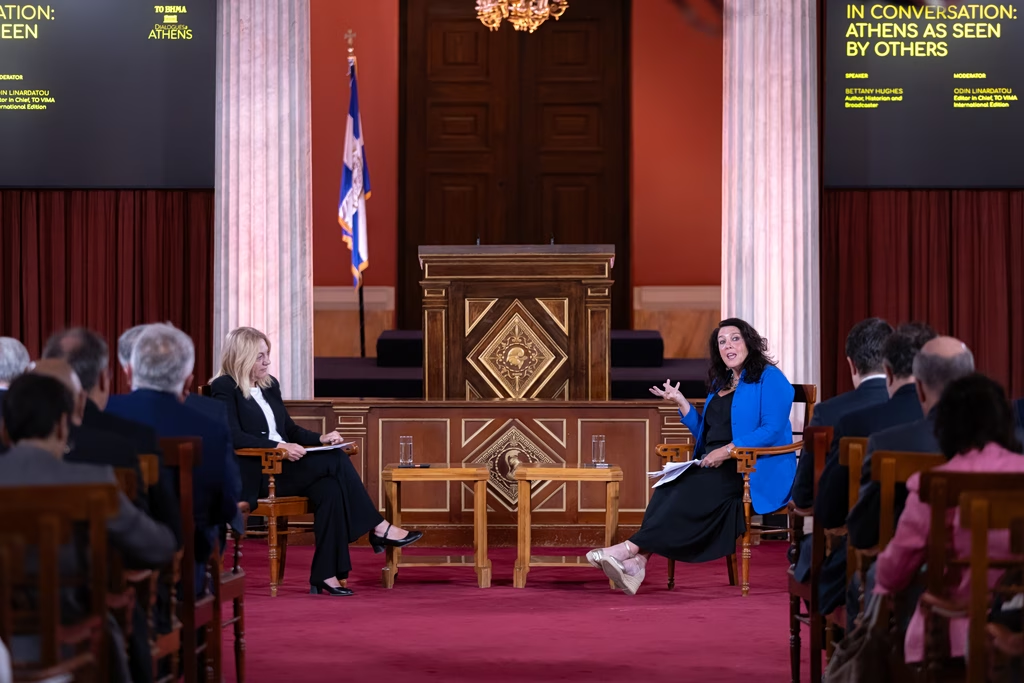
The first topic of discussion included the Odyssey and an observed renewed interest in the Classics across the world.
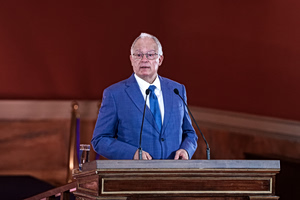
Prime Minister Kyriakos Mitsotakis said it is not easy to condense a 3,000-year-old epic into three hours, but called the cinematography of Christopher Nolan’s Odyssey incredibly impressive. The film’s commercial success, he noted, has revived interest in classical Greek studies, a core government priority, and confirms the value of incentives for international productions filming in Greece, a growing industry that creates jobs.
Daniel Mendelsohn agreed about condensing such an epic into a few hours, arguing that even ten hours might not have been sufficient. He pointed to powerful scenes like the Cyclops cave and the storms at sea. While some classicists complain people will only know the Odyssey from the film, he argued there is no downside, noting that sales of Odyssey translations are about 80% higher than last year.
The Parthenon Sculptures
Mendelsohn said the sculptures clearly belong in Athens. He noted that past debates on their return involved colonialism and cultural condescension toward Greece, but that changing attitudes on provenance over the last 30 years could lead to more productive negotiations. He reminded the audience that the first request for their return was made in 1836.
Mitsotakis said he prefers the term “reunification” to “return,” since the sculptures are part of a dismembered monument. He said they were clearly stolen by Lord Elgin and that ownership is not in question. The Parthenon frieze, he noted, tells the story of ordinary Athenian citizens honoring their gods, a message with special resonance when democracy is under pressure from both right and left.
He admitted talks have not progressed and said Greece will intensify its claims toward both the British Museum and the British government, since a 1963 law bars the museum from permanently removing items from its collection. He noted that the new British prime minister supported the sculptures’ return before taking office. Mitsotakis proposed a win-win deal: a cultural partnership offering the British Museum temporary exhibitions of Greek treasures that have never left the country, drawing on the collection of the National Archaeological Museum, which will close for years for renovation. With British public opinion in favor, he said the issue will also be part of discussions on closer UK-Europe relations.
Urban Planning and Green Spaces
Mitsotakis described Athens as a fascinating but chaotic city that grew without planning in the 1950s and 1960s. He said the unification of archaeological sites, now nearly complete, makes Athens an open museum. He highlighted the city’s turn toward its 50-kilometer coastline from Piraeus to Sounion, including the new park at Faliro, and the restoration of Tatoi, the former royal residence. Creating small parks, he said, is mainly the municipality’s job, adding that the current mayor has not done much in that direction.
The Housing Crisis
Mitsotakis called housing a European problem and a side effect of strong growth, with the Greek economy outpacing the eurozone average. He said Greece returns a full month’s rent, up to 800 euros, to every tenant renting a primary residence, roughly an 8% reduction. More supply is needed, however. The government has banned new short-term rental licenses in Athens’s historic center and offers tax incentives to convert short-term rentals to long-term ones. He pointed to Spain as a case where a socialist government failed to handle the crisis.
He proposed a build-to-rent model, allowing developers to add one or two floors if they build exclusively for long-term rentals. Greece’s highest administrative court has rejected similar incentives, so a balance must be found between environmental protection and the state’s constitutional duty to provide housing.
The Agora, Physical and Digital
Mendelsohn described the ancient agora as a space for exchanging ideas, citing a story from Herodotus in which a Persian king is told the agora is a place in the city center where people lie to each other. Mendelsohn then asked whether a uniquely Athenian space for exchanging ideas could be created today, possibly in a non-physical form.
Mitsotakis said the problem with the non-physical kind of digital agora is that it is curated by social media algorithms and functions as an echo chamber, which partly explains political polarization. He argued people need more physical spaces to gather, praised the large number of clubs and associations in Greece, and said the state and municipalities have a duty to create such spaces.
Public Transportation
Mitsotakis said most Athens buses are now new and electric, and the government is increasing service on the 20 most popular routes. The new metro line is a complex project with delays, but he called it the long-term answer to congestion. Line 1 is also being upgraded, with the first new train delivered and 14 more expected next year. A special police unit now patrols public transit, transit runs 24 hours on Saturdays, and road deaths have dropped about 30% in two years.
Lessons From Athenian Democracy
Mendelsohn warned against idealizing ancient Athens, noting its democracy was limited and ultimately collapsed. The concern with the Sophists, he said, was their ability to make the worse argument appear better, something visible today in the use of media and technology to distort reality. Speaking as an American, he pointed to the rapid collapse of many US institutions and suggested studying Athens’s failures to understand today’s challenges.
Artificial Intelligence and Education
Mendelsohn said modern democracies may be too large for citizens to feel connected, and compared AI to the printing press and writing as a life-changing technology. AI poses philosophical and practical threats, he said, and teachers must remind students that the real is real and the artificial is artificial.
Mitsotakis noted that while parents once told children to become programmers, AI can now write code better than the best programmers but cannot answer fundamental moral questions. Answering those requires training in classical philosophy. He predicted a revival of the liberal arts, but warned of the temptation to let AI replace thinking. The answer, he said, is encouraging young people to experience the beauty of struggling with a difficult text until they truly understand it.