 Μake us preferred on Google
 Alexis Tsipras accused the government of neutering the judiciary and turning Greece into what he called “essentially a regime,” in the first installment of a three part interview published Monday by in.gr. Two further installments are due Tuesday and Wednesday.
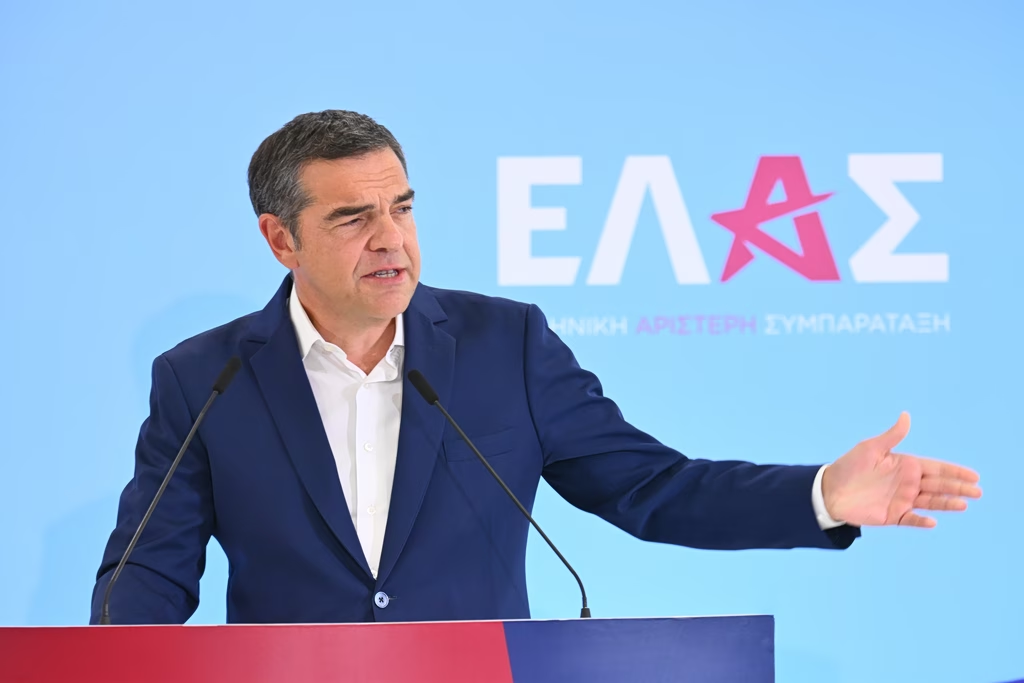
The former prime minister, who governed Greece from 2015 to 2019 and now leads the Greek Left Alliance, a party he founded in May 2026 under the acronym ELAS, said Greek courts have been sidelined by leadership appointed by the current government, and argued that European institutions have increasingly had to step in as a result.
“We have become the best customer of the European Public Prosecutor’s Office,” he said, citing the wiretapping scandal, the alleged cover up following the 2023 Tempi rail disaster that killed 57 people, and the ongoing corruption scandal at OPEKEPE, the agency that disbursed European Union farm subsidies.
Corruption and prices as ‘twin siblings’
Tsipras placed corruption alongside the cost of living crisis as the two central problems facing Greek society, describing them as inseparable.
“Corruption and high prices are twin siblings, because a large part of the price problem stems from that same corruption,” he said, arguing that graft diverts public resources away from essential services.
He offered a direct example: “Every euro missing from the public purse because it went into kickbacks or no bid contracts is a euro missing from public schools. It is a euro missing from public hospitals.”
Energy, food and housing at the center of the plan
Tsipras identified three drivers of the affordability crisis: the high cost of energy, food and housing. He rejected the idea that high prices are purely an imported problem, attributing much of the pressure to profiteering, cartels and oligopolies, and what he called the government’s unwillingness to confront them.
On energy, he said his party already has a plan to convert PPC, the Public Power Corporation, from an entity serving the interests of investment funds and private stakeholders into one that steers competition to benefit Greek households and lower prices. He said tapping European Union provisions for long term energy contracts could cut average energy costs by 30 percent.
For food prices, he proposed a digital price observatory tracking each product “from the field to the shelf” and monitoring profit margins at every link in the supply chain.
Rejecting subsidies in favor of confronting oligopolies
Tsipras said subsidy programs and one off payments, often referred to in Greece as “pass” schemes, do not address the causes of high prices.
“The issue of high prices cannot be addressed with subsidies,” he said. “Our approach is not to subsidize our way through the crisis, because that solves nothing.” He said, however, he would not rule out emergency support for citizens who need it, but insisted the underlying causes have to be tackled through what he described as a more decisive confrontation with powerful business interests.
Housing measures: regulating Airbnb, ending the Golden Visa for homes
Tsipras called for regulating short term rental platforms such as Airbnb and ending the Golden Visa residency by investment scheme as it applies to residential property. He also proposed incentives to bring vacant private properties back onto the rental market, using state owned real estate for housing, and developing new social and affordable housing programs.
The former PM also acknowledged that such measures could not provide immediate relief, but he highlighted that the first meaningful results could appear within one to two years.
‘Not the enemy’: positioning against entrenched interests
Tsipras pushed back on the idea that his political platform clashes with the European Union itself. “The European Union is not the enemy or the adversary,” he said. “The enemy is entrenched thinking and, of course, the very powerful interests that will resist a plan like this.” He argued that Greece’s core problem is not the market economy but its distortion by monopolies and oligopolies, saying capitalism needs to function under conditions of normalcy.
He summarized his broader economic aim as “raising wages, lowering the cost of living,” and said Greece should be converging with the European Union average rather than trailing behind it.
Learning from 2015
Tsipras said his experience in government has changed how he approaches politics since his first term began in January 2015. “In 2015 I knew what I wanted to do and what I wanted to happen, but I didn’t know exactly how it could be done,” he said. “Having now had that experience of governing, I can say today that I not only know what I want, but also how to do it.”
He also distanced himself from sweeping promises, saying politics is not the art of the possible but the art of expanding what is possible, built through what he called small daily victories rather than pledges of instant transformation.
The ‘sirens’ of politics
The interview closed on a more personal note, with Tsipras invoking Homer’s Odyssey and the idea of Ithaca. He said every political journey carries its own sirens, chief among them vanity and narcissism, which he said have to be kept in check.
Asked to respond to criticism that he has become more subdued and less combative, Tsipras pointed to the contradictory attacks he receives. “The main criticism from New Democracy is that I am the Maduro of the Mediterranean. Others say I am someone who has compromised,” he said. “When you hear such contradictory criticism, the truth is probably somewhere in the middle.”
The second part of the interview is due to be published Tuesday, with the third part following Wednesday.