 Μake us preferred on Google
 A newly discovered planetary system 71 light-years from Earth is so strikingly different from our own solar system that astronomers are struggling to find the right vocabulary to describe it.
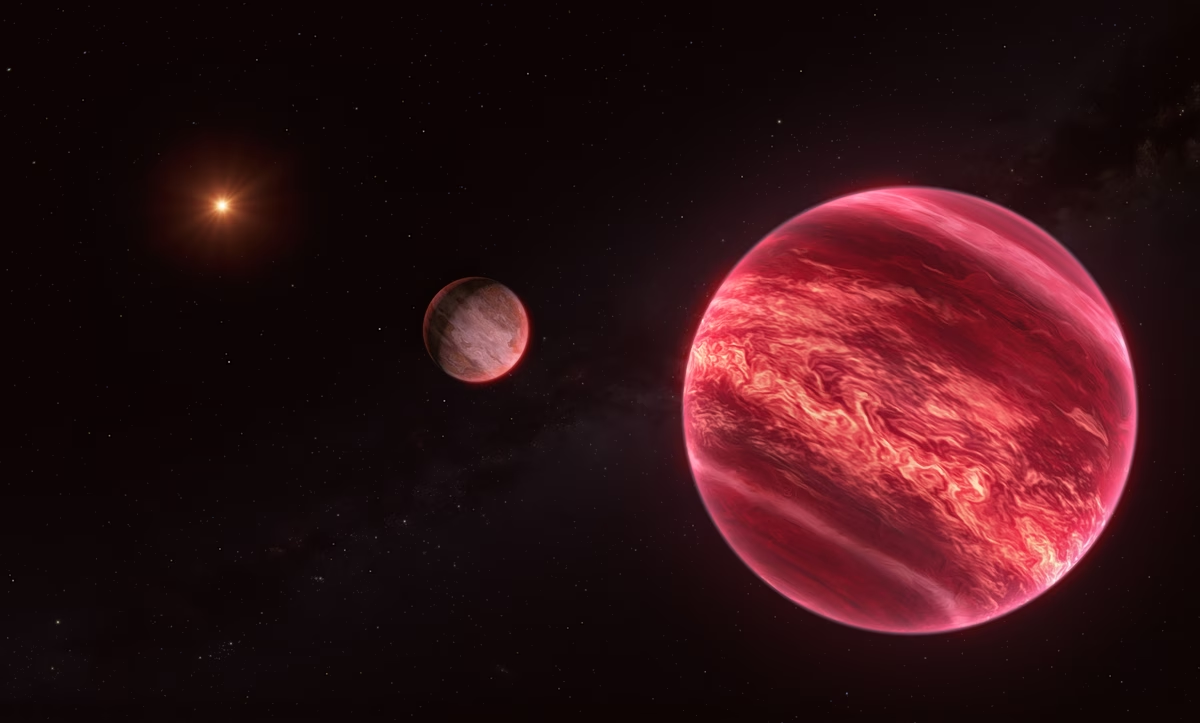
The system centers on a red dwarf, a small star with about 40% of the Sun’s mass, orbited by a brown dwarf, an object that sits on the boundary between planets and stars. Orbiting that brown dwarf, in turn, is a Jupiter-sized object just discovered using the Very Large Telescope at the European Southern Observatory in Chile.
Using our own solar system as a reference point, an object circling another body that itself orbits a star would normally be called a moon, or in this case an “exomoon,” since it lies outside the solar system. But the object orbiting the brown dwarf doesn’t resemble any moon in our solar system: it’s enormous and made of gas rather than rock.
What should it even be called?
Study lead author Kevin Hoy of Chile’s Diego Portales University, whose team published the findings in Nature, said this will definitely spark debate. He said most astronomers currently accept “exomoon” as an acceptable working term until more formal definitions are adopted for objects like this one, adding that scientists have essentially reached the limits of how far solar-system terminology can be stretched to describe other planetary systems.
A “Pandora’s box”
The object has at least 90% of Jupiter’s mass and takes 170 days to complete an orbit around the brown dwarf, sitting five times closer to it than Earth is to the Sun. Co-author Alice Zurlo, also of Diego Portales University, said the discovery has opened a Pandora’s box for the scientific community: it’s a genuinely new and unusual type of object, unlike anything seen in our own solar system, and researchers will need theoretical models to understand how such bodies form and whether they’re common.
Although astronomers have found more than 6,300 exoplanets, spotting an exomoon is a much harder task, and only a handful of candidates exist so far. For this particular one, researchers still don’t have a clear picture of how it formed. Zurlo said it may have formed from the disk of gas and dust surrounding the brown dwarf, the way planets form around stars, or alternatively it could have been gravitationally captured by the brown dwarf afterward.
Brown dwarfs share roughly the same composition as stars but have far less mass, meaning they can’t sustain nuclear fusion in their cores. This particular brown dwarf has 33 times Jupiter’s mass and a diameter 50% larger, and it’s also much hotter. Since the system is still very young, Zurlo said the brown dwarf continues to glow from residual heat left over from its formation.
Since the first exoplanets were discovered in the 1990s, astronomers have found a wide variety of planetary systems, some quite different from our own. Even so, this one stands out. “Yes, this system is genuinely strange. It likely went through a particularly chaotic dynamical history,” Hoy said, adding that it’s very difficult to pin down exactly what that chaotic history looked like.