Europe’s forests can no longer be protected using the methods of the past. Prolonged droughts, extreme wildfires, new diseases, and increasingly frequent severe weather events are creating conditions in which simply preserving existing forest cover is not enough.
Active adaptation is required, with species diversification, sustainable management, and financial and institutional support for those responsible for forests as key tools.
That is the conclusion of the European research program Informa Forests, coordinated by the ITACA Institute at the Polytechnic University of Valencia. Over four years, scientists studied forest ecosystems across five different biogeographic regions of Europe, looking for ways to strengthen their resilience against new climate threats.

Ancient stone arch covered in green ivy and moss framing a rocky stream flowing through a lush tropical jungle, historical ruins in natural forest environment. Source: Shutterstock
The study’s core message is that there is no single solution for the whole continent. Strategies need to be adapted to local conditions, water availability, tree species, terrain, land use, and the specific risks each region faces.
Forests with Variety
Diversifying forest species emerged as one of the most effective adaptation strategies. Mixed forests, where different tree species coexist, show greater resilience to drought, fire, insect infestations, and disease.
By contrast, areas dominated almost exclusively by a single species are more vulnerable. A disease, a pest, or a prolonged drought can affect most of the vegetation at once, causing widespread weakening or death of the trees.

Landes of Gascogne forest, with a close view of some leaves and flowers. Source: Shutterstock
In mixed forests, each species responds differently to stress. Some trees withstand water shortages better, others have greater heat tolerance, and others recover faster after a disturbance. This biological diversity acts as a kind of natural insurance against uncertainty.
Program coordinator José Vicente Oliver stressed that adapting Europe’s forests requires a combination of solutions tailored to each region’s specific characteristics.
He noted that science-based sustainable management will be essential if forests are to keep absorbing carbon dioxide, support water availability, preserve biodiversity, and provide social and economic value.
Beyond Carbon
The research warns that forest policy should not treat forests solely as carbon storage. Capturing carbon dioxide matters for limiting climate change, but it isn’t the only function forest ecosystems serve.
Forests regulate the water cycle, protect soil from erosion, sustain thousands of plant and animal species, and support the economy of rural and mountain areas. They provide timber and other natural resources, create jobs, and serve as spaces for recreation and public health.
According to researcher Eduardo Rojas, forest management must balance different goals: carbon capture, biodiversity protection, water resource conservation, sustainable production of forest products, and the ability to adapt to future disturbances.
Pursuing maximum carbon storage as a single-minded goal can even lead to poor choices. A dense, uniform forest may capture large amounts of carbon in the short term, but it also consumes more water and accumulates more fuel. If it’s eventually destroyed by a major wildfire, much of that stored carbon returns to the atmosphere.
Fire Prevention
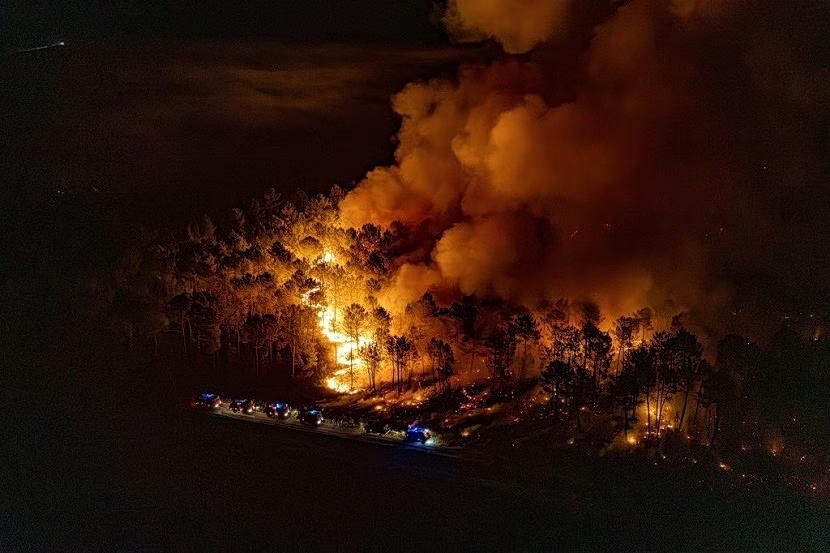
Informa Forests warns that extreme wildfires are expected to increase across Europe. Rising temperatures, drier vegetation, and prolonged dry spells are creating conditions for fire fronts that are difficult to control with conventional firefighting methods.
The solution, according to the scientists, lies mainly in what happens before a fire breaks out. Clearing and using biomass, creating zones with reduced fuel load, controlled grazing, and maintaining a mosaic of different land uses can limit how intensely and how fast a fire spreads.
Researcher Marta Esteve said the best way to put out a major wildfire is to prevent it from starting in the first place, noting that prevention and sustainable management will be key tools in Europe’s adaptation.
Special emphasis is also placed on supporting forest owners and managers. Implementing the necessary measures requires a stable legal framework, adequate funding, and compensation for the services forests provide to society.
The researchers examined tools such as voluntary carbon markets and forest certification systems. These can help finance sustainable management, provided they rely on strict, transparent, and scientifically grounded methods.
The program had a budget of 5.3 million euros from Horizon Europe and brought together 14 partners from eight EU countries. The models and tools developed aim to help both forest managers and governments.
For the Mediterranean and Greece, where large wildfires and rural abandonment create an explosive mix, the conclusion is clear: a resilient forest isn’t one left to chance, but one managed with knowledge before the flames appear.