A NASA spacecraft orbiting the moon has captured the clearest images yet of the crater left behind by a crashing SpaceX rocket. The space agency released before-and-after photos of the impact site on Tuesday.
The Falcon rocket’s upper stage slammed into the moon at 5,400 mph (8,700 kph) on August 5, after drifting through space for more than a year. It had launched a pair of private moon landers in 2025, carrying experiments and a small rover, as part of NASA’s effort to expand commercial lunar exploration.
Based on the new images from NASA’s Lunar Reconnaissance Orbiter, scientists estimate the fresh crater measures about 60 feet (18 meters) across and less than 10 feet (3 meters) deep.
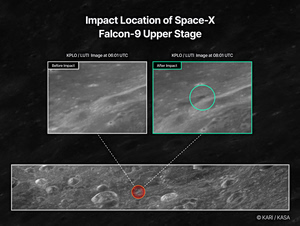
A composite of satellite images show the surface of the moon before and after the crash of the second stage of a SpaceX Falcon 9 rocket, which was launched from Firefly Aerospace towards the moon in January 2025, in this handout image released on August 6, 2026. KARI/KASA/Handout via REUTERS
Dark and bright streaks radiate outward from the crater like butterfly wings. The darker lines mark material that had been sitting near the surface, worn down over time by solar wind, cosmic rays, and micrometeorite impacts. The brighter streaks show fresh rock and soil thrown up from deeper underground.
The orbiter photographed the crater a week after the crash from 60 miles (96 kilometers) above the surface, moving at about one mile per second. Flight controllers had to tilt the spacecraft so its cameras could point directly at the impact site.
The orbiter completes a polar orbit around the moon every two hours as the moon rotates beneath it. It took six days for the crash site to come into view.
South Korea’s Danuri spacecraft was actually the first to capture and send back images of the impact site.
The Lunar Reconnaissance Orbiter has been circling the moon since 2009, serving as NASA’s close-up eyes on the lunar surface as the agency works toward returning astronauts to the moon.