 Μake us preferred on Google
A giant star in the Andromeda galaxy grew steadily brighter for seven years. Over that time it more than doubled in size while its surface temperature hardly changed. In October 2025, it erupted.
According to a study published November 18 in Nature, the slow brightening and sudden outburst point to a smaller star that orbited inside a massive companion until the two became one.
Little Bao And Big Bao
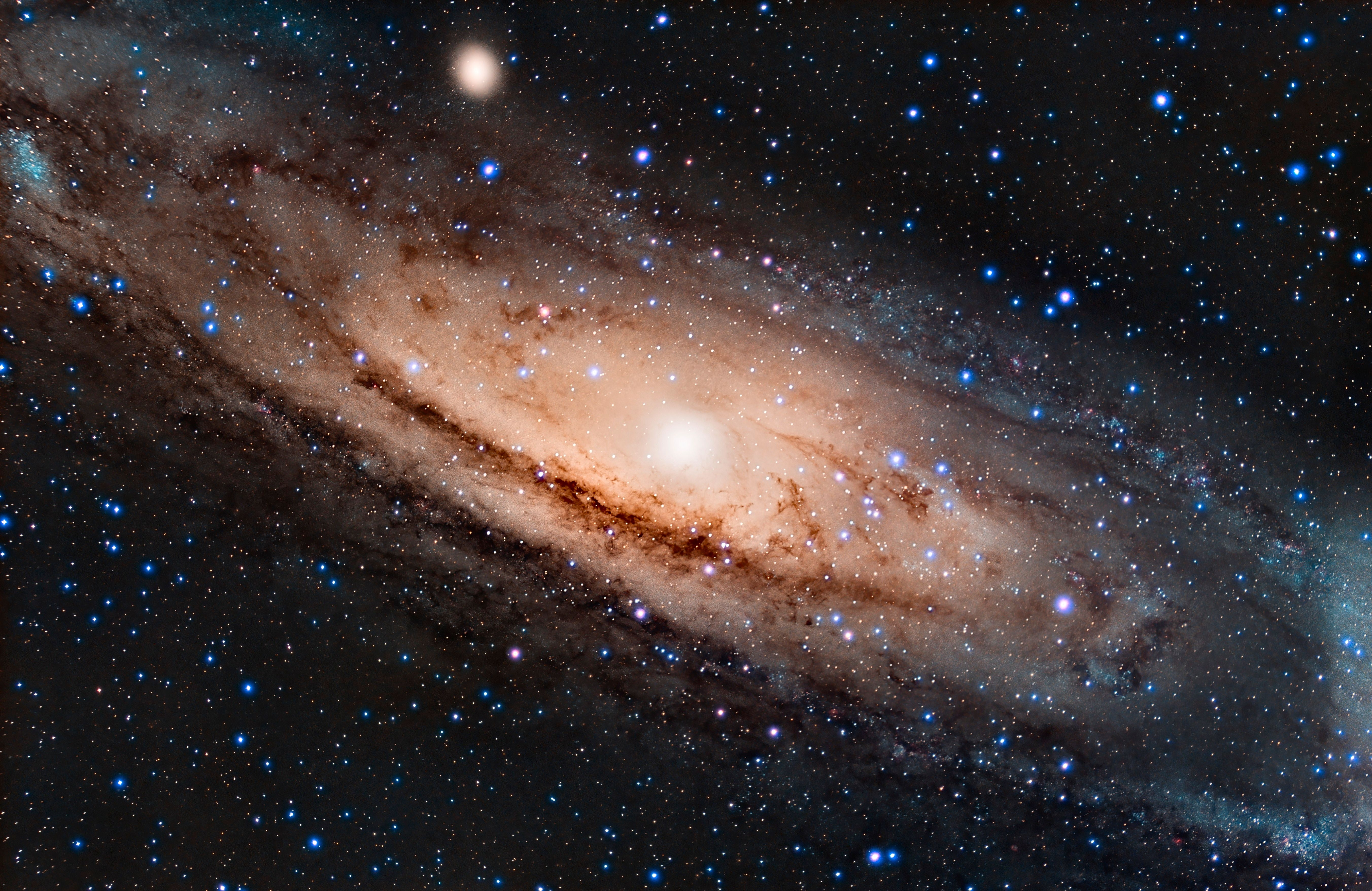
The pair have been nicknamed Little Bao and Big Bao, after the eruption’s official designation, AT 2025abao. The system lies in the Andromeda galaxy, about 2.5 million light-years from Earth.
Before the merger, the primary star was about 7 solar masses, about 350 times the Sun’s radius, and about 18,000 times as bright as the Sun. The companion was about 0.7 solar masses, making it slightly less massive than the Sun.
The same team had laid the groundwork in a study published last year. After combing through nearly 30 years of telescope data, they found that the giant began brightening in 2018. They suggested that a smaller star was circling ever closer to it and had slipped inside its outermost layers.
Astronomers call this rarely observed stage in the life of a binary system common-envelope evolution. The gas between the stars at this stage is known as a common envelope because its outer layer is shared between them.
Why The Giant Brightened
With the eruption in view, Columbia University astrophysicist Viraj Karambelkar and his colleagues took another look at the years of brightening.
One possible explanation was gas streaming away from the stars and giving off light as it slowed. But even if all the energy of that gas turned into light, it would not be enough to account for the glow.
The researchers concluded that their original binary explanation fit better. As Little Bao moved through Big Bao’s gaseous outer layers, the gas pushed back against it. That drag caused the smaller star to spiral inward and pass energy to the surrounding gas. Part of that energy escaped as light, which made Big Bao shine brighter.
Co-author Kishalay De of Columbia University said that as the companion kept orbiting, “it keeps peeling off the primary star’s outer layers, and that gas flows away into the surrounding space.”
What Caused The Eruption
The team then turned to the eruption itself. If the outburst had thrown enough of the shared gas into space, the two stars could have survived in an even tighter orbit.
But the researchers estimate that only about a tenth of the giant’s outer gas escaped. The eruption expelled around 0.1 to 0.2 solar masses of material. The energy carried by that fast-moving gas also suggests Little Bao reached Big Bao’s core. Together, these clues point to a merger. Their model had suggested the companion might have had enough leftover energy to escape, but further analysis showed it was dragged into the primary’s core.
The pace of the event surprised the researchers. The stars spent millennia orbiting each other before merging after about seven orbits, or about seven years, while other known binary mergers of two smaller stars took thousands of orbits. Co-author Nadejda Blagorodnova said she expected an outburst from such an extended star to take years. Instead, the brightness rose and peaked within a week.
De described the companion’s plunge as “almost like a bomb exploding inside a living star.”
A Fleet Of Telescopes
The reconstruction drew on several observatories. NASA’s James Webb Space Telescope supplied infrared observations that helped the researchers model the stars and surrounding dust, while the Swift Observatory, SPHEREx, NEOWISE and ground-based telescopes captured other stages of the event.
Webb observed Bao on December 24, 2025, 47 days after the eruption peaked. NASA calls this the earliest follow-up of such an event. Its mid-infrared data allowed the researchers to trace dust ejected by the primary star over centuries, including almost two months after the merger.
“Stellar mergers are very, very difficult to observe in real time because they are hard to predict,” Karambelkar said in a NASA statement. Speaking to Space.com, he said a star’s effect when it engulfs a companion is “very subtle — like throwing a bucket of water in a large ocean.”
What Comes Next
For now, the system is too shrouded in dust to see directly what is left. The dust is not expected to clear for years or even decades, and the team plans to keep watching. NASA describes the newly single star as potentially “rejuvenated” by the merger.
The researchers also want to find more mergers of this kind. “Now we can go and try to look for similar systems,” Karambelkar said, “and hopefully aim to catch more of these systems even before they erupt.”
Source: Sciencenews