
 Μake us preferred on Google
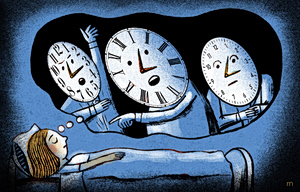
Health advice usually focuses on getting seven to nine hours of sleep a night. But a growing body of research on the body clock suggests that the timing of sleep may matter just as much for mental health as its length.
Going to bed and getting up at different times from one day to the next throws off the body’s central clock. That in turn disrupts the biological rhythms that control hormone release, body temperature and the regulation of emotions.
Researchers at the University of California, San Francisco (UCSF) and the University of California, San Diego (UCSD) studied several months of continuous health data from about 23,000 adults. Their findings, published in Scientific Reports, show that the less regular people’s sleep was, the more likely they were to report severe depression, anxiety and loneliness. The study was led by first author Dr. Severine Soltani and senior author Dr. Ashley Mason.
Months Of Data Instead Of A Single Week
Earlier research on sleep regularity mostly relied on sleep diaries kept by participants or on short, week-long recordings. To get a longer-term picture, the team used data from TemPredict, a nationwide U.S. study launched in 2020 in which participants wore Oura smart rings that tracked their movement and vital signs.
The participants, whose average age was 46, provided an average of 154 days of continuous sleep data. Each month, they also filled out standard questionnaires measuring depression, anxiety and loneliness.
Using the ring data, the researchers calculated each person’s Sleep Regularity Index (SRI), a score from 0 to 100 that reflects how consistently someone falls asleep and wakes up at the same times each day. A higher score means a more consistent routine.
The team also compared the full multi-month data with a single “typical week.” The links between irregular sleep and psychological distress turned out to be considerably stronger when measured over the longer period.
Mason, an associate professor in UCSF’s Department of Psychiatry and Behavioral Sciences, explained that keeping regular sleep and wake times helps keep the body’s circadian rhythms in sync. When that timing becomes irregular, she said, the rhythms can drift out of alignment, which is associated with depression and other mental health conditions.
Worse Symptoms With Every Drop In Regularity
Across the group, lower sleep regularity scores went along with more severe symptoms, step by step:
- Depression: People with few or no depressive symptoms had an average SRI of 84. The score fell to 83 for those with mild depression, 81 for moderate depression and 75 for severe depression.
- Anxiety: Participants with normal anxiety levels averaged 84, compared with 79 for those with severe anxiety.
- Loneliness: People who reported high levels of loneliness also had noticeably more irregular sleep schedules.
To put the numbers in context, Soltani, formerly of UCSD’s Bioinformatics and Systems Biology graduate program, said a person with an SRI of 84 typically goes to bed and wakes up about an hour earlier or later than the day before. For someone with an SRI of 75, that daily shift is closer to an hour and a half.
Mason added that the effects go beyond the body clock itself. Shifting wake-up times also unsettle the daily routines that help keep mood steady, such as exposure to morning sunlight, mealtimes, exercise and time spent with other people.
Which Comes First?
Because the study tracked associations rather than cause and effect, the researchers say the relationship likely runs in both directions. Depression and anxiety often disrupt sleep, but an unstable sleep schedule can also wear down emotional resilience. Mason noted that other long-term studies suggest irregular sleep may come first and contribute to later health problems, rather than simply being a result of them.
The findings suggest that a daily drift of just 30 to 60 more minutes separates healthy people from those with severe psychiatric symptoms. That points to a specific habit that can be changed. Future clinical trials will test whether helping people keep steady wake-up times and get regular morning light could serve as an easy-to-scale add-on treatment for depression, anxiety and loneliness.
The research was funded by the Medical Technology Enterprise Consortium and the U.S. Army Medical Research and Development Command under the U.S. Department of Defense, as well as the #StartSmall Foundation and Oura Health.
Source: Neurosciencenews.com