 Μake us preferred on Google
 For many passengers who rely on public transportation, summer has become a daily ordeal. With temperatures already exceeding 30°C, several transit services are operating without air conditioning. Conditions are also proving difficult on buses.
Even before the peak of summer has arrived, and with temperatures not yet surpassing 35°C, conditions on many public transport vehicles have already become suffocating, as some lack air conditioning altogether while others have systems that operate only partially.
“I can see you’re soaked. Did you just get off?” one passenger was asked. “Well, when they fix it, we’ll be fine,” came the reply.
“We’re all going to die in there,” another passenger said.
“It’s a disaster. Half the trains are old and don’t have air conditioning at all. And it’s only June. I don’t know what July and August will be like,” another commuter commented.
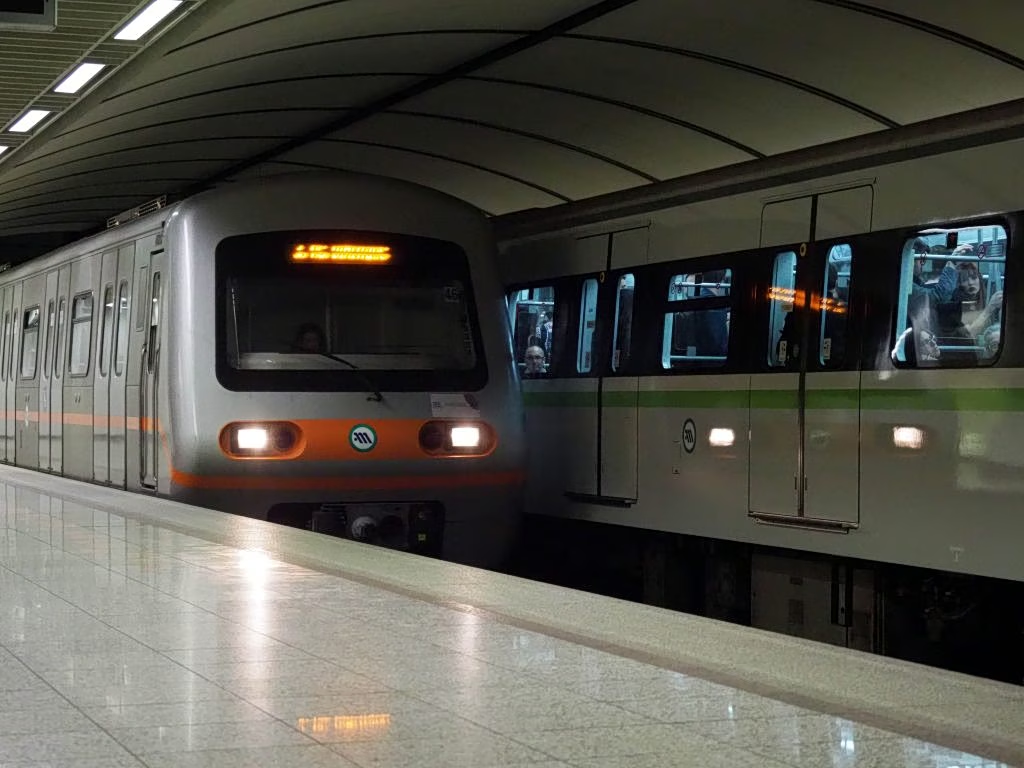
The biggest problem has been identified on 28 of the 52 trains operating on Athens Metro Lines 2 and 3. These trains were built without air conditioning. Four of them have also been transferred to Line 1, the city’s electric railway, where they operate morning and evening routes during the summer months.
“What’s happening on the metro?” a passenger asked. “There’s no air conditioning at all.” Asked how commuters cope, the response was simple: “We suffer.”
“I got on the metro this morning—it was extremely hot, and everyone was sweating,” another passenger said.
Authorities say that a tender will be announced within the month for the installation of air conditioning systems on 12 first-generation metro trains.
“Unfortunately, about half of them are without air conditioning,” another commuter said. “Especially during midday, when there are a lot of people and the heat is intense. Even on the older trains that do have air conditioning, many systems don’t work properly or need to be replaced. They need to fix them.”
This summer will be the first in which all Athens buses are equipped with functioning air conditioning. However, because buses stop frequently—roughly every 300 meters—requiring doors to open and close constantly, and due to high outdoor temperatures and open windows, the effectiveness of the cooling systems is significantly reduced.
“There are losses because of the windows. People want ventilation; that habit has remained since the coronavirus pandemic. Otherwise, if a vehicle doesn’t have air conditioning, it is withdrawn from service,” said Giorgos Konstantopoulos, a driver with OSY, Athens’ public bus operator.
“Even when there is air conditioning, the buses are so crowded that people can’t feel it,” another passenger said. Asked how commuters endure the conditions, the response was blunt: “They don’t.”
Some passengers, frustrated by delays and long waiting times, are opting to use their own vehicles instead.
“Public transport doesn’t work for me in terms of time. The vehicles are delayed, there’s no air conditioning, and now that it’s summer, I need to be at work at a specific time. I can’t rely on it,” one commuter said.
In an effort to reduce perceived temperatures on station platforms, a pilot misting system has been installed at Thissio Station on Athens’ electric railway network. The project is set to expand to eight additional stations.