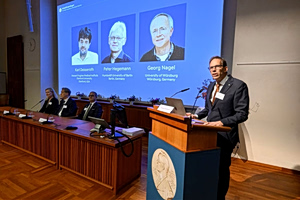
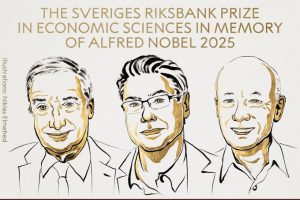
Francis Halzen has been awarded this year’s Nobel Prize in Physics, the Royal Swedish Academy of Sciences announced in Stockholm, citing his “major contribution to the IceCube Neutrino Observatory and the discovery of high-energy neutrinos of astrophysical origin.”
When Wolfgang Pauli proposed the neutrino in 1930, he reportedly said: “I have done a terrible thing. I have postulated a particle that cannot be detected.” Nearly a century later, the 2026 prize goes to a man who not only detected neutrinos but turned them into a telescope for the universe.
Halzen, 82, was born in Belgium and has taught at the University of Wisconsin–Madison since 1972. In 1988, he and a colleague conceived the idea of using the South Pole’s ice as a detector. Two decades later, that idea became IceCube: a cubic-kilometer observatory buried about two kilometers beneath the Antarctic surface, with light sensors lowered into holes bored with hot water.
Neutrinos offer a unique view of the cosmos. Charged particles from cosmic “accelerators” are deflected by magnetic fields and no longer point back to their sources, while gamma rays can be absorbed along the way. Neutrinos, electrically neutral and barely interacting with matter, travel in straight lines, even through the entire Earth. On the rare occasions they collide with the ice, they emit a faint blue glow known as Cherenkov radiation, which researchers use to reconstruct their paths and pinpoint where in the sky they came from.
The undertaking was formidable. The astrophysical neutrinos IceCube seeks are so rare that even a detector of its size records only about one a day, but their energies are at least a thousand times greater than those reached by CERN’s Large Hadron Collider. Completed in 2011, IceCube detected its first evidence of high-energy neutrinos from space just two years later. More recently, with the help of machine learning, it has even imaged our own Milky Way in neutrinos. The detector is run by an international collaboration of more than 450 researchers from 14 countries.
Reached by phone in Italy, Halzen told the Academy that no one had expected the project to work, crediting the many talented young people who believed in it for his being there. Asked what this new window might reveal about the universe, he candidly admitted he could not yet say, noting that the main achievement had been proving neutrino astronomy exists. Early evidence points to supermassive black holes in other galaxies, he said, but the real science still lies ahead.
The prize, worth 12 million Swedish kronor, will be presented in Stockholm on December 10.