 Μake us preferred on Google
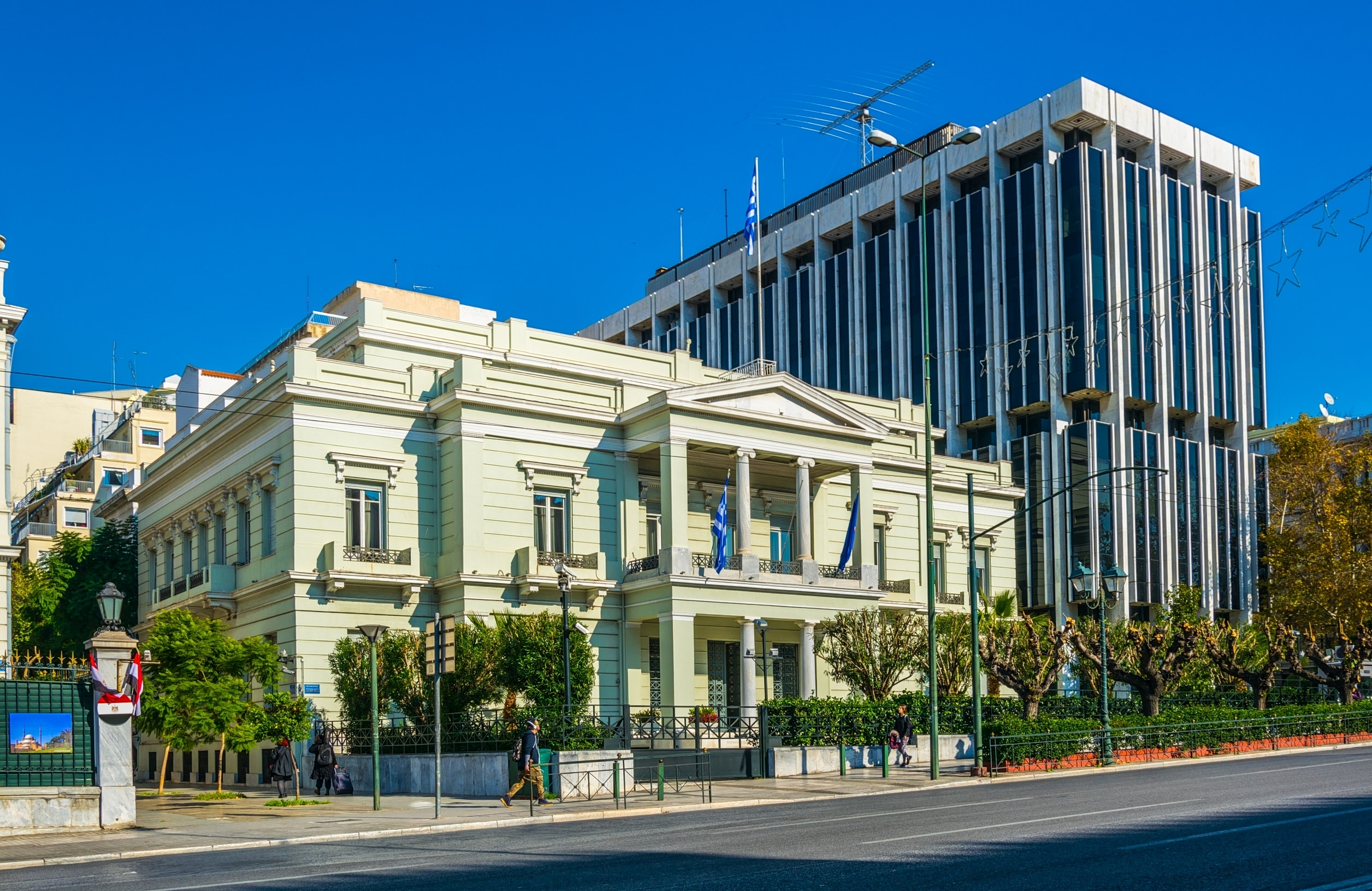
The cause of flooding in the basement of Greece’s Foreign Ministry remains unexplained nearly two months after the incident, as an ancient underground aqueduct near the building has emerged as a possible avenue for further investigation.
Although extensive inspections have ruled out the building itself as the source of the problem, officials have yet to determine where the water came from. The ministry’s technical service is still awaiting answers, while precautionary measures have been taken at its headquarters on Vasilissis Sofias Avenue, including the purchase of pumps to remove water quickly should flooding occur again.
A new dimension to the investigation has been raised by Panos Defteraios, a civil and geotechnical engineer and speleologist with the Water Resources and Environment Department at the National Technical University of Athens. Defteraios studies ancient underground aqueducts and says substantial quantities of water flow daily through the Peisistratian Aqueduct, relatively close to the ministry.
He cautions, however, that the aqueduct has not been established as the source of the flooding.
“Anything is possible. It could be a problem with the network, or it could also be related to other underground works being carried out,” Defteraios said, adding that a specialized study would be needed to determine the water’s origin.
The composition of the soil is not known at every point in the area, he noted, and it remains unclear whether the water that flooded the ministry was the same water carried by the ancient aqueduct.
An ancient aqueduct carrying up to 1,300 cubic meters daily
Research conducted by Defteraios and his team found that the National Garden of Athens is irrigated continuously with water from the Peisistratian Aqueduct, at an estimated flow of 1,000 to 1,300 cubic meters every 24 hours.
The aqueduct begins at the foothills of Mount Hymettus, near the Monastery of St. John the Theologian. It then runs parallel to the Ilissos River toward the Agios Thomas area of Goudi, passing through the former military district, now home to the Army Park.
Its underground route has been documented through historical and technical records, including a survey by architect Ernst Ziller in 1877, records by a former longtime director of the National Garden, Tambakis, and more recent engineering projects, including metro construction.
One example of the aqueduct’s potential interaction with underground construction occurred in 2003. During work on an underground parking facility opposite the Children’s Hospital, large quantities of water flooded the excavations for months. At the same time, the National Garden had run dry.
According to Defteraios, water returned to the underground tunnel and the garden after construction progressed and the underground leak was sealed.
A tunnel 10 to 12 meters underground
Defteraios and his team measured water flows inside the ancient underground passage in 2022 and 2023, as part of a project commissioned by the bodies responsible for managing the National Garden under the Municipality of Athens.
The currently active section of the aqueduct can be accessed from Agios Thomas Square in Goudi. Researchers identified an underground tunnel with an accessible length of approximately 350 meters, running 10 to 12 meters below the square toward central Athens, beneath Papadiamantopoulou Street.
The ancient section connecting Goudi to the National Garden has been inactive for centuries. Since the Ottoman period, water from the blocked Peisistratian Aqueduct, which emerged at Agios Thomas, has been diverted toward the city through a newer channel known as “Tsakmaki.”
The water was subsequently collected in a Roman reservoir on Mourouzi Street, next to the National Garden, together with water from the also-blocked Hadrianic Aqueduct, which originated in the Agios Dimitrios area of Ampelokipoi.
From 1875 onward, water from the Peisistratian Aqueduct was allocated exclusively to the National Garden. In 1920, the Ottoman-era channel was replaced with metal pipes, which still carry water to the lake at the garden’s Vasilissis Sofias Avenue entrance. From there, channels distribute the water throughout the garden for irrigation.
Water flows back into Athens’ underground network
The route taken by the water after irrigation is another important aspect of the research, Defteraios said.
According to his findings, water returns through a well to an unexplored underground network connected to the ancient aqueduct. The network has branches extending toward Plaka, Monastiraki, Kerameikos and other parts of Athens.
Defteraios also said that the water visible in an opening at Monastiraki Square does not come from the Ilissos River’s Eridanos tributary near Mount Lycabettus, but from the Peisistratian Aqueduct.
As a result, the area around the National Garden continuously replenishes an underground aquifer. A significant proportion of the water used daily to irrigate the garden’s plants seeps into the ground through various routes.
The same water has also been identified in other locations, including a well inside the National Garden that is used for irrigation and a well in the crypt of the Russian Orthodox Church. Both are connected to the same ancient underground network.
The aqueduct lies within 500 meters of the Foreign Ministry
The Foreign Ministry is located approximately 200 to 500 meters from the points identified by Defteraios and his team.
This proximity does not establish that water from the Peisistratian Aqueduct caused the flooding in the ministry’s basement. It does, however, highlight the presence of an extensive underground hydrological system in the surrounding area, whose possible effects on the local ground conditions may warrant further investigation.