 Μake us preferred on Google
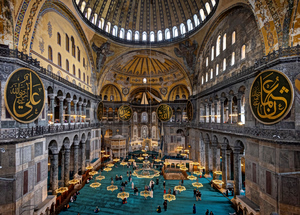
An extensive network of underground tunnels and chambers beneath Istanbul’s Hagia Sophia is coming to light through restoration work at the historic monument, revealing architectural remains and infrastructure that have remained buried for centuries.
Turkish authorities have cleared 420 meters of underground passages and are considering making parts of the network accessible to visitors, provided the necessary measures are taken to protect the monument and ensure public safety.
Türkiye clears 420 meters of tunnels beneath Hagia Sophia in Istanbul, plans to open suitable sections to public
https://t.co/xbfC2Qi0vZ
— Türkiye Today (@turkiyetodaycom) November 20, 2026
The scale of the discoveries was presented by Turkey’s Minister of Culture and Tourism, Mehmet Nuri Ersoy, who visited the underground facilities accompanied by scientists involved in the restoration program. CNN Türk broadcast footage showing the passages and work being carried out in areas that had remained covered by soil and fill material for centuries.
According to figures released by Ersoy, nearly 3,000 tons of material have been removed from the Vizier’s Garden and the western garden. The work has uncovered six underground spaces and nine tunnels.
Ayasofya-i Kebir Cami-i Şerifi’nde Cumhuriyet tarihinin en kapsamlı restorasyon çalışmaları kapsamında yer altı tünellerine inerek yürüttüğümüz çalışmaların son durumunu yerinde inceledik.
Vezir Bahçe ve Batı Bahçe’den yaklaşık 3 bin ton dolgu malzemesi çıkardık, toplam 420 metrelik tünel hattını temizledik. Batı Bahçe’de tespit ettiğimiz altı ayrı mekân ve dokuz tünelde tarihî yapıları koruma ve güçlendirme çalışmalarımızı sürdürüyoruz.
Hedeflerimizden biri de Ayasofya’nın yer altındaki bu tarihî zenginliğinin uygun bölümlerini ziyaretçilerimizle buluşturmak. Bu doğrultuda, yapının korunmasını ve ziyaretçi güvenliğini esas alan bir teşhir projesi hazırlamayı planlıyoruz.
Ayasofya’nın yer altında, mevcut yapısından daha eski bir döneme ait olduğunu değerlendirdiğimiz tarihî katmanlara da ulaştık.
Ayasofya’nın geçmişine ışık tutarken bu eşsiz mirası geleceğe taşımaya devam edeceğiz.
— Mehmet Nuri Ersoy (@MehmetNuriErsoy) November 20, 2026
The interventions form part of a wider conservation and restoration program at Hagia Sophia, which Turkish authorities describe as the largest undertaken at the monument during the Turkish Republic.
Remains may predate the present-day monument
One of the most significant discoveries was made in the Vizier’s Garden, where researchers uncovered an underground burial structure known as a hypogeum.
Cleaning and excavation work revealed architectural layers more than 1.5 meters below the previously known floor level. The area had been covered in mud, and the excavation exposed traces of an earlier structure.
Scientists are investigating whether the remains belong to a construction phase predating the present-day Hagia Sophia.
The current building was constructed under Byzantine Emperor Justinian between 532 and 537, on the site of earlier Christian churches. However, the newly uncovered remains have not yet been securely dated, and their possible connection to an earlier period remains under investigation.
Nine tunnels uncovered beneath Hagia Sophia
Six underground spaces have been identified in the monument’s western garden, connected by a network of nine tunnels.
According to Ersoy, three of the spaces may have formed underground sections of the former atrium, the courtyard associated with the church complex.
The passages vary in width from four to 4.8 meters. Seven of the nine tunnels have been cleared of accumulated material, while documentation and surveying work is continuing in the remaining two.
The total length of the sections cleared so far is 420 meters.
Particular attention has been drawn to the longest tunnel, which measures 180 meters. Researchers are examining whether it may have been connected to what is known as the Roman Road of Constantinople.
The passage runs parallel to Hagia Sophia’s facade, extending from the area in front of the Fatih Madrasa to the visitor entrance, with an incline of approximately 3%.
Its possible connection to the historic road network of the Byzantine capital is still being studied, as its original function has not been established.
An underground water management network
Scientists believe the tunnels formed part of a broader water management system in historic Constantinople.
Some sections appear to have been used to distribute water and drain rainwater, functions essential to protecting and maintaining a large architectural complex such as Hagia Sophia.
The discoveries could provide further insight into the engineering infrastructure developed around the monument during different historical periods.
Restoration work is also addressing structural damage beyond the removal of accumulated material. The interventions include repairing vaults, reinforcing masonry and stabilizing sections that have deteriorated over time.
In one underground space measuring 56 meters, structural damage has already been repaired along an 18-meter section. Stainless-steel supports are also being installed in other tunnels to reinforce the structures and ensure their stability.
Could the underground passages open to visitors?
Turkish authorities are now examining how the newly uncovered spaces could be presented to the public.
Ersoy said a dedicated study is being planned to assess the possibility of opening parts of the underground network to visitors. Any such plans would have to safeguard the monument’s archaeological and architectural value while ensuring visitor safety.
No decision has been announced on which sections might become accessible, and no timetable has been set.
The authorities are also examining whether the underground network could help improve ventilation inside Hagia Sophia. According to technical assessments presented by the minister, the existing underground opening meets just 3.6% of the monument’s ventilation needs.
Further studies will assess whether some of the historic passages could contribute to a modern fresh-air supply system without altering their architectural character.
The ongoing investigations are expected to shed more light on the tunnels’ original uses, their dates and their relationship to the wider Hagia Sophia complex. Nearly 15 centuries after the present-day building was constructed, the work is revealing new aspects of the monument’s history beneath the ground.