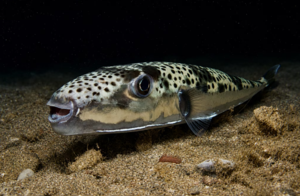
Fishermen have begun hunting the invasive silver-cheeked toadfish in Greek waters following the government’s decision to introduce a bounty for the species. In the town of Ierapetra, on the island of Crete, fishermen caught 200 toadfish in a single day. At the same time, however, they continue to count the extensive damage the fish causes to their nets and the mounting challenges facing their profession.
Although the Ministry of Development’s pilot program offers a bounty of €5.33 per kilogram, fishermen say it remains unclear what procedure they are supposed to follow after catching the fish.
The pilot program has been launched in Crete and the South Aegean, where the species is most widespread.
“Today we caught about 10 kilos of silver-cheeked toadfish—20 fish in our heavy nets”, says Charalambos Tzarakis, President of the Ierapetra Fishermen’s Association. “We’ll keep hunting them, and their population will decline, there’s no doubt about that. But there needs to be a plan for what happens next. They should be stored in freezers provided by the regional authorities. Who will collect them? Who will take delivery? That’s where the problem lies.”
In Heraklion, fishermen say they remain in despair. “Yesterday we set our nets, and they caused 50 tears. Fifty damaged spots in a single day. In ten days, that’s 500. Repairing just one tear takes between half an hour and an hour. Then you have to buy new nets, and replacing them costs €6,000 to €7,000.”
Professional fishermen across Crete face daily problems caused by the invasive silver-cheeked toadfish. Many say they are pessimistic about the future of the profession.
“We go out to work, and they destroy the nets, they destroy the longlines. We’re losing a huge amount of income. Now we have to make different gear—heavier equipment with steel cable—just to catch them,” one says.
“It affects tourism, and it affects fishermen. There won’t be another generation—we’re the last one, ” says Mr. Nikos, who has two grown sons who used to work on his fishing boat before both of them changed professions.