 Μake us preferred on Google
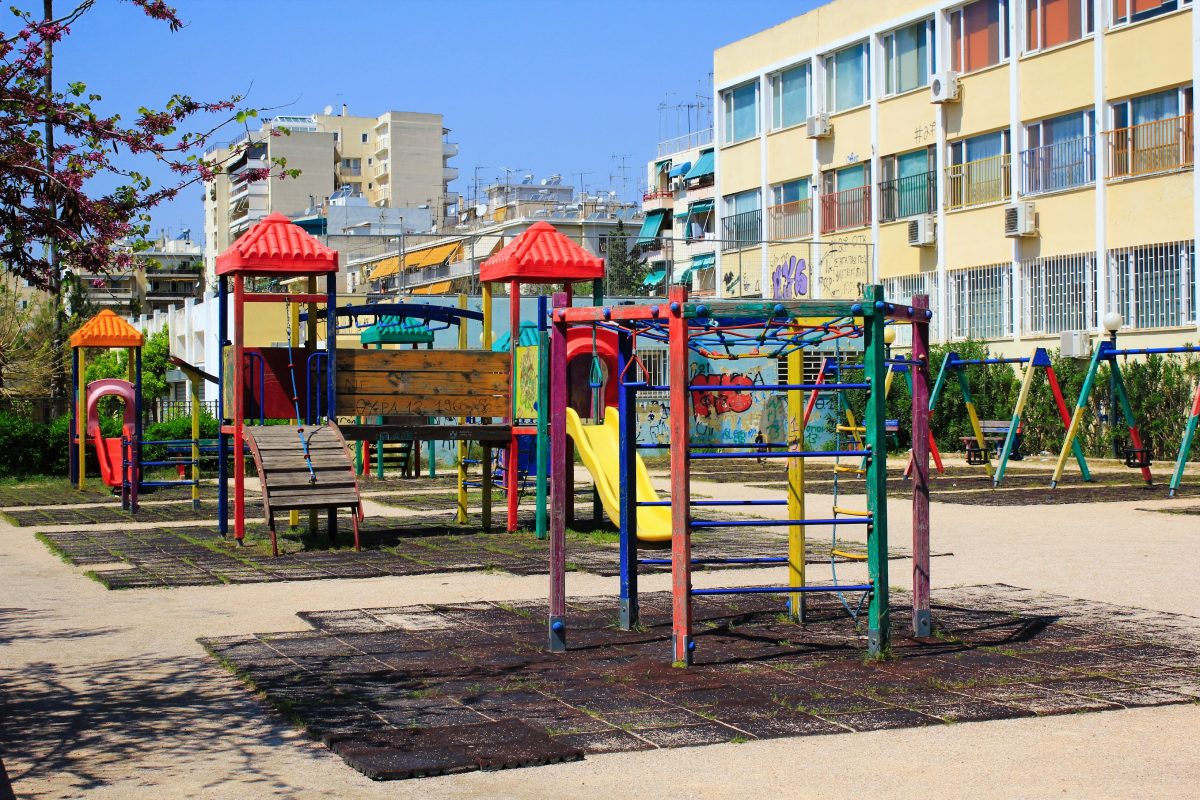
 According to a recent study by the Heinrich Böll Foundation, 33% of playgrounds in Thessaloniki have no trees at all, while 27% have only artificial flooring. Unfortunately, this picture applies to almost all of Greece. It is true that artificial surfaces provide safety (reducing the likelihood of children getting injured) and at the same time reduce costs and maintenance burdens for municipalities, which operate with limited green-space staff responsible for vegetation management across their areas. At the same time, they also “suit” parents who do not want their children to get “dirty” while playing in soil. The old open playfields bear little resemblance to today’s standardized playgrounds. How should playgrounds be designed to support a child’s healthy development? We gathered questions from parents and sought answers through discussions with Associate Professor Dr. Angeliki Paraskevopoulou from the Department of Crop Science at the Agricultural University of Athens, who has extensively studied the topic.
What does play in a playground offer?
A lot. First of all, it is a way to encourage children’s physical activity, especially at a time when research shows that, due to insufficient physical activity combined with poor nutrition, childhood obesity is on the rise. However, the standardization of playgrounds does not support the development of children’s creativity. Stimuli should vary so that children’s experiences are enriched, thereby developing cognitive skills—knowledge of the environment and nature, socialization, and self-confidence.
What do children prefer?
In a survey by the Agricultural University, children said their favorite equipment is the swing, the horizontal bar, and the slide, but their favorite games are tag, hide-and-seek, and ball games—in other words, free play. It is unstructured play that promotes physical activity. In a playground, this can be supported through an open space with plants—even a very small one, a kind of island. There, children can play hide-and-seek and interact with nature; often they simply play by observing different parts of plants such as leaves.
What are the best materials?
As natural as possible. Contact with plants strengthens children’s immune systems, as in cities they essentially live in a sterile environment. They do not come into contact with plants, pollen, or soil. Yet these elements help develop their immune systems. It is no coincidence that allergy cases have increased in recent years. At the same time, a tree also functions as a natural cooling system (shade can reduce temperatures by up to 20°C).
Plastic or metal equipment?
Plastic surfaces also have relatively high specific heat capacity. Even plastic surfaces have been recorded reaching temperatures of up to 50°C. Many factors play a role. For example, if metal is coated with glossy varnish it reflects radiation and emits less heat than the same metal coated with matte varnish. A stainless-steel slide, properly oriented (so it is not exposed to direct sunlight), can be significantly cooler. Even color, according to research, can play a role.
Do rubber floors increase temperatures?
According to Dr. Paraskevopoulou’s research, in summer rubber flooring can reach temperatures above 60°C. Measuring emitted thermal radiation with a thermal camera, temperatures of up to 73°C have been recorded.
Rubber floors often smell strongly in summer. Is this a sign they may not be a healthy material?
Studies in the United States have examined various materials. There is not sufficient data or scientific evidence proving that they harm children, although there are several indications to the contrary. Because these materials are used outdoors, they are difficult to regulate and control.
How can children be protected from ultraviolet radiation?
Especially in a Mediterranean country with high levels of sunshine, ultraviolet radiation is a major risk. Proper shading is therefore essential—something that unfortunately is rarely implemented. Planting in playgrounds is minimal and usually only peripheral (as fencing). Proper shade could easily and effectively be provided through vegetation, especially trees that both protect and create a comfortable thermal environment.
Which factors should be considered in design?
The climate of the area where the playground will be built should be studied. It should be assessed how, using orientation or possibly nearby buildings, equipment and plants can be appropriately placed. Plants should be able to withstand high temperatures and have low water requirements—in our country, one of the richest in biodiversity in Europe, there are many options. All of this, of course, must take into account the municipality’s maintenance capacity.